

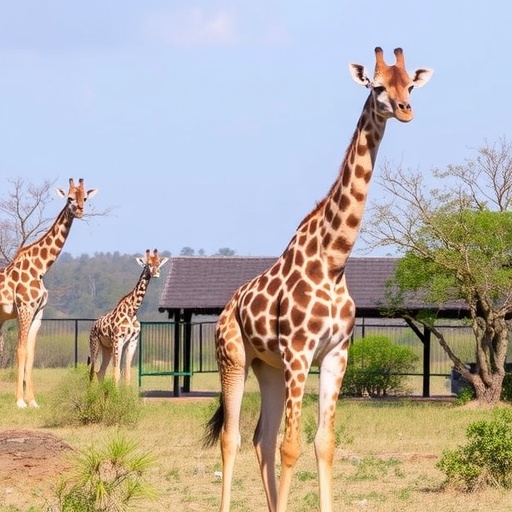
In recent years, the Southern giraffe (Giraffa giraffa) has emerged as an essential focus of conservation efforts, particularly in Hwange National Park, Zimbabwe. This majestic species, known for its long neck and distinct spotted coat, is under increasing threat from long-term environmental changes. A new study conducted by Pasipanodya et al. published in Environmental Monitoring and Assessment delves into the intricate spatio-temporal variations in habitat suitability for this iconic species in one of Africa’s most revered national parks. The findings highlight the urgency for adaptive management strategies to safeguard the future of Southern giraffes in their natural habitat.
The research emphasizes that habitat suitability for Southern giraffes is influenced by multifaceted factors such as climate change, land-use alteration, and human encroachment. These elements significantly affect the distribution, abundance, and overall wellbeing of the giraffe population in Hwange National Park. As the climate continues to warm, shifting rainfall patterns notably impact the availability of forage, which is critical for the sustenance of giraffes. This study brings attention to the critical relationship between environmental factors and the giraffe’s habitat, elucidating the immediate need for conservation efforts to adapt to these changes.
One of the key findings of Pasipanodya et al. reveals that the spatial distribution of suitable habitats for Southern giraffes has changed dramatically over the past few decades. The researchers employed advanced modeling techniques and satellite imagery to track these variations across the park. Their analysis indicates a concerning trend: areas once ripe for giraffe grazing are becoming less favorable due to increasing aridity and land conversion for agricultural practices. The researchers call attention to the need for a thorough understanding of these shifting patterns to inform conservation strategies effectively.
Moreover, the study demonstrates the importance of long-term data collection and monitoring in determining habitat suitability. By utilizing historical data alongside contemporary assessments, the authors underscore the criticality of a comprehensive approach to biodiversity conservation. Such data-driven strategies enable wildlife managers and policymakers to enact timely interventions that may mitigate the adverse effects of environmental changes on giraffe populations.
The researchers also explore the role of human activities in habitat degradation. Human encroachment, particularly through agriculture and settlement expansion, exacerbates the challenges faced by Southern giraffes. As natural habitats shrink, giraffes are forced into fragmented landscapes, making it increasingly difficult for them to find food and mates. This fragmentation not only threatens the giraffe’s survival but also creates conflicts with local communities. The urgent need for sustainable land-use practices and community engagement is vital in addressing the challenges presented by environmental changes.
In addition, the study addresses the implications of climate variability and extreme weather events, such as droughts and floods. These events have significant repercussions on vegetation patterns, directly influencing giraffe habitat suitability. The researchers emphasize the necessity of developing climate resilience strategies that can help giraffes adapt to these changes. This includes promoting landscape connectivity, which ensures that giraffes can migrate to more suitable habitats during adverse conditions.
Pasipanodya et al. further highlight the importance of stakeholder collaboration in conservation efforts. Involving local communities in wildlife protection initiatives can foster coexistence between people and giraffes, ultimately enhancing the effectiveness of habitat conservation strategies. The emphasis on participatory approaches in conservation underscores the notion that successful outcomes depend on shared responsibility among various stakeholders, including governments, NGOs, and local populations.
The study’s findings suggest that proactive measures must be taken to enhance the resilience of Southern giraffes against ongoing environmental changes. Recommendations include establishing protected corridors that will facilitate movement between fragmented habitats and ensuring the availability of key resources critical for survival. Moreover, integrating climate adaptation strategies into biodiversity policies will be paramount in preserving the long-term viability of giraffes amidst an uncertain future.
Additionally, educational programs aimed at raising awareness about the plight of Southern giraffes are essential. Increasing public understanding of the giraffes’ ecological role and the challenges they face can cultivate a sense of stewardship and encourage local communities to participate in conservation initiatives. Through educational outreach, conservationists can foster a societal commitment to protecting these magnificent creatures and their habitats.
In conclusion, the work of Pasipanodya et al. serves as a pivotal reminder of the complex interplay between environmental change and wildlife conservation. The study provides a comprehensive overview of the spatio-temporal variations in habitat suitability for Southern giraffes in Hwange National Park, highlighting both the challenges and opportunities that lie ahead for conservationists. As these changes unfold, there is an urgent need for innovative strategies that prioritize habitat preservation and resilience-building efforts. The future of the Southern giraffe may depend on our ability to adapt to, and mitigate, the profound impacts of a changing environment.
The implications of this research extend beyond the borders of Hwange National Park, serving as a crucial case study for similar conservation challenges across Africa. Understanding the dynamics at play in Hwange can inform broader conservation strategies and policies that benefit not only Southern giraffes but also other vulnerable wildlife species facing the consequences of environmental change. As we progress, the need for collaborative actions, informed by robust scientific data, will become increasingly critical in our quest to conserve the biological richness of our planet.
Subject of Research: Habitat suitability of Southern giraffe under environmental change in Hwange National Park, Zimbabwe.
Article Title: Spatio-temporal variation in habitat suitability of Southern giraffe (Giraffa giraffa) under long-term environmental change in Hwange National Park, Zimbabwe.
Article References:
Pasipanodya, E.V., Zvidzai, M., Mawere, K.K. et al. Spatio-temporal variation in habitat suitability of Southern giraffe (Giraffa giraffa) under long-term environmental change in Hwange National Park, Zimbabwe.
Environ Monit Assess 198, 116 (2026). https://doi.org/10.1007/s10661-025-14938-y
Image Credits: AI Generated
DOI: https://doi.org/10.1007/s10661-025-14938-y
Keywords: Southern giraffe, habitat suitability, environmental change, Hwange National Park, conservation strategies, climate adaptation, stakeholder collaboration.


