

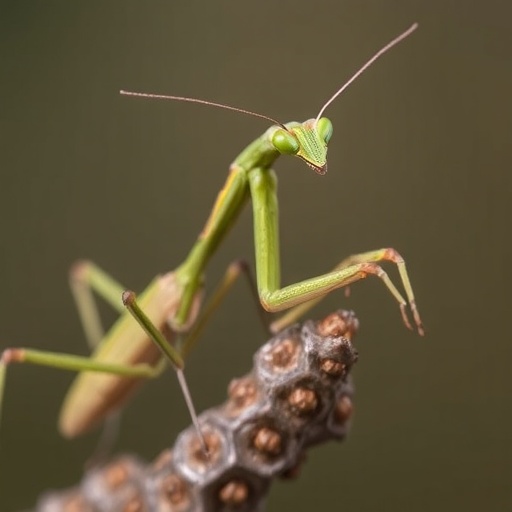
The Asian mantises Hierodula tenuidentata and Hierodula patellifera have recently emerged as significant invasive threats to European biodiversity, challenging longstanding ecological balances traditionally maintained by native mantis species. These compelling insects, native to Asia, have expanded their range across the Mediterranean and into continental Europe over the past decade, where they have rapidly established large, viable populations. This surge is attributed in part to warming climates, which facilitate their northward movement and survival in environments that were once inhospitable.
Unlike the native European mantis, Mantis religiosa, the Hierodula species exhibit remarkable reproductive strategies that accelerate their population growth and invasive potential. Each female mantis produces an average of around 200 nymphs per ootheca, nearly double the reproductive output of M. religiosa. Furthermore, these Asian mantises demonstrate a notably lower incidence of nymph cannibalism during early development stages, promoting higher survival rates and enabling rapid population expansion in invaded habitats. These traits coupled with their adaptability to new environments mark them as a formidable invasive force with broad ecological implications.
Ecologically, the invasion of Hierodula tenuidentata and H. patellifera disrupts native insect communities and broader food webs. A particular concern is the predator-prey dynamics involving native European mantis males, which these invasive mantises exploit during mating encounters, leading to elevated mortality among native individuals. Such lethal sexual interactions, combined with predation on essential pollinators like honeybees and the consumption of vulnerable vertebrate species including lizards and tree frogs, reveal the profound, multifaceted threats these invaders pose to biodiversity.
The intersection of human-mediated environmental change and invasive species ecology is especially pronounced in this case. Urban and suburban landscapes provide ideal conditions for Hierodula expansion, with artificial structures such as insect hotels serving as hunting platforms and urban heat islands extending their viable activity periods into colder months. This symbiosis between human infrastructure and invasive species underscores how anthropogenic factors can unintentionally facilitate ecological invasions, enabling species like Hierodula mantises to establish beyond their natural environmental constraints.
Predation dynamics in invaded ecosystems reveal an intriguing interplay involving domestic cats, which have become primary vertebrate predators of these invasive mantises. Accounting for 45% of observed predation events involving Hierodula mantises, cats act as a significant biotic control. However, this containment strategy is imperfect and indiscriminate, as cats also prey on native mantises and other indigenous fauna, exacerbating pressures on already declining native species. This highlights the complexity of managing invasive species within human-influenced ecosystems where multiple stressors coexist.
The ecological ramifications extend beyond individual species interactions, raising urgent conservation concerns for endemic species on Mediterranean islands and other sensitive ecosystems. Hierodula mantises’ broad prey range and high predatory efficiency threaten to destabilize endemic invertebrate and vertebrate populations, potentially triggering cascading effects through affected communities. These risks necessitate comprehensive assessments and targeted management strategies to curb their spread and impact.
Recognizing the urgency of this issue, researchers including Roberto Battiston and colleagues have mobilized citizen science initiatives to monitor and understand the distribution and impact of these invaders. Over 2,300 reports from public participants have been aggregated, providing invaluable data for tracking their expansion and informing management actions. This participatory approach not only enhances scientific understanding but also fosters public awareness and engagement critical for effective biodiversity conservation.
Practical measures for mitigating the spread of Hierodula mantises focus on targeted removal of oothecae during winter months when these egg cases are externally visible on leafless branches. Oothecae are brownish, spongy structures approximately 2–3 centimeters in size, and their removal can substantially reduce reproductive success. However, specialists caution that correct identification is imperative to avoid mistakenly disrupting native mantis populations, underscoring the importance of expert guidance alongside public involvement in control efforts.
The rapid expansion of these Asian mantises in Europe offers a stark illustration of how climate change and human modification of landscapes accelerate invasive species’ success. By altering temperature regimes and providing new anthropogenic niches, human activities inadvertently reduce natural constraints, facilitating invasive species invasions that reshuffle ecological assemblages and jeopardize native biodiversity. This case thus exemplifies broader environmental challenges where global change and biological invasions intersect.
From a bioindicator perspective, the presence of mantises has historically signified rich, biodiverse ecosystems. Native mantises often act as sentinel species reflecting environmental health. The displacement and decline of native mantises by invasive Hierodula species not only threaten biodiversity directly through predation and competition but also compromise the ecological indicators upon which environmental assessments depend. Preservation of native mantids is therefore vital for maintaining both ecosystem integrity and the scientific tools used to monitor it.
The future management of invasive Hierodula mantises will require a multifaceted approach integrating ecological research, public education, and coordinated conservation actions. Continued monitoring through citizen science, combined with expert-led interventions such as ootheca removal and habitat management, can help slow their spread. Additionally, understanding interactions with native predators and the indirect effects of human-modified environments will be crucial for developing holistic strategies.
Ultimately, the story of Hierodula tenuidentata and Hierodula patellifera illustrates the ever-evolving challenges posed by invasive species in a rapidly changing world. Their establishment and proliferation in new continents serve as a powerful reminder of the need for vigilance, scientific collaboration, and public participation. Only by harnessing collective efforts can we hope to safeguard native biodiversity and maintain ecological resilience in the face of such biological invasions.
Subject of Research: Animals
Article Title: Call me invasive: Testing the first impacts of the alien mantises Hierodula patellifera and Hierodula tenuidentata on European biodiversity
News Publication Date: 9-Feb-2026
Web References:
- Journal of Orthoptera Research: https://jor.pensoft.net/article/165233/
- DOI link: http://dx.doi.org/10.3897/jor.35.165233
- GRIO Citizen Science Project: https://biodiversityassociation.org/en/what-we-do/projects/research/grio/
References:
Battiston R, Di Pietro W, Boscato F, Fasano A (2026) Call me invasive: Testing the first impacts of the alien mantises Hierodula patellifera and Hierodula tenuidentata on European biodiversity. Journal of Orthoptera Research 35(1): 179-190.
Image Credits: Negative interactions of Hierodula preying on invertebrates: A. Muscidae (photo credit: A. Bianchi), B. Vespa crabro (photo credit: S. Moro), C. Argynnis paphia (photo credit: M. Silenzi). D. Anacridium aegyptium (photo credit: D. Maistrello), E. Cicada orni (photo credit: S. Tenani), F. Halyomorpha halys (photo credit: M. Algeri Bricoli).
Keywords:
Invasive species, Invasive animals, Biodiversity, Biodiversity conservation, Entomology, Invertebrates


