

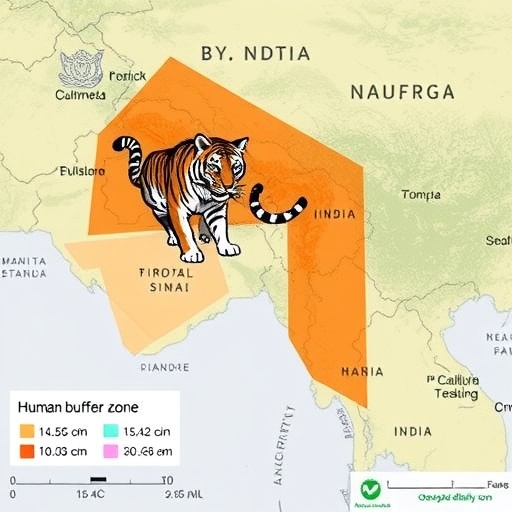
In recent years, the interplay between human activities and wildlife conservation has come to the forefront of environmental science. A crucial study led by Rawat et al. emphasizes the pressing ecological changes occurring within the transitional buffer zone of Jim Corbett National Park (JCNP) in India. This research, published in the environmental science journal “Environmental Monitoring and Assessment,” sheds light on how these ecological dynamics are increasing the risk of human-tiger conflict in the area.
The Jim Corbett National Park, a UNESCO World Heritage Site, is renowned for its rich biodiversity and is home to a significant population of tigers. However, the transitional buffer zone surrounding the park has been witnessing adverse ecological changes. The geospatial approach adopted by the researchers has enabled them to map and analyze these changes meticulously. The analysis highlights the increasing pressures from surrounding human settlements, agricultural practices, and urban development, which encroach upon the habitats and territories of these majestic felines.
One of the major findings of the study reveals that habitat fragmentation is a direct result of human-induced pressures in the buffer zone. As agricultural activities expand, they alter the landscape, leading to the division of natural habitats into smaller, isolated patches. This fragmentation not only restricts the movement of tigers but also disrupts their hunting patterns, leading them to venture into human-dominated spaces in search of food, thus escalating the risk of conflict.
Furthermore, the researchers identified the role of climate change in exacerbating ecological disturbances within this sensitive zone. Increased temperatures and altered rainfall patterns have significant implications for the flora and fauna of the area. Changes in vegetation cover can lead to a scarcity of prey for the tigers, which may force them to migrate outside their natural habitats, thereby heightening human-tiger encounters.
The findings of the research hold critical implications for wildlife management and conservation strategies in the JCNP. By integrating geospatial technology and ecological data, the researchers provide actionable insights that could help conservationists develop effective mitigation measures. Such measures may include creating wildlife corridors that facilitate safe movement for tigers, thereby reducing the likelihood of conflicts with humans.
In addition, the study underscores the importance of community engagement in wildlife conservation efforts. Local communities play a vital role in shaping the landscape and can either contribute to the problem or be part of the solution. Education and awareness programs could foster relationships between humans and tigers, promoting coexistence rather than adversarial interactions.
The research also raises substantial policy-level considerations. Government agencies and conservation organizations are urged to revisit zoning laws and land-use planning within the transitional buffer zone to ensure sustainable practices. This may involve regulating agricultural expansion and enforcing stricter controls on urban development, which can further threaten wildlife habitats.
Moreover, the innovative use of geospatial analysis can be expanded beyond JCNP, shedding light on similar ecological challenges across India’s vast national parks. By collaborating with technology experts and environmental scientists, wildlife managers can create a blueprint for mitigating human-wildlife conflict in various geographical contexts.
As the landscape of Jim Corbett National Park continues to evolve, understanding these ecological shifts will be pivotal in safeguarding both the tigers and the local human population. The adaptive management strategies suggested by Rawat et al. could very well serve as a model for other regions grappling with similar dilemmas, highlighting a pathway towards a more resilient coexistence.
In conclusion, the research conducted by Rawat and colleagues not only presents alarming statistics about the encroachment within the transitional buffer zone but also puts forth a comprehensive roadmap for mitigating human-tiger conflict. The urgency of the findings emphasizes a collective responsibility—from policymakers to local communities—to ensure that both human and wildlife thrive in a shared landscape. The balance between development and conservation is delicate; understanding its complexities is crucial for sustainable future endeavors.
Ultimately, this study serves as a clarion call to prioritize ecological integrity amidst increasing human encroachment. By cultivating awareness and taking proactive measures, we can strive towards a harmonious existence with nature, reflecting not just on the current challenges but also on the shared benefits of biodiversity preservation.
Subject of Research: Ecological changes in the transitional buffer zone of Jim Corbett National Park and their impact on human-tiger conflict.
Article Title: Adverse ecological changes along transitional buffer zone of Jim Corbett National Park increasing human-tiger conflict risk: geospatial approach.
Article References:
Rawat, M.S., Rawat, A. & Rawat, P.K. Adverse ecological changes along transitional buffer zone of Jim Corbett National Park increasing human-tiger conflict risk: geospatial approach.
Environ Monit Assess 198, 79 (2026). https://doi.org/10.1007/s10661-025-14936-0
Image Credits: AI Generated
DOI: https://doi.org/10.1007/s10661-025-14936-0
Keywords: Jim Corbett National Park, human-tiger conflict, geospatial analysis, ecological change, wildlife conservation.


