
Wednesday, December 3, 2025
Science
No Result
View All Result
  • Login
  • HOME
  • SCIENCE NEWS
  • CONTACT US
  • HOME
  • SCIENCE NEWS
  • CONTACT US
No Result
View All Result
Scienmag
No Result
View All Result
Home Science News Mathematics

Geographic differences in US homicide rates have decreased since the 1970s

August 28, 2024
in Mathematics
Reading Time: 3 mins read
0
Are the geographic disparities in U.S. violent crime rising?
67
SHARES
608
VIEWS
Share on FacebookShare on Twitter
ADVERTISEMENT

A new study finds that, counter to expectations, geographic disparities in rates of homicides in the US have decreased in recent decades. Richard Boylan of Rice University in Houston, Texas, US, presents these findings in the open-access journal PLOS ONE on August 28, 2024.

Are the geographic disparities in U.S. violent crime rising?

Credit: Richard T. Boylan, 2024, PLOS ONE, CC-BY 4.0 (

A new study finds that, counter to expectations, geographic disparities in rates of homicides in the US have decreased in recent decades. Richard Boylan of Rice University in Houston, Texas, US, presents these findings in the open-access journal PLOS ONE on August 28, 2024.

Since the 1970s, gaps in economic and social wellbeing between Americans living in different regions have grown. Some researchers hypothesize that areas with reduced economic and social well-being would see higher rates of violent crime. For instance, impoverished areas with lower tax bases might receive less police protection, or a lack of job opportunities may lead to greater involvement in criminal enterprises, in which violence can be an effective tool.

However, few studies have systematically examined potential links between geographic economic disparities and geographic disparities in violent crime rates. To address this gap, Boylan analyzed data from the National Center for Health Statistics, comparing homicide rates between the US’s 741 commuting zones across both urban and rural areas —distinct geographic areas within which most residents live and work, with few commuting into another zone.

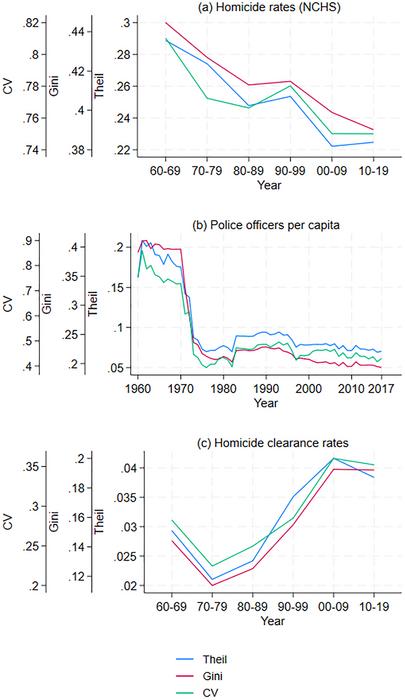
Boylan found that, since the 1970s, disparities in US homicide rates between US commuting zones have steadily decreased, even while economic and social inequalities increased.

One potential explanation for these findings, as Boylan notes, is that since the 1970s, geographic disparities in policing, incarceration, and the share of the population that is African American has also decreased across the US. He suggests that future research could examine whether any of these factors could have contributed to the decreased disparities in homicide rates.

Alternatively, Boylan suggests, the expected violence-boosting effects of worsening social and economic conditions in some areas might have been mitigated by state, county, and federal law enforcement bodies stepping in to ensure continued prosecution of violent crime, such as in instances when local police departments were disbanded in economically challenged cities.

In contrast to the homicide findings, the researcher notes, geographic disparities in US life expectancies have increased since the 1960s, likely due to state policies that include tobacco taxes and Medicaid expansions.

Dr. Boylan adds: “There is a perception that job losses in the rust belt have led to an increase in inequality in crime. However, I provide empirical evidence that inequalities across different parts of the country in crime have steadily decreased since the 1960s and that this decrease coincides with decreases in disparities in policing, incarceration, and the share of the population that is African American.”

#####

In your coverage please use this URL to provide access to the freely available article in PLOS ONE:

Citation: Boylan RT (2024) Are the geographic disparities in U.S. violent crime rising? PLoS ONE 19(8): e0308799.

Author Countries: USA

Funding: The author(s) received no specific funding for this work.


Journal

PLoS ONE

DOI

10.1371/journal.pone.0308799

Article Title

Are the geographic disparities in U.S. violent crime rising?

Article Publication Date

28-Aug-2024

COI Statement

No authors have competing interests.

Share27Tweet17
Previous Post

Study: Among Viking societies, Norway was much more violent than Denmark

Next Post

Red flag laws may reduce the growing burden of firearm homicides

Related Posts

blank
Mathematics

Introducing BioCompNet: A Deep Learning Workflow for Automated Body Composition Analysis Advancing Precision Management of Cardiometabolic Disorders

November 15, 2025
blank
Mathematics

Machine Learning Reveals Hidden Structures in Finite Simple Groups

November 15, 2025
blank
Mathematics

Manipulating Triple Quantum Dots in Zinc Oxide Semiconductors

November 15, 2025
blank
Mathematics

Daily Environmental Antibiotic Exposure Could Speed Up Global Antibiotic Resistance, New Study Reveals

November 14, 2025
blank
Mathematics

Atomic Insights May Revolutionize Efficiency in Chemical Manufacturing

November 13, 2025
blank
Mathematics

Advancing Image Compression: Enhanced Efficiency and Flexibility

November 13, 2025
Next Post

Red flag laws may reduce the growing burden of firearm homicides

  • Mothers who receive childcare support from maternal grandparents show more parental warmth, finds NTU Singapore study

    Mothers who receive childcare support from maternal grandparents show more parental warmth, finds NTU Singapore study

    27587 shares
    Share 11032 Tweet 6895
  • University of Seville Breaks 120-Year-Old Mystery, Revises a Key Einstein Concept

    995 shares
    Share 398 Tweet 249
  • Bee body mass, pathogens and local climate influence heat tolerance

    652 shares
    Share 261 Tweet 163
  • Researchers record first-ever images and data of a shark experiencing a boat strike

    522 shares
    Share 209 Tweet 131
  • Groundbreaking Clinical Trial Reveals Lubiprostone Enhances Kidney Function

    490 shares
    Share 196 Tweet 123
Science

Embark on a thrilling journey of discovery with Scienmag.com—your ultimate source for cutting-edge breakthroughs. Immerse yourself in a world where curiosity knows no limits and tomorrow’s possibilities become today’s reality!

RECENT NEWS

  • Boosting Cancer Immunotherapy by Targeting DNA Repair
  • Addressing Dumpsite Risks: A Action Framework for LMICs
  • Evaluating eGFR Equations in Chinese Children
  • Global Guidelines for Shared Decision-Making in Valvular Heart Disease

Categories

  • Agriculture
  • Anthropology
  • Archaeology
  • Athmospheric
  • Biology
  • Blog
  • Bussines
  • Cancer
  • Chemistry
  • Climate
  • Earth Science
  • Marine
  • Mathematics
  • Medicine
  • Pediatry
  • Policy
  • Psychology & Psychiatry
  • Science Education
  • Social Science
  • Space
  • Technology and Engineering

Subscribe to Blog via Email

Success! An email was just sent to confirm your subscription. Please find the email now and click 'Confirm Follow' to start subscribing.

Join 5,191 other subscribers

© 2025 Scienmag - Science Magazine

Welcome Back!

Login to your account below

Forgotten Password?

Retrieve your password

Please enter your username or email address to reset your password.

Log In
No Result
View All Result
  • HOME
  • SCIENCE NEWS
  • CONTACT US

© 2025 Scienmag - Science Magazine