

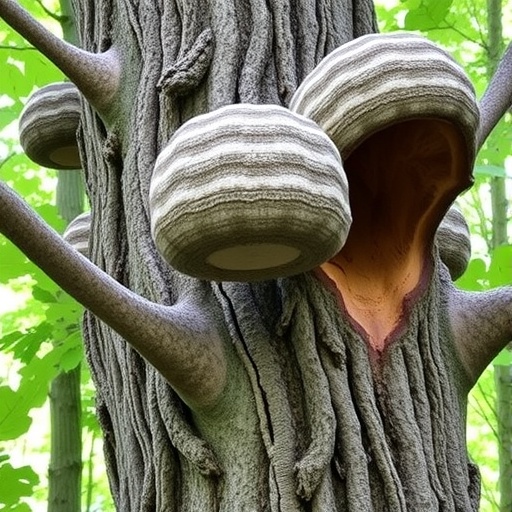
For more than a century, the American chestnut tree stood on the precipice of extinction, devastated by an invasive fungal pathogen that swept through North American forests with relentless ferocity. Today, however, a groundbreaking study employing cutting-edge genomic technologies offers renewed hope for the restoration of this iconic species. The research illuminates how leveraging the power of high-resolution genome assemblies and innovative breeding strategies can dramatically accelerate efforts to rescue the American chestnut from the edge of ecological oblivion.
The catastrophic loss of the American chestnut (Castanea dentata) illustrates one of the earliest and most consequential examples of how an introduced pathogen can reshape entire ecosystems. In the late 19th century, the necrotrophic fungus Cryphonectria parasitica was accidentally introduced from Asia, hitching a ride on imported Chinese chestnuts (Castanea mollissima). Within decades, this blight fungus decimated billions of native American chestnuts across a swath of forests stretching from Maine down to Mississippi, effectively rendering the species functionally extinct in its former range. The loss was more than ecological; the American chestnut was a keystone species valued for its timber and nuts.
Despite the staggering scale of devastation, ongoing efforts to restore the American chestnut have persisted for well over a century. Success has been limited, primarily due to the complexity of blight resistance genetics and the difficulty in reintroducing disease-resistant traits without sacrificing the tree’s native characteristics. Prior breeding programs have focused on incorporating resistance alleles from Chinese chestnuts through backcrossing, but the genetic architecture governing blight resistance remained elusive and complicated. This intricate resistance involves multiple genes and interactions that traditional methods struggle to unravel or optimize efficiently.
In response to these challenges, Jared Westbrook and colleagues implemented a state-of-the-art approach by generating chromosome-scale reference genome assemblies for three pivotal chestnut species integral to hybrid breeding initiatives. These comprehensive genome maps provide unprecedented insight into the genomic landscape and genetic mechanisms underlying disease resistance. By comparing these high-quality genomes, the team identified a remarkable conservation of protein-coding genes but noted that copy number variation (CNV)—variations in the number of copies of particular genes—appears critically linked to enhanced blight resistance, particularly in the Chinese chestnut lineage.
Further advancing their investigation, Westbrook’s team employed RNA sequencing to probe how the two species respond at the transcriptomic level upon blight infection. Their findings revealed stark disparities between American and Chinese chestnuts’ genetic responses, underscoring the inherent resistance present in the latter. Complementing these transcriptomic insights, metabolite profiling unveiled a distinct biochemical arsenal within Chinese chestnuts, dominated by compounds that actively inhibit fungal growth. Such metabolites represent promising targets for enhancing resistance traits in the American chestnut through breeding or biotechnological interventions.
This multifaceted genomic and metabolic data underscore the complexity of the resistance phenotype and reinforce the notion that single-gene approaches are unlikely to suffice. The researchers argue that recurrent selection—a process of continually selecting superior individuals over successive generations—and multigenerational intercrossing to retain a high proportion of American chestnut ancestry may prove most effective. By blending resistance traits while preserving native genetic backgrounds, breeders can develop hybrids that withstand disease pressures without compromising native ecosystem functions.
Importantly, the study highlights the necessity of long-term field trials to accurately assess genetic gains achieved through breeding programs. Environmental variables profoundly influence phenotypic expression, so evaluating candidate families across multiple geographically distinct field sites is critical to disentangling genetic from environmental effects. Such rigorous, replicated field evaluations ensure that the most resilient and adapted individuals are identified for future restoration plantings, maximizing ecological and genetic success.
The larger implications of this research extend beyond chestnut restoration. It exemplifies how the integration of high-resolution genomics, transcriptomics, and metabolomics can revolutionize conservation and breeding programs for other tree species imperiled by invasive pathogens. By illuminating complex resistance mechanisms and guiding precision breeding strategies, these approaches herald a new era of ecological renewal and forest resilience in the face of global biological threats.
Moreover, this work sets a precedent for deploying genomics to accelerate restoration timelines. The traditional slow pace of forest tree breeding, often hampered by long generation times and complex genetics, can be dramatically shortened by targeting key genetic elements informed by genome assemblies and expression data. The ability to rapidly generate hybrids with substantial disease resistance at around 70 to 85% American chestnut ancestry signals a transformative leap forward, with practical prospects for reestablishing viable populations across the species’ historic range.
In the words of lead author Jared Westbrook, “It is crucial that breeding programs incorporate long-term genetic evaluations in diverse environments to ensure restoration success.” This candid recognition reflects a rigorous scientific ethos, underscoring the combination of genomics-driven innovation with time-tested ecological principles necessary to revive this storied species. Success would be a monumental ecological victory—restoring not merely a singular species but a keystone of North American forest ecosystems.
Accompanying the study, commentary by experts Steven Strauss and Gancho Slavov delves deeper into the scientific and practical facets of this restoration journey, underscoring the broader evolutionary and conservation challenges at play. These perspectives contribute to a rich dialogue on how cutting-edge science can meet the pressing need to reconcile biodiversity loss caused by historic and ongoing anthropogenic impacts.
As this research charts a hopeful path toward the resurrection of the American chestnut, it offers a blueprint for addressing other global conservation crises wrought by invasive pathogens and environmental change. The fusion of genomic sciences with classical breeding techniques emerges as a powerful toolset—one capable of transforming the dreams of species restoration into tangible ecological realities.
The relentless march of blight nearly erased one of North America’s most emblematic trees, yet through innovative scientific endeavor, the possibility of its return grows closer. The American chestnut’s story embodies both the vulnerability and resilience of natural systems, affirming that with persistence and ingenuity, even the most daunting biological challenges can be met and overcome.
Subject of Research: Genomic and breeding strategies for restoration of American chestnut trees endangered by blight disease.
Article Title: Genomic approaches to accelerate American chestnut restoration
News Publication Date: 12-Feb-2026
Web References: 10.1126/science.adw3225
Keywords: American chestnut, blight resistance, Cryphonectria parasitica, genomic assemblies, copy number variation, RNA sequencing, metabolite profiling, recurrent selection, hybrid breeding, forest restoration, invasive pathogen, conservation genomics


