

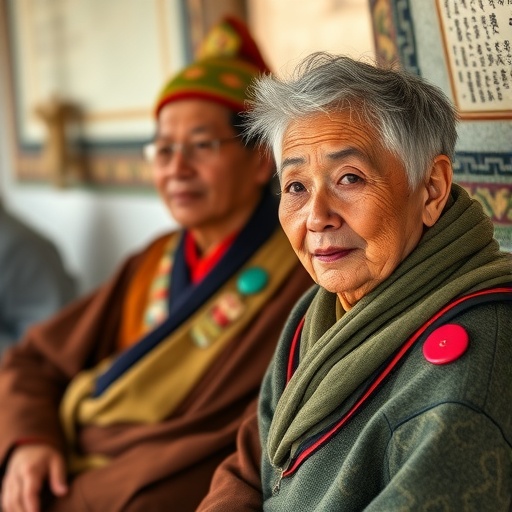
In an illuminating new study poised to reshape our understanding of health equity, researchers Jia, Chen, and Zhang uncover complex patterns of gendered ageism embedded within the health service utilization in Tibet. Their empirical investigation delves deep into the structural forces that differentially impact men and women as they age, revealing a troubling divergence that begins in midlife and widens markedly in old age. This pioneering research, published in the prestigious International Journal for Equity in Health, offers not only a granular analysis of the intersection between gender, age, and healthcare access but also a call to action for policymakers and healthcare professionals worldwide.
Health service utilization has long been recognized as a critical indicator of population well-being and health system responsiveness. Yet, beneath aggregate figures, stark inequities often lurk, shaped by social determinants such as gender and age. Tibet, with its unique sociocultural landscape and healthcare infrastructure challenges, provides a compelling context to explore these disparities. The authors employ robust quantitative methodologies, analyzing vast datasets to track utilization patterns over numerous cohorts, thereby capturing subtle shifts that illuminate systemic gendered ageism—discrimination that occurs at the nexus of gender and aging.
This research punctuates the emerging consensus that health inequities are not static but evolve across the lifespan. The study finds that in the midlife years, around the ages of 40 to 55, gendered disparities in accessing health services already begin to manifest, often disguising themselves under seemingly neutral statistics. However, as individuals advance into older age, these disparities intensify dramatically. Elderly women in Tibet face significantly reduced access to essential health services compared to their male counterparts, a gap influenced by both cultural practices and institutional biases deeply embedded in health systems.
The authors argue convincingly that this midlife emergence of gendered disparities marks a crucial inflection point. Midlife, a period often overlooked in health equity discourse, represents a critical window where cumulative social disadvantages begin to translate into tangible health service barriers. In Tibet, the intersectionality of gender and age is exacerbated by traditional patriarchal norms that elevate male authority and visibility within health decision-making spheres, thus marginalizing female older adults both culturally and structurally.
A key contribution of this study lies in its methodological rigor. The researchers leverage longitudinal data, employing advanced statistical models to isolate structural determinants from individual-level factors. By doing so, they lay bare the systemic nature of gendered ageism, distinguishing it from mere personal or circumstantial differences. This approach unveils how institutional policies, resource allocation, and localized health service delivery mechanisms combine to form a structural web that limits elderly women’s utilization of healthcare.
Furthermore, the authors contextualize their findings within Tibet’s unique socio-political environment. The region’s healthcare system contends with geographic remoteness, resource scarcity, and culturally specific health practices that collectively shape access. Tibetan elderly women often bear a double burden, navigating not only age-related physical health issues but also entrenched gender biases that curtail their health-seeking behaviors and service reception. The study’s insight into the cultural norms influencing these behaviors enriches the broader discourse on intersectionality in health.
The divergence in health service use observed in old age emerges as both a reflection and reinforcement of societal inequities. Lower health utilization among elderly women correlates with worse health outcomes, increased vulnerability, and diminished quality of life, perpetuating a cycle of disadvantage that is difficult to break. The study’s findings emphasize an urgent need for gender-sensitive and age-responsive health policies that prioritize equity, particularly in underserved and culturally complex regions like Tibet.
This research also raises profound questions about how health systems globally might inadvertently perpetuate disparities. Structural gendered ageism, as revealed in this study, is not merely a Tibetan phenomenon but a potentially widespread issue masked by superficial parity in health statistics. Consequently, the findings encourage a re-examination of health metrics and evaluation frameworks to incorporate nuanced demographic and socio-cultural factors that influence access and outcomes.
The implications for health practitioners are equally significant. Training programs, resource distribution, and patient outreach must be recalibrated to recognize the compounded barriers faced by elderly women. Interventions that are culturally sensitive and attuned to the intersection of gender and age can foster trust and engagement, thereby improving utilization rates and health outcomes. The study suggests that community-based participatory approaches may be particularly effective in addressing these entrenched inequities.
Moreover, the authors highlight the importance of policy integration, arguing that addressing gendered ageism in health services requires cross-sectoral collaboration. Social welfare, education, and legal frameworks need to work in tandem with the health sector to dismantle discriminatory structures. For Tibet, this means concerted efforts to empower elderly women economically, socially, and politically, enabling them to overcome barriers to health care utilization.
The study’s longitudinal nature allows for the tracing of cohort-specific trajectories, providing a dynamic picture of how gendered ageism evolves over time. This temporal lens is crucial for designing interventions that are both preventative and reactive. By identifying midlife as the starting point for divergence, the research advocates for early, sustained, and targeted policy responses that could nip disparities in the bud before they escalate into more severe inequities.
As the global population ages, the challenge of ensuring equitable health service access intensifies. The Tibetan case study offered by Jia, Chen, and Zhang is a compelling microcosm of challenges faced worldwide, especially in regions with deeply ingrained cultural norms that influence gender roles. Their findings foreshadow the critical need for sensitive adaptation of health systems to accommodate the complex identities of patients, including intersections of gender, age, ethnicity, and socioeconomic status.
The study’s contribution extends beyond its empirical findings, serving as a catalyst for further research. By uncovering structural gendered ageism in a hard-to-reach and culturally distinct population, it invites exploration into other marginalized groups who may suffer similar inequities hidden beneath aggregate health data. It also prompts the development of innovative data collection and analytical tools that can better capture the multifaceted nature of health inequities.
In sum, this comprehensive empirical study represents a landmark contribution to equity in health discourse. By exposing the midlife emergence and old-age divergence of structural gendered ageism in health service utilization in Tibet, Jia, Chen, and Zhang illuminate pathways toward more just and inclusive health governance. Their findings resonate far beyond Tibet, staking a claim for urgent and universal reforms to health systems worldwide so that aging populations—especially women—are supported equitably, dignifiedly, and effectively in their healthcare journeys.
With its blend of cultural insight, rigorous methodology, and practical policy recommendations, the research offers a vital blueprint for confronting the silent but pervasive epidemic of structural gendered ageism. It compels global health stakeholders to heed the voices of the often-overlooked elderly women and to build health systems that truly serve all, regardless of gender or age.
Subject of Research: Structural gendered ageism in health service utilization in Tibet
Article Title: From midlife emergence to old-age divergence: an empirical study on structural gendered ageism in health service utilization in Tibet
Article References:
Jia, C., Chen, W. & Zhang, X. From midlife emergence to old-age divergence: an empirical study on structural gendered ageism in health service utilization in Tibet. Int J Equity Health (2025). https://doi.org/10.1186/s12939-025-02733-7
Image Credits: AI Generated


