

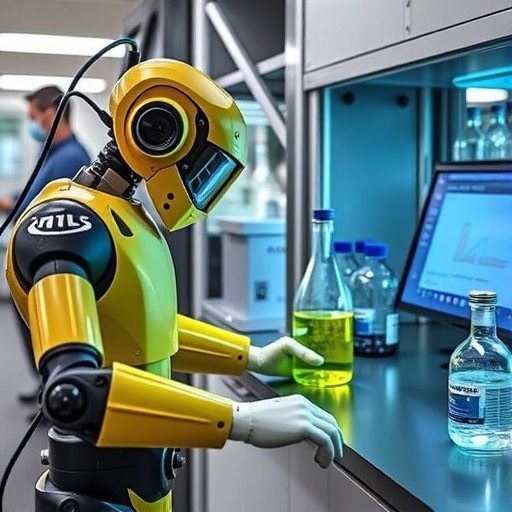
In a remarkable leap forward for catalyst research and automation technology, scientists at the Korea Institute of Energy Research (KIER) have unveiled a groundbreaking robotic platform that revolutionizes the evaluation of catalytic materials. This advanced system not only accelerates the pace of catalyst performance testing but also markedly enhances the precision and reliability of experimental data. The innovation comes from Dr. Ji Chan Park’s research team at KIER’s Clean Fuel Research Laboratory, who have engineered an entirely automated workflow that outperforms traditional manual methods by an astonishing margin.
Catalyst development has traditionally been a painstaking process, requiring extensive repetitive testing to optimize composition and reaction conditions. Such experimentation often spans weeks or even months, with results susceptible to variability introduced by human operation. Recognizing these challenges, the KIER team set out to design a platform capable of automating the labor-intensive and error-prone steps within catalyst performance evaluation. What they created is a dual-robotic system that manages the entire catalytic testing procedure with minimal human intervention, ushering in an era of ultra-efficient and high-fidelity data acquisition.
At the core of the system’s innovation is the division of the experimental workflow into two coordinated stages, each managed by a dedicated robot. The first robot tackles the intricate task of sample identification, precise placement, and initiation of spectral measurements—an essential technique that assesses catalyst activity through ultraviolet-visible (UV/Vis) absorbance changes during reaction progression. This automated handling ensures consistent sample positioning and timing, mitigating variability and potential operator-induced bias that have historically plagued manual assays.
Complementing the first robot, the second robot oversees the operational logistics critical to continuous, long-duration experiments. It assumes responsibility for sample handling logistics, including the placement, retrieval, and disposal of catalyst samples. Additionally, this robot manages consumable replacement autonomously, allowing for stable, uninterrupted operation across many hours or even days. Such functionality is vital for high-throughput screening scenarios where frequent human involvement can bottleneck the process and introduce inconsistencies.
The synergy between these two robotic agents is orchestrated through an optimized integrated control system, enabling them to operate simultaneously and flawlessly maintain each experimental phase. With this system in place, the entire catalyst performance evaluation that once required 32 days of manual labor was compressed into just 17 hours. This dramatic acceleration—a 45-fold increase in speed—represents not only a breakthrough in operational efficiency but also signifies a new standard for experimental throughput in catalysis research.
Beyond speed, the robotic platform enhances the reliability of results, reducing variability among experiments by approximately 32%. This improvement ensures highly reproducible and trustworthy data, critical for developing catalysts that transition successfully from laboratory settings to practical applications. The stability of the platform under high-throughput and continuous conditions showcases its robustness, facilitating ongoing long-term studies without the need for constant human supervision.
Technically, the system leverages UV/Vis spectroscopy for its primary analytic method. By monitoring the absorbance characteristics of samples under ultraviolet and visible light, the approach offers a sensitive and non-invasive means of tracking catalyst activity and reaction kinetics. This spectroscopic data serves as a reliable indicator of catalytic performance, particularly as it captures dynamic changes during reactions, enabling real-time assessment without destructive sampling.
Importantly, this automation addresses a previously unmet challenge: managing overnight and lengthy continuous experiments. While prior AI-driven or computational methods have accelerated catalyst design on theoretical grounds, they fell short of automating physical manipulations within extended experimental protocols. The KIER platform fills this gap by proficiently handling real-time mechanical tasks that require precision and immediate responsiveness—tasks once exclusively reliant on trained human operators.
The KIER team secured a Korean patent for their “catalyst performance evaluation automation system,” underscoring the innovation’s novelty and potential for commercialization. This intellectual property achievement lays the groundwork for deploying the technology across industrial and research laboratories, potentially transforming the catalyst discovery landscape worldwide. By ensuring reproducibility, scaling throughput, and reducing human error, the platform is poised to catalyze breakthroughs in energy, environmental, and chemical manufacturing sectors.
Looking ahead, Dr. Park emphasized plans to expand the system’s capabilities beyond present applications. Future directions include broadening the scope of catalytic reactions and materials amenable to automated evaluation. Furthermore, the team aims to integrate theoretical modeling more tightly with experimental workflows, leveraging artificial intelligence to accelerate catalyst design cycles further, establishing a fully-fledged AI-driven catalyst development ecosystem.
This pioneering work was supported by the Korea Institute of Energy Research’s institutional R&D initiatives and the Ministry of Trade, Industry and Energy (MOTIE). The results were published in Chemical Science, a prestigious peer-reviewed journal, reflecting the high impact and scientific rigor of the research. The article offers a detailed exposition of the platform’s architecture, operational protocols, and performance metrics, serving as a valuable reference for researchers aspiring to build similar automated systems.
In conclusion, the KIER team’s robotic platform marks a significant advance in the scientific method applied to catalyst development. By leveraging robotics, machine coordination, and precise spectroscopic analysis, they have transformed an arduous, variable, and time-intensive process into a streamlined, reproducible, and ultra-fast operation. As this technology matures, it holds the promise of accelerating the discovery of next-generation catalysts vital for clean fuels and sustainable energy solutions, aligning perfectly with global efforts to achieve carbon neutrality and a green future.
Subject of Research: Automated robotic platform for catalyst performance evaluation
Article Title: Fully automated and high-fidelity robotic platform enabling accelerated discovery of nanocatalysts
News Publication Date: 30-Dec-2025
Web References: 10.1039/d5sc06192j
Image Credits: KOREA INSTITUTE OF ENERGY RESEARCH
Keywords
Catalyst Automation, Robotic Platform, High-Throughput Screening, UV/Vis Spectroscopy, Nanocatalysts, AI Integration, Experimental Reproducibility, Continuous Operation, Catalyst Performance Evaluation, Korea Institute of Energy Research, Clean Fuel Research, Chemical Science


