

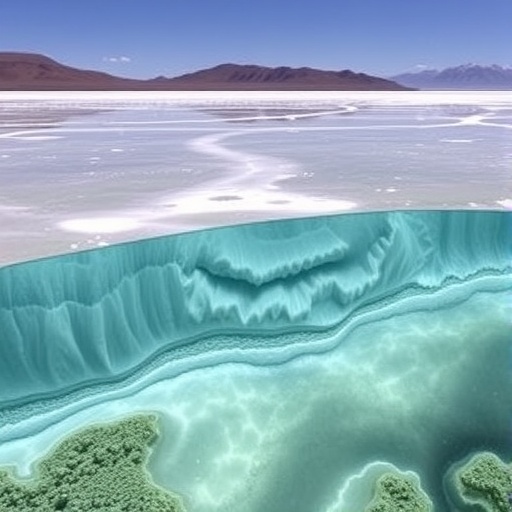
A remarkable discovery beneath the Great Salt Lake in Utah is reshaping our understanding of freshwater reservoirs hidden below hypersaline environments. Utilizing cutting-edge airborne electromagnetic (AEM) survey methods, a team led by University of Utah geophysicists has illuminated a vast subterranean freshwater basin stretching beneath the lake’s eastern margin, particularly under Farmington Bay and Antelope Island. This study, published recently in the journal Scientific Reports, represents a pioneering effort to characterize freshwater accumulation beneath a body of intensely saline water, something previously thought to be inaccessible to such noninvasive imaging techniques.
The research hinges on the premise that the Great Salt Lake’s surface is extraordinarily saline, a hallmark of terminal lakes where evaporation exceeds inflow, concentrating salts to create a harsh chemical milieu. However, beneath this briny surface, the study reveals a continuous expanse of freshwater-saturated sediments extending to depths ranging from three to four kilometers, equivalent to approximately 10,000 to 13,000 feet. This astonishing discovery challenges conventional hydrologic models which assumed that saline brine would dominate the subsurface environment beneath the lake’s salty veneer, limiting freshwater presence primarily to marginal zones.
Central to the study was the deployment of airborne electromagnetic geophysical methods, an innovative approach that enabled researchers to discriminate between saltwater and freshwater by exploiting their contrasting electrical conductivities. Saltwater, laden with electrolytes, exhibits high conductivity, whereas freshwater resists electrical flow to a much greater degree. By suspending electromagnetic sensors beneath a helicopter, the research team conducted a comprehensive survey covering 154 miles across Farmington Bay and northern Antelope Island. Data gathered was subjected to rigorous tomographic inversion techniques, which integrated electromagnetic measurements with magnetic data to generate three-dimensional images of the subsurface.
These advanced imaging results unveiled a distinct saline-freshwater interface, with surface layers uniformly saline, transitioning sharply within tens of meters to resistive sediments interpreted as freshwater-saturated zones. The interface varied in thickness and depth but was consistently evident beneath the lakebed, suggesting a stable and expansive freshwater reservoir lying under the lake’s hypersaline upper layer. The boundary between shallow and deep geological formations was identified by abrupt changes in magnetic data, indicating that beneath the shallow sediments less than 200 meters deep lies a deeper basin reaching over 3 kilometers down.
The study places particular emphasis on several unusual surface features—circular mounds covered with dense phragmites reeds emerging from the desiccated lakebed of Farmington Bay. These formations correspond to artesian freshwater seeps where groundwater rises under pressure through permeable sediment gaps in the salt crust. Their presence provides direct evidence of active freshwater flow beneath the lakebed and serves as a surface manifestation of the vast subsurface reservoir. This phenomenon not only corroborates geophysical survey findings but also highlights the dynamic interaction between groundwater systems and the lake environment.
From a hydrological perspective, the findings carry profound implications. Freshwater inflow from mountain watersheds, according to traditional models, was expected to be mostly peripheral to the lake, mixing superficially and giving way to brine beneath. Instead, the research suggests that freshwater plunges deeply into the lake’s interior, displacing denser saline water and creating an extensive freshwater lens several kilometers thick. This overturns assumptions about the Great Salt Lake’s hydrodynamics and calls for reevaluation of groundwater flow models in terminal lake systems.
Beyond its scientific novelty, the existence of this massive freshwater reservoir presents practical opportunities. The exposed lakebed, especially in Farmington Bay, has become a significant source of airborne dust causing public health concerns and environmental degradation in nearby urban areas. These dust emissions are enriched with toxic metals, necessitating innovative mitigation strategies. Groundwater experienced in the discovered aquifer may offer a sustainable, natural means to dampen dust hotspots by controlled pumping and surface wetting, potentially reducing particulate emissions while preserving the integrity of the subsurface water system.
However, the researchers stress the importance of cautious management, recognizing the need to fully understand hydrogeological connectivity and system sustainability before any extraction occurs. The fresh groundwater is both a precious natural resource and a critical component of the lake’s ecological balance. Overexploitation or poorly planned utilization could disrupt the delicate salinity gradients and sediment stability, leading to unintended ecological consequences. Therefore, ongoing studies aim to map the extent of the freshwater aquifer with more granularity and to develop predictive models of aquifer recharge and depletion under varying climatic and anthropogenic pressures.
This pilot study, while extensive, covers only a fragment of the Great Salt Lake’s 1,500-square-mile expanse. Encouraged by the success of this initial campaign, researchers are advocating for a full-lake airborne electromagnetic survey to systematically characterize the freshwater reservoir’s spatial distribution and depth variability. Achieving this would mark a milestone in the application of geophysical imaging to large saline lake environments globally and could set a precedent for similar investigations under terminal lakes in other arid and semiarid regions around the world.
The technological aspect of this research showcases the integration of electromagnetic surveying with magnetic data inversion to resolve complex subsurface features. The Consortium for Electromagnetic Modeling and Inversion (CEMI) at the University of Utah developed a sophisticated approach whereby surface electromagnetic data, which typically represent shallow subsurface conditions, are merged with magnetic anomalies that provide deep crustal structural information. This multidisciplinary methodology allows researchers to delineate interfaces between sediments and basement rock, estimate porosity volumes, and quantify the freshwater content with unprecedented detail.
Looking forward, the combination of these geophysical tools with hydrologic monitoring and geochemical analyses promises a holistic understanding of the aquifer system’s origin, recharge mechanisms, and its interaction with lake hydrodynamics. Such comprehensive knowledge will be essential for regional water resource planning, especially as climate change and water demand intensify resource pressures in the Western United States. Policymakers and water managers could leverage this information to balance ecological preservation with practical human needs.
In conclusion, the groundbreaking use of airborne electromagnetic surveys to peer beneath the Great Salt Lake’s deceptively hostile salt surface has unveiled a hidden reservoir of freshwater of considerable magnitude and accessibility. This finding redefines hydrologic paradigms in terminal lake systems, offers new pathways for environmental mitigation, and exemplifies the power of advanced geophysical techniques in Earth sciences. As follow-on research expands, the hope is that this knowledge will translate into sustainable practices preserving both water resources and public health while deepening scientific understanding of complex groundwater-saltwater interactions.
Subject of Research: Not applicable
Article Title: Airborne Geophysical Imaging of Freshwater Reservoir Beneath the Eastern Margin of Great Salt Lake
News Publication Date: 27-Feb-2026
Web References: https://doi.org/10.1038/s41598-026-40995-5
Image Credits: Brian Maffly, University of Utah
Keywords: Geophysics, Groundwater, Electromagnetism


