

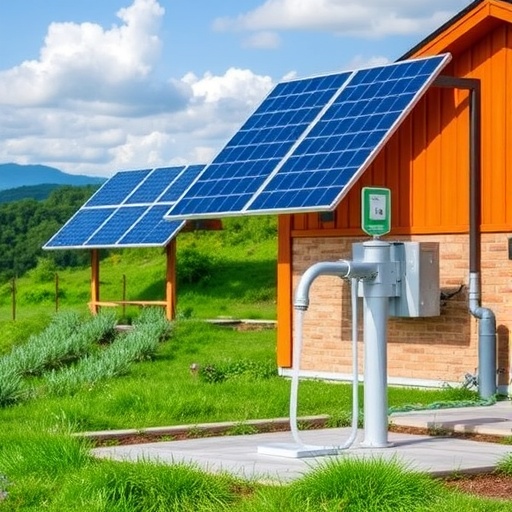
In recent years, the focus on renewable energy has surged, especially in the realm of solar power and its applications in various fields. One area that stands to benefit significantly from advancements in solar technology is agricultural irrigation, where solar water pumping systems have emerged as a popular choice for efficient water management. Researchers Chundawat, Kumar, and Saini have contributed to this field with their study on the availability prediction of solar water pumping systems, utilizing stochastic modeling and nature-inspired algorithms.
The significance of solar water pumping systems cannot be overstated. These systems offer a sustainable alternative to traditional diesel-powered pumps, allowing for reduced carbon footprints while providing reliable agricultural irrigation in many regions around the world. The accuracy in predicting the performance and availability of these systems is crucial for optimizing their deployment and ensuring that they meet the energy demands of agricultural activities, particularly in areas that suffer from unreliable electricity access.
Chundawat and colleagues emphasize that the variability of solar energy poses a significant challenge for the reliability of solar water pumping systems. Day-to-day fluctuations in sunlight can lead to uncertainty in the volume of water pumped, directly impacting irrigation schedules and consequently crop yields. This study tackles these challenges head-on by developing a robust predictive framework that leverages both stochastic modeling techniques and insights drawn from nature-inspired algorithms.
The authors have proposed a novel approach that incorporates historical weather data to model the availability of solar irradiance, which is fundamental for the operation of solar water pumps. By utilizing a stochastic modeling framework, the researchers can account for the inherent uncertainties associated with solar energy generation. This model facilitates a more accurate prediction of the pumping availability over set periods, which is crucial for farmers relying on these systems.
Nature-inspired algorithms have gained considerable traction in recent years due to their effectiveness in solving complex optimization problems. Chundawat and his team employ these algorithms to refine their predictive model further, demonstrating their capability to adapt to changing environmental conditions. The integration of these algorithms allows for the optimization of system parameters, enhancing the overall efficiency of solar water pumping systems.
One of the study’s key findings is that the combination of stochastic modeling and nature-inspired algorithms significantly improves the accuracy of availability predictions when compared to traditional methods. This advancement paves the way for more reliable planning and management of agricultural water resources. Farmers can utilize these predictions to make informed decisions about irrigation schedules, thereby improving water conservation and crop resilience against drought conditions.
The implications of this research extend beyond individual farms, as the findings contribute to a broader understanding of how solar water pumping systems can be integrated into sustainable agricultural practices globally. In regions where water scarcity is a pressing issue, these findings can help governments and agricultural organizations to formulate policies that promote the adoption of solar-powered irrigation solutions.
Furthermore, the study highlights the importance of data collection and weather forecasting in enhancing the performance of solar water pumping systems. By establishing a comprehensive dataset of solar irradiance patterns and correlating this data with water pumping effectiveness, stakeholders can continuously monitor and adjust their systems according to real-time conditions. This proactive approach ensures that the irrigation process is both efficient and sustainable.
The potential for scalability is another facet of Chundawat and his team’s findings. The predictive model can be adapted and implemented in various regions, given that it is constructed upon data that could be collected in local contexts. This flexibility makes it a valuable tool for farmers around the world, as it provides the ability to tailor solar water pumping solutions to specific climatic and environmental conditions.
Moreover, the integration of technology such as artificial intelligence and machine learning into the prediction models represents a forward-thinking approach to addressing agricultural challenges. As these technologies evolve, they can be further refined to accommodate additional variables, enhancing the overall ability to forecast and manage resources within agricultural systems.
In a world increasingly aware of the need for sustainable practices, this research fuels the dialogue on how we can innovate to meet our food and water needs without compromising environmental integrity. By showcasing the potential of renewable energy sources like solar power in agricultural applications, the work of Chundawat and his team offers a glimpse into a greener future.
In conclusion, the availability prediction of solar water pumping systems represents a pivotal advancement in the integration of renewable energy into modern farming practices. Through their innovative use of stochastic modeling and nature-inspired algorithms, Chundawat, Kumar, and Saini are not only addressing the challenges of water scarcity but also paving the way for sustainable agricultural practices worldwide. Their work exemplifies how technology can harmonize with nature to create solutions for some of the most pressing challenges faced by humanity.
With the ongoing research and developments in this field, it will be exciting to see how these findings are applied in real-world scenarios and the potential enhancements in crop productivity and sustainability that can result from improved solar water pumping systems.
Subject of Research: Prediction of solar water pumping system availability using stochastic modeling and nature-inspired algorithms.
Article Title: Availability prediction of solar water pumping system through stochastic modeling and nature-inspired algorithms.
Article References:
Chundawat, J.S., Kumar, A. & Saini, M. Availability prediction of solar water pumping system through stochastic modeling and nature-inspired algorithms.
Discov Artif Intell (2026). https://doi.org/10.1007/s44163-025-00700-3
Image Credits: AI Generated
DOI: 10.1007/s44163-025-00700-3
Keywords: solar water pumping systems, stochastic modeling, nature-inspired algorithms, agricultural irrigation, renewable energy, predictive modeling, solar energy, water management, sustainability, crop yields, water scarcity.


