

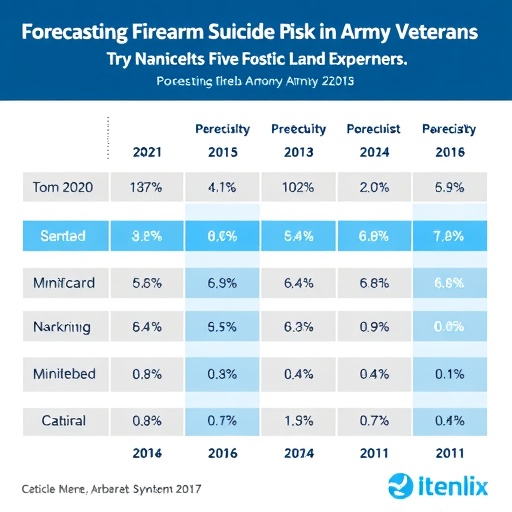
In a groundbreaking study that addresses one of the most pressing public health crises in the United States, researchers have developed innovative machine-learning models aimed at predicting firearm-specific suicides among US Army veterans transitioning from active service. Suicide rates among veterans are alarmingly higher than among civilians, with firearms playing a central role in the majority of these tragic deaths. This study, utilizing a decade’s worth of data from over 800,000 veterans, highlights a critical evolution in predictive analytics for suicide prevention, demonstrating nuanced insights into method-specific risks that could revolutionize intervention strategies.
Suicide prevention within veteran populations has long been a complex challenge, primarily because traditional predictive models do not differentiate between methods of suicide. However, firearms account for a significant portion of veteran suicides, a fact that has driven the development of both universal and firearm-specific prevention approaches. The researchers capitalized on this critical distinction, hypothesizing that models tailored specifically to predict firearm-related suicide risk might outperform or complement broader, method-agnostic algorithms used in clinical and public health settings.
The study harnessed a vast dataset encompassing US Army veterans who discharged between 2010 and 2019, totaling 800,579 individuals. This extensive longitudinal dataset offered unprecedented statistical power for model development and validation, enabling machine-learning algorithms to identify subtle patterns and risk factors indicative of firearm suicide lethality in the ensuing decade post-discharge. The researchers’ methodological rigor also ensured models were not just predictive but calibrated fairly across demographic lines.
Central to the study were two classes of machine-learning models: firearm-specific and method-agnostic. The firing-specific models were explicitly trained to predict suicides involving firearms, employing features and variables directly related to access to and use of firearms, whereas the method-agnostic models generalized across all suicide methods without specificity. Despite differences in focus, both models achieved comparable overall predictive performance, with AUC (area under the curve) scores tightly ranged around 0.71, signaling moderate but clinically relevant discrimination capacity.
Calibrated probability estimates are critical for predictive models to be effectively translated into real-world interventions. This study reports an impressively low Integrated Calibration Index (ICI) for both models, hovering between 0.0003% and 0.0005%, indicating extremely well-calibrated risk probabilities. Such precision in calibration indicates that the likelihood estimates generated by these models closely mirror actual observed outcomes, an essential attribute for decision-making protocols that hinge on risk thresholds where intervention would be triggered.
Intriguingly, the predictive utility of the models diverged somewhat depending on the chosen intervention threshold. At the highest risk thresholds—where intervention is costly or intensive—the method-agnostic model demonstrated superior performance in identifying veterans at imminent risk of firearm suicide. This finding suggests that while firearm-specific risk factors are crucial, generalized suicide risk indicators remain indispensable in capturing those at the extreme end of the risk spectrum.
Conversely, at lower intervention thresholds, where broader but less resource-intensive prevention measures may be feasible, the firearm-specific model outpaced its method-agnostic counterpart. This suggests that method-specific models might enable earlier, more targeted engagement with at-risk veterans through firearm-specific risk mitigation strategies, such as secure firearm storage or temporary transfer interventions—a strategy that public health officials and clinicians have long advocated for.
The researchers also examined model fairness across different demographic subsets, focusing on sex and race/ethnicity disparities. Model fairness is an increasingly important consideration in artificial intelligence-driven healthcare, ensuring algorithms do not perpetuate or exacerbate existing inequities. In this context, the firearm-specific model demonstrated superior fairness, maintaining equitable predictive performance across sex and racial/ethnic categories. This points to the potential for such models to support more just and effective intervention programs.
The study’s findings underscore the critical importance of multimodal intervention frameworks that blend method-agnostic and method-specific approaches. Because the models excelled under different conditions, a coordinated application—deploying method-agnostic models at high thresholds and firearm-specific ones at lower thresholds—could optimize resource allocation and risk mitigation. This insight transforms how veterans’ suicide risk assessments could be operationalized in healthcare settings and veteran support services.
From a technical perspective, the machine-learning process drew on a wide array of variables, including demographic information, military service history, health records, prior behavioral health diagnoses, and access to firearms. The algorithms employed advanced statistical learning techniques, likely leveraging ensemble methods and nonlinear classifiers, to discern complex nonlinear interactions and temporal trends that traditional models might overlook. This sophistication allows for dynamic, data-driven risk stratification over a 10-year horizon, a significant advance over existing static risk assessments.
Moreover, the extended follow-up period of up to a decade post-discharge reflects the enduring vulnerability among veterans, emphasizing the necessity for long-term surveillance and support. Suicidal behaviors may not manifest immediately upon transition from active duty but can surface years later, driven by cumulative psychosocial stresses, physical injuries, or untreated mental health conditions. These models’ ability to predict firearm suicides over such an extended timeframe represents a milestone in precision mental health forecasting.
While the study marks a pivotal step forward, the authors acknowledge that no predictive model is infallible. Suicide prevention inherently requires a multifaceted, compassionate approach that integrates clinical judgment, social support, and policy measures alongside predictive analytics. Yet, pairing data-driven insights with tailored, firearm-specific prevention strategies has the potential to save lives by proactively identifying those most at risk and delivering timely interventions.
This research also invites broader considerations about firearm policy and veteran healthcare infrastructure. Effective firearm suicide prevention often involves measures like lethal means counseling, safe storage campaigns, and temporary firearm relinquishment during periods of crisis. Embedding predictive models within veteran healthcare systems could facilitate personalized risk communications and support these interventions’ timely application, bridging data science and public health practice.
As artificial intelligence continues to influence healthcare paradigms, the challenge lies not only in perfecting predictive accuracy but also in ethically integrating these tools into care pathways. The study illustrates how rigorous development and validation of models—attuned to demographic fairness and method-specific nuances—can push the envelope. The promise is profound: to reduce the tragic toll of firearm suicides among veterans through smarter, more actionable intelligence.
Implementation of these models at scale will require robust collaboration between military and civilian healthcare providers, information technology infrastructure enhancements, and ongoing validation across diverse veteran cohorts. Additionally, transparent communication about the models’ benefits and limitations will be vital to engender trust among veterans and clinicians alike. The study’s publicly available findings represent an open invitation to policymakers and healthcare leaders to invest in these transformative tools.
In conclusion, this pioneering research elucidates the power of specialized machine-learning models to predict firearm suicide risk in a highly vulnerable population. It offers nuanced insights that could recalibrate veteran suicide prevention strategies by marrying method-agnostic with firearm-specific approaches. The careful attention to fairness and calibration addresses ethical imperatives, while the practical applicability promises to save lives. As veteran suicide remains a national emergency, such innovative ventures into data science herald a hopeful trajectory toward more precise, equitable, and effective interventions.
Subject of Research: Suicide prediction models for firearm-specific suicide risk among transitioning US Army veterans.
Article Title: Predicting firearm suicide among US Army veterans transitioning from active service.
Article References:
Houtsma, C., Kennedy, C.J., Liu, H. et al. Predicting firearm suicide among US Army veterans transitioning from active service. Nat. Mental Health (2025). https://doi.org/10.1038/s44220-025-00559-4


