

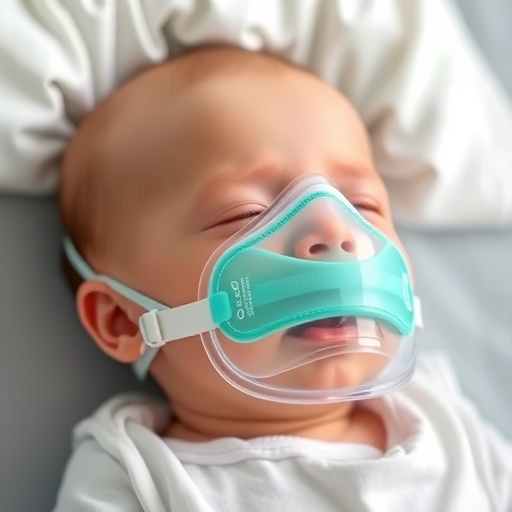
In the delicate world of neonatal care, the precision of every intervention can define the trajectory of a newborn’s health. Among these critical interventions, positive pressure ventilation stands as a cornerstone in providing respiratory support to infants struggling to breathe at birth. Yet, despite its ubiquity, nuances in technique—such as the inflation level of face masks used during ventilation—remain relatively unexplored. Now, a groundbreaking study has plunged into this overlooked frontier, revealing significant differences in applied forces on newborn faces with partially versus fully inflated face masks during ventilation.
The recent randomized crossover manikin trial spearheaded by Cavallin et al. delivers fresh insight into optimizing neonatal ventilation strategies. Utilizing an innovative neonatal manikin designed to mimic the delicate facial structure of newborns, the investigators compared positive pressure ventilation applied with two contrasting face mask inflation volumes: a partially inflated mask at 25 ml, and a fully inflated mask at 35 ml. Their meticulous approach examined not only the forces imparted on the manikin’s face but also measured cuff pressure dynamics and the degree of air leak during ventilation.
Understanding why applied force matters is essential. Excessive force exerted by a face mask could potentially injure a newborn’s fragile facial tissues, leading to bruising, edema, or even long-term sequelae. Conversely, insufficient force risks inadequate seal formation, resulting in ineffective ventilation and air leaks that compromise oxygen delivery. The delicate balance between these extremes is thus a critical component in clinical practice, yet quantitative data guiding optimal mask inflation have been scarce—until now.
The study’s methodology utilized a randomized crossover design, ensuring that each mask inflation condition was tested on the same manikin to reduce variability. By quantifying the force distribution across the face during positive pressure applications, the team could rigorously ascertain how inflation volume impacts the interaction between mask and neonatal skin analog. Additionally, real-time monitoring of cuff pressures and leakage allowed for comprehensive analysis of ventilation quality under each condition.
Results demonstrated a compelling difference: the fully inflated face mask, inflated to 35 ml, applied significantly higher forces on the manikin’s facial surface compared to the partially inflated 25 ml mask. This finding raises clinical concerns about tissue trauma risks with fully inflated masks, especially during prolonged ventilation sessions or when used repetitively. Remarkably, the partially inflated mask maintained an effective seal with reduced applied force, suggesting a safer yet equally efficacious alternative.
The measurement of cuff pressure further illuminated the physiological implications of mask inflation. Elevated cuff pressures associated with the fully inflated masks could potentially exacerbate pressure-related injuries, while the lowered pressures seen with partial inflation might offer a gentler ventilation approach without sacrificing performance. Notably, the study found that air leak—a common ventilation challenge—did not significantly increase with partial inflation, debunking fears of compromised efficacy.
The implications for neonatal intensive care units (NICUs) are profound. This nuanced understanding equips clinicians with evidence-based guidance to tailor ventilation approaches meticulously, potentially reducing iatrogenic injuries while safeguarding respiratory support effectiveness. With neonatal patients being among the most vulnerable in medicine, such optimization is not merely desirable but essential to improving morbidity and mortality outcomes.
This research also sparks further questions about the design and material properties of face masks used in neonatology. Could new, more pliable mask materials that conform better to facial anatomy be developed in conjunction with optimal inflation strategies? Might real-time pressure sensors be integrated into masks to provide clinicians immediate feedback, minimizing harmful forces instantaneously? These avenues open promising opportunities for innovation in neonatal care devices.
Moreover, the study sheds light on an often overlooked aspect of neonatal ventilation — operator technique. The pressure and force applied are inherently influenced by the practitioner’s hand positioning, strength, and experience. Training protocols incorporating these findings could revolutionize how clinicians are taught to administer positive pressure ventilation, emphasizing not only timing and technique but also mechanics of mask inflation and interface pressure.
One must also consider the broader systemic effects of such findings. Reducing mask-induced facial trauma can shorten the duration of ventilation support, minimize the need for sedation or analgesia, and alleviate parental stress by improving infant comfort. These indirect but vital benefits underscore how subtle technical refinements propagate ripple effects throughout patient care pathways.
The study’s randomized crossover design lends robustness to its conclusions, mitigating inter-subject variability often encountered in clinical trials. However, it is important to acknowledge limitations inherent in manikin-based studies. Neonatal skin and tissue responsiveness to mechanical forces can vary widely in vivo, necessitating follow-up clinical trials to validate these promising results in real patients. Nonetheless, this work lays a critical scientific foundation for such translational exploration.
In summary, the research led by Cavallin and colleagues represents a pivotal step forward in neonatal ventilation science. By quantifying the applied forces of partial versus full face mask inflation, they provide a vital framework guiding safer, more effective respiratory support. Their findings advocate for a paradigm shift in ventilation interfaces, underscoring that less inflation can equate to gentler yet effective care.
As neonatal care continues to evolve with advances in technology and understanding, studies like this remind us that even the seemingly simple components of care—such as mask inflation volume—can profoundly influence outcomes. It is a testament to the importance of precision, innovation, and evidence-based practice in safeguarding the most vulnerable lives. The reverberations of this study are likely to echo across NICUs worldwide, soon translating into improved protocols and, ultimately, healthier beginnings for countless newborns.
This work exemplifies how blending engineering principles with clinical insight yields practical solutions to age-old challenges. By challenging assumptions and quantifying physical forces in clinical settings, the researchers illuminate pathways to enhanced care delivery and patient safety. The neonatal landscape is poised to benefit immensely from these meticulous endeavors that bring science from theory to the bedside.
As neonatal ventilation protocols are reassessed in light of these findings, one can anticipate a surge in device innovation and clinical training adaptation tailored to optimize mask inflation and force application. This could represent a paradigm shift whereby routine neonatal resuscitation will incorporate technology-enabled feedback to guide mask pressures in real time, reducing human variability and improving consistency.
Ultimately, this study not only advances neonatal respiratory care but also elegantly demonstrates the power of detailed biomechanical analysis in resolving pressing clinical conundrums. In the quest to protect newborns’ fragile lives, every gram of force matters—and now, we are closer to applying it with surgical precision.
Subject of Research: Positive pressure ventilation in neonatal care, comparing applied forces and effectiveness between partially and fully inflated face masks during ventilation on a newborn manikin.
Article Title: Applied forces with partially vs. fully inflated face masks during neonatal ventilation: a randomized crossover manikin trial.
Article References:
Cavallin, F., Zamunaro, A., Maglio, S. et al. Applied forces with partially vs. fully inflated face masks during neonatal ventilation: a randomized crossover manikin trial. Pediatr Res (2025). https://doi.org/10.1038/s41390-025-04308-2
Image Credits: AI Generated
DOI: https://doi.org/10.1038/s41390-025-04308-2


