

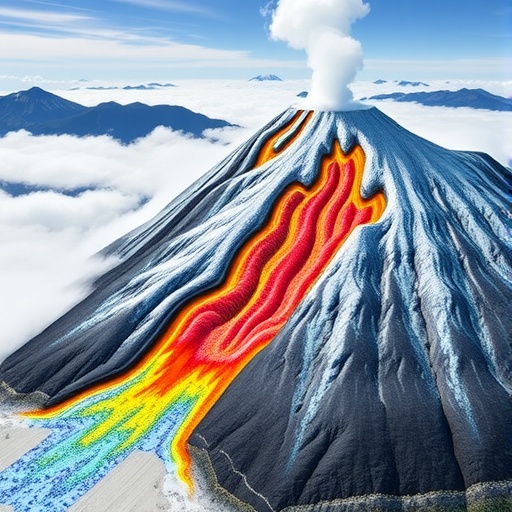
In a groundbreaking study set to redefine our understanding of volcanic systems, researchers Terakawa, Maeda, and Horikawa have unveiled new insights into the complex interplay between seismic activity and hydrothermal development at Japan’s Mount Ontake. Their work, published in Communications Earth & Environment in 2026, meticulously explores how volcano-tectonic earthquakes serve as windows into fluid-induced stress changes deep beneath the Earth’s surface, illuminating mechanisms that drive hydrothermal system evolution. This research not only advances fundamental geophysical science but also holds crucial implications for volcanic hazard monitoring and geothermal energy exploitation worldwide.
Mount Ontake, located in central Japan, has long been recognized for its volatile nature and history of sudden, often catastrophic eruptions. The 2014 explosive eruption, which tragically claimed dozens of lives, emphasized the urgent need to unravel the complex physical processes underpinning volcanic unrest. Terakawa et al. turn their attention to the focal mechanisms of volcano-tectonic earthquakes—earthquakes generated by brittle failure within the volcanic edifice—to decipher the stresses induced by migrating or accumulating fluids in the subsurface. By analyzing these intricate seismic signals, the researchers seek to uncover how fluid pressures and stress distributions dynamically interact to cultivate hydrothermal systems that precede eruptive activity.
The study’s key innovation lies in its detailed examination of crustal stress changes inferred from earthquake focal mechanisms, which describe the orientation and nature of fault slip during seismic events. Using an extensive catalog of volcano-tectonic earthquakes recorded at Mount Ontake, the authors apply robust inversion techniques to infer stress tensors and assess deviations attributable to fluid movements. The results reveal that ascending and pressurizing hydrothermal fluids modulate the stress field, effectively weakening rock and facilitating fault slip. This fluid-induced stress redistribution acts as a catalyst for seismicity and plays a central role in the growth and sustainability of hydrothermal conduits—fluid pathways that are critical to volcanic degassing and heat transport.
This fluid-driven feedback mechanism implies that hydrothermal systems do not simply develop as passive responses to tectonic forces but instead actively reshape the stress environment through fluid migration. The researchers demonstrate that even subtle changes in pore fluid pressure can significantly alter stress orientations and magnitudes, thereby influencing the likelihood and location of earthquake occurrence. Such insights deepen our conceptual models of volcano dynamics and offer tangible tools for forecasting eruptive precursors. In particular, the coupling between fluid injection and seismicity at Mount Ontake provides a template for similar analyses at other hydrothermally active volcanoes worldwide.
The implications of this study extend beyond pure geodynamics. The patterns of stress changes and seismicity documented here suggest that continuous seismic monitoring, combined with focal mechanism analysis, can serve as a powerful proxy for tracking the evolution of subsurface fluid systems. This approach can be instrumental in volcanic hazard analysis, allowing scientists and policymakers to better anticipate shifts in hydrothermal activity that may herald impending eruptions. By detecting changes in fluid pressure responsible for earthquake triggering, it becomes possible to identify critical thresholds in volcanic unrest, improving early warning capabilities and potentially saving lives.
Beyond hazard assessment, these findings shed light on the intricate physical environment that supports geothermal energy reservoirs associated with volcanic areas. Hydrothermal activity is essential for the formation and sustainability of geothermal systems, and understanding how fluid-induced stress variations govern hydrothermal pathways is vital for optimizing resource extraction strategies. The detailed stress maps derived from seismic focal mechanisms can guide geothermal exploration by pinpointing zones of fluid overpressure and fractured rock that maximize permeability and heat exchange.
The methodology employed by Terakawa and colleagues represents a major advance in volcanic seismology. Their integration of high-resolution seismic data with sophisticated mechanical modeling bridges the gap between observational seismology and rock physics. By rigorously linking earthquake mechanisms with in situ fluid conditions, the study provides a quantitative framework for interpreting the feedback between seismicity and fluid dynamics. This framework can be adapted and applied to other geologically complex settings, making the work a cornerstone for future multidisciplinary research into coupled hydro-mechanical processes.
Mount Ontake’s geological setting, characterized by a complex interplay of magmatic and hydrothermal forces, is an ideal natural laboratory for this study. The volcano’s frequent volcano-tectonic earthquakes, often clustered near hydrothermal vents and fracture zones, highlight the intimate relationship between evolving fluid pressures and seismicity. The authors’ careful spatial-temporal analysis reveals how these earthquakes not only reflect but also modulate the stress landscape, enabling a dynamic view of how hydrothermal systems expand and contract in response to fluid fluxes.
This revelation has broader ramifications for our understanding of fluid transport mechanisms in the Earth’s crust. Hydrothermal fluids, often derived from magmatic degassing or meteoric water infiltration, exert dynamic control over rock strength and permeability. Terakawa et al.’s findings underscore the necessity of incorporating fluid pressure effects into models of fault mechanics and seismic hazard beyond volcanic contexts, such as in geothermal fields and hydrocarbon reservoirs, where fluid-induced seismicity is increasingly recognized.
Moreover, the study underscores the vital role of interdisciplinary collaboration in Earth sciences. Integrating geophysical data, geological fieldwork, and numerical modeling enables a holistic approach toward deciphering complex natural phenomena. The research team’s work exemplifies how advances in seismological techniques combined with insights from rock mechanics and fluid dynamics can yield unprecedented clarity about the hidden processes fueling volcanic systems.
As the global demand for sustainable energy grows, understanding the fundamental controls on hydrothermal system development takes on new urgency. The insights gained from Mount Ontake’s volcano-tectonic earthquake analyses could inform the design of more efficient geothermal power plants by identifying the subsurface conditions that optimize fluid circulation and heat extraction. Simultaneously, they provide a scientific foundation for mitigating risks associated with induced seismicity from fluid injection, a growing challenge in energy and waste management sectors.
Terakawa and colleagues’ study serves as a clarion call to the scientific community to rethink traditional approaches to volcanic monitoring. Rather than relying solely on surface observations or bulk seismicity rates, their focal mechanism-based approach enables a more nuanced and physics-based understanding of volcano dynamics. This paradigm shift is vital for enhancing predictive models of volcanic activity in a world where ambient seismic noise and climatic changes increasingly complicate observational datasets.
The potential for real-time implementation of this research is promising. Modern seismic networks and computational advances allow rapid determination of focal mechanisms, offering near-instantaneous snapshots of stress changes linked to fluid migration. By integrating these capabilities into volcano observatories, eruption forecasting could transition from qualitative assessments to quantitative probabilistic models grounded in fundamental science.
In conclusion, the insights gleaned from analyzing volcano-tectonic earthquake focal mechanisms at Mount Ontake reveal a complex but decipherable fingerprint of fluid-induced stress modulation driving hydrothermal system formation and evolution. This discovery not only advances geophysical knowledge but also enhances practical efforts in volcanic hazard mitigation and sustainable geothermal energy development. As volcanoes continue to pose risks and opportunities, studies like this provide critical tools to better understand, anticipate, and harness the dynamic forces beneath our feet.
Article References:
Terakawa, T., Maeda, Y. & Horikawa, S. Volcano-tectonic earthquake focal mechanisms reveal fluid-induced stress changes driving hydrothermal system development at Mount Ontake.
Commun Earth Environ (2026). https://doi.org/10.1038/s43247-026-03463-6


