

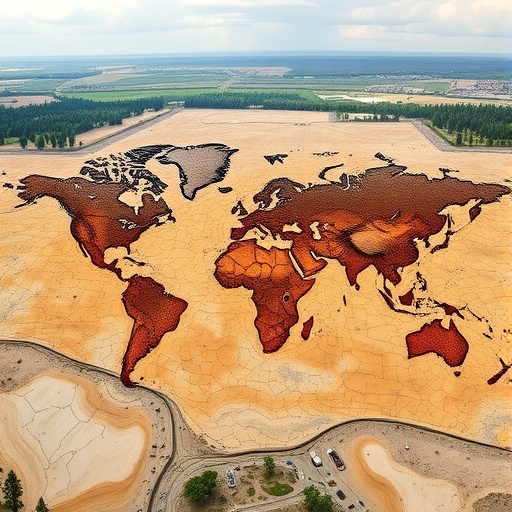
Flash Droughts: Unseen Drivers of Global Vegetation Decline and Recovery Delays
In recent years, the escalating frequency and intensity of flash droughts have emerged as a potent and troubling force impacting terrestrial ecosystems worldwide. Unlike traditional droughts, flash droughts develop rapidly, often within the span of a few weeks, leaving ecosystems with minimal time to adapt or respond. Groundbreaking research led by Chai, Miao, AghaKouchak, and colleagues, published in Nature Communications in 2025, unveils how these sudden hydrological events exacerbate vegetation loss across continents and critically delay natural recovery processes. Their findings illuminate new dimensions of drought impacts in the context of climate change, compelling scientists and policymakers to rethink ecological resilience and resource management strategies.
Flash droughts are characterized by swift onset and intensification, primarily triggered by a combination of meteorological factors including intense heat waves, persistent clear skies, and reduced precipitation. This confluence accelerates soil moisture depletion, creating harsh conditions for vegetation well before typical seasonal droughts. The study meticulously quantified vegetation stress responses globally by integrating satellite-derived greenness indices with high-resolution climatic datasets, revealing substantial deviations from normal vegetation phenology. The rapid drying of soils not only impairs plant physiological functions but also disrupts ecosystem carbon and water cycles, compounding stress on biomes that depend on steady moisture availability.
One of the striking aspects highlighted by the researchers is the spatial heterogeneity of flash drought impacts. While some regions exhibit pronounced vegetation dieback, others display subtle physiological stress markers that cumulatively undermine ecosystem productivity. This spatial variability is attributed to differences in land cover types, soil textures, and local climatic conditions which modulate vulnerability. Such granularity enhances our understanding of ecosystem-specific responses, underscoring the need for localized drought mitigation approaches rather than one-size-fits-all policies. Furthermore, the study’s use of advanced remote sensing technologies, including normalized difference vegetation indices (NDVI) and evapotranspiration anomalies, allowed for precise mapping of flash drought footprints on a global scale.
The temporal analysis presented in the research reveals that flash droughts not only accelerate vegetation degradation but significantly delay subsequent recovery phases. Recovery lag times—defined as the interval between drought cessation and vegetation normalization—show notable elongation following flash drought episodes compared to conventional droughts. This implies that ecosystems experience prolonged stress periods, heightening the risk of irreversible damage. Delayed recovery can cascade through food webs, affecting herbivore populations and the broader biodiversity reliant on plant communities. The study also highlights the feedback loops where degraded vegetation cover alters local microclimates, potentially fostering conditions for subsequent drought events and creating cyclical stress patterns.
Underlying the complexity of flash drought dynamics is the interaction between atmospheric demand and soil hydrology. Elevated temperatures increase evapotranspiration demand, which in the absence of compensatory precipitation, strips moisture from soils at unprecedented rates. This imbalance is magnified by changing land-use practices such as deforestation and urban expansion, which modify surface energy balances and hydrological cycles. The researchers emphasize that anthropogenic influences, combined with shifting climate regimes, intensify flash drought risks, thereby amplifying threats to global food security and carbon sequestration capacity. Addressing these challenges requires integrated climate, land, and water management policies informed by multidisciplinary scientific insights.
The research team employed state-of-the-art climate models, validated with observational data, to forecast future flash drought trends under various emission scenarios. Projections indicate an increased frequency and spatial extent of flash droughts in several critical agricultural and forested regions by mid-century. Such scenarios portend heightened vulnerability and demand urgent action to enhance ecological resilience. The ability to predict flash drought onset with greater accuracy is pivotal for resource managers, enabling preemptive interventions such as adaptive irrigation scheduling, drought-resistant crop deployment, and conservation of vulnerable habitats.
In addition to natural vegetation, the study addresses the socio-economic implications of flash drought-induced vegetation loss. Agricultural productivity losses linked to these events threaten local livelihoods, exacerbate food supply chain disruptions, and may induce price volatility in global markets. The hidden nature of flash droughts—due to their rapid emergence and subtle early-warning signals—poses unique challenges for disaster preparedness and response frameworks. Existing drought indices and monitoring systems require refinement to capture the rapid dynamics of flash droughts effectively, thereby improving early alert systems for sustaining agricultural operations and natural resource stewardship.
The interdisciplinary nature of the study bridges climatology, ecology, and socioeconomics, fostering a holistic appreciation of flash drought impacts. By linking climatic drivers with ecosystem responses and human vulnerabilities, the research broadens the conceptual framework through which drought phenomena are understood. This approach highlights feedback mechanisms whereby human activities influence drought susceptibility, which in turn affects ecosystem services that support human well-being. Consequently, the study advocates for strengthened collaboration across scientific disciplines and stakeholder communities to develop adaptive strategies aligned with sustainable development goals.
Moreover, the findings illuminate the critical role of vegetation monitoring as a diagnostic and prognostic tool in drought management. High temporal resolution satellite observations facilitate near-real-time tracking of vegetation status, enabling timely assessments of drought severity and progression. Integrating these data with ground-based measurements and socio-economic indicators helps construct robust vulnerability maps. These tools allow policymakers to prioritize intervention zones and allocate resources effectively. The research thus underscores advances in Earth observation technologies as indispensable assets in understanding and combating accelerating climate extremes.
The researchers further explore how alterations in vegetation phenology triggered by flash droughts may disrupt ecological processes like nutrient cycling, habitat availability, and reproductive timing. Changes in leaf area index, stomatal conductance, and phenophase shifts influence plant-water relations and trophic interactions. Such modifications not only hamper ecosystem productivity but also reduce biodiversity resilience, thereby weakening ecosystem functions critical for climate regulation. Understanding these biophysical pathways is crucial for anticipating long-term ecological transformations and guiding restoration efforts post-drought.
Importantly, the study calls attention to the global interconnectedness of drought impacts, where regional flash droughts can have cascading transboundary effects on air quality, hydropower generation, and food trade. The integration of global climate networks and data-sharing platforms enhances cooperation among countries facing shared climatic risks. This global perspective aligns with the emerging paradigm of planetary health, which articulates the mutual dependence of human health and environmental systems. The findings advocate for international policy frameworks to incorporate flash drought risk assessments within broader climate adaptation and mitigation strategies.
In conclusion, the pioneering investigation by Chai et al. brings to light the underestimated but rapidly escalating phenomenon of flash droughts and their profound influence on global vegetation dynamics. By revealing mechanisms through which rapid soil moisture deficits intensify vegetation loss and protract recovery, the study challenges traditional drought paradigms, emphasizing the urgency of incorporating flash drought assessments into climate resilience planning. This research serves as a clarion call for science-driven interventions to mitigate cascading ecological and societal impacts in an era marked by unprecedented climatic volatility.
Collectively, these insights lay the groundwork for future research directions aimed at refining flash drought detection methodologies, improving predictive capabilities, and developing ecosystem-specific adaptation strategies. The integration of cutting-edge remote sensing, climate modeling, and ecological monitoring represents a promising pathway to mitigate the vulnerabilities exposed by flash droughts. As the planet confronts accelerating environmental changes, harnessing scientific knowledge to safeguard ecosystem services and human well-being remains a paramount priority illuminated by this landmark study.
Subject of Research: Global flash drought dynamics and their impacts on vegetation loss and recovery
Article Title: Flash droughts exacerbate global vegetation loss and delay recovery
Article References:
Chai, Y., Miao, C., AghaKouchak, A. et al. Flash droughts exacerbate global vegetation loss and delay recovery.
Nat Commun (2025). https://doi.org/10.1038/s41467-025-67173-x
Image Credits: AI Generated


