

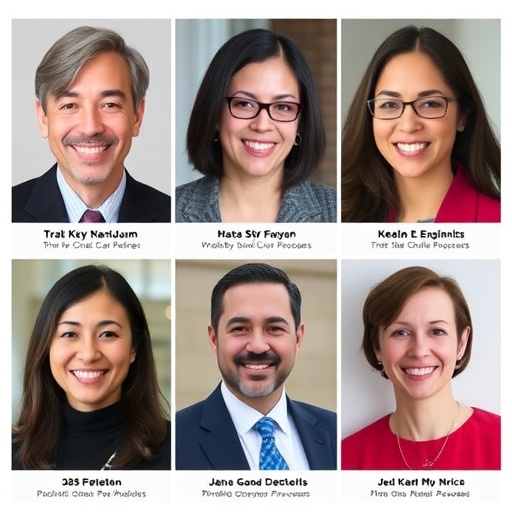
In a remarkable testament to interdisciplinary excellence, five faculty members affiliated with the CUNY Graduate Center have been named Fellows of the American Association for the Advancement of Science (AAAS) for 2025. This prestigious honor celebrates scientists who have made extraordinary contributions across diverse fields, including biology, physics, mathematics, and environmental science. Their selection not only underscores their individual achievements but also highlights the Graduate Center’s role as a powerhouse of pioneering research that pushes the boundaries of human knowledge and addresses global challenges.
Kevin H. Gardner, a distinguished chemist and biologist, stands at the nexus of molecular biology and biomedical innovation. As the founding director of the Structural Biology Initiative at CUNY’s Advanced Science Research Center (ASRC), Gardner’s groundbreaking research has elucidated critical protein mechanisms fundamental to cancer progression. His identification of a vulnerable region in the HIF-2 alpha protein catalyzed the development of belzutifan, a targeted drug that inhibits this protein’s function and offers new therapeutic avenues for treating certain cancers. Furthermore, Gardner’s advancements in optogenetics—a technique that harnesses light to manipulate cellular activities—demonstrate how fundamental biological insights can translate into powerful tools for scientific inquiry and medical therapy.
Specializing in evolutionary biology, David J. Lohman has made significant strides in uncovering the intricate patterns of butterfly evolution and mimicry, particularly within the richly biodiverse ecosystems of Southeast Asia. By integrating comprehensive genomic datasets connecting nearly all known butterfly genera, Lohman has constructed an unprecedented platform for studying speciation dynamics, trait evolution, and biogeographical dispersal. His work not only illuminates the evolutionary processes that drive biodiversity but also provides a framework for understanding how ecological changes impact species adaptation and survival over time.
Vinod Menon’s contributions lie at the forefront of condensed matter physics and nanoscience, where his pioneering demonstration of strong light-matter interactions in two-dimensional (2D) materials has opened new research horizons. These engineered photonic systems allow unprecedented control over quantum properties at an atomic scale, offering transformative potential for developing advanced information processing technologies, ultra-sensitive sensors, and novel optoelectronic devices. Menon’s research merges fundamental physical principles with innovative material science applications, heralding a new era of quantum-enabled technologies with far-reaching implications.
In the realm of pure mathematics, Christina Sormani’s research advances geometric analysis by developing novel methods to understand the deformation and evolution of geometric spaces, an area integral to the mathematical framework of general relativity. Her work spans complex topics including Riemannian geometry, metric space theory, and geometric measure theory, providing critical insights into how space, time, and gravity interact on a fundamental level. Sormani’s commitment extends beyond research excellence; she is a champion for diversity and inclusion, mentoring the next generation of mathematicians, particularly women and underrepresented minorities, thus cultivating broader participation in a historically exclusive field.
Environmental scientist Charles Vörösmarty has emerged as a global thought leader in water security and freshwater resource management. His research integrates climate science, hydrology, ecology, and socioeconomics to address how the interplay of natural and anthropogenic factors shapes the availability and quality of freshwater ecosystems. Vörösmarty’s influential contributions have informed international water policy and sustainable development frameworks, emphasizing the need for integrative strategies that blend engineered infrastructure with nature-based solutions to mitigate water scarcity and safeguard ecosystem health under the pressures of climate change and population growth.
The 2025 cohort of AAAS Fellows chosen from the CUNY Graduate Center embodies the multifaceted nature of contemporary scientific progress, where convergences between theory, experimentation, and application fuel innovation. This recognition offers a unique vantage point on how interdisciplinary research can synergistically advance knowledge and generate solutions to society’s most pressing scientific and environmental issues. The forthcoming Fellows Forum in Washington, D.C., where these scholars will be honored, marks a celebration of their achievements and an opportunity to inspire future scientific endeavors.
Gardner eloquently states that the essence of impactful science lies in bridging fundamental understanding with tangible real-world outcomes. His research highlights the power of structural biology to not only decipher protein mechanisms but also to inspire the development of life-saving therapeutics. Such translational science underscores the critical role academic research plays in shaping the future of medicine and biotechnology.
Lohman’s investigation into butterfly mimicry transcends taxonomy and ecology, tackling foundational evolutionary questions with broad implications. His integrative genomic approaches enable the detection of evolutionary patterns across extensive temporal and spatial scales, providing a dynamic picture of biodiversity’s evolving tapestry. This work is vital for informing conservation strategies and understanding the biological consequences of environmental change.
Menon’s exploration of light-matter coupling in 2D systems represents a significant leap in our capacity to manipulate quantum phenomena. By pioneering the use of engineered photonic media, he has established a platform that not only unravels the fundamental physics of interaction at an atomic level but also lays groundwork for practical devices capable of revolutionizing computation and sensing technologies. The potential applications are transformative, ranging from quantum information science to advanced imaging modalities.
Sormani’s theoretical contributions provide essential mathematical underpinning necessary for decoding the complexities of spacetime geometry. Her innovations facilitate deeper comprehension of how geometric spaces morph under gravitational forces, echoing the profound insights of Einsteinian physics while pushing mathematical boundaries. Her advocacy for accessibility in mathematics equally advances the field by fostering a more diverse and inclusive scientific community.
Vörösmarty’s holistic perspective on water security integrates ecological integrity with human developmental needs, emphasizing the interconnectedness of environmental and societal health. His international collaborations and policy-shaping work emphasize the urgency of sustainable water management amidst growing global stressors. By championing nature-based as well as engineered interventions, Vörösmarty’s research paves the way for resilient water infrastructures that harmonize with ecosystem dynamics.
The distinction of being named an AAAS Fellow is a lifetime honor recognizing sustained excellence and ethical leadership in science. The CUNY Graduate Center’s impressive representation among these Fellows exemplifies its commitment to fostering cutting-edge, socially relevant research. These scholars’ achievements reflect a vibrant intellectual environment that encourages collaboration across disciplines, ultimately advancing science as a tool for societal betterment.
This landmark recognition by the AAAS not only celebrates individual talent but also signals the Graduate Center’s ascending profile as a hub for consequential scholarship. By fostering robust research in fields as varied as molecular biology, evolutionary ecology, quantum physics, pure mathematics, and environmental science, the institution embodies the spirit of innovation vital to addressing 21st-century challenges.
The confluence of these five honorees’ work illustrates the diverse ways in which modern science intersects with global progress. From deciphering life’s molecular machinery to elucidating cosmic geometry, and from enabling next-generation technologies to crafting sustainable environmental solutions, their collective impact reverberates across scientific disciplines and societal boundaries.
Subject of Research: Biomedical advances in cancer therapy, evolutionary biology of butterflies, strong light-matter interaction in 2D materials, geometric analysis in mathematics with applications in general relativity, and global water security and environmental science.
Article Title: Five CUNY Graduate Center Faculty Named 2025 AAAS Fellows for Groundbreaking Contributions Across Science and Mathematics
News Publication Date: March 26, 2026
Web References:
– https://www.gc.cuny.edu/
– https://www.aaas.org/fellows
– https://asrc.gc.cuny.edu/people/kevin-gardner/
– https://www.gc.cuny.edu/people/david-j-lohman
– https://www.gc.cuny.edu/people/vinod-m-menon
– https://www.gc.cuny.edu/people/christina-sormani
– https://asrc.gc.cuny.edu/people/charles-vorosmarty/
Image Credits: Alex Irklievski
Keywords: AAAS Fellows, CUNY Graduate Center, cancer therapy, HIF-2 alpha, butterfly evolution, mimicry, 2D materials, light-matter interaction, geometric analysis, general relativity, water security, environmental science


