

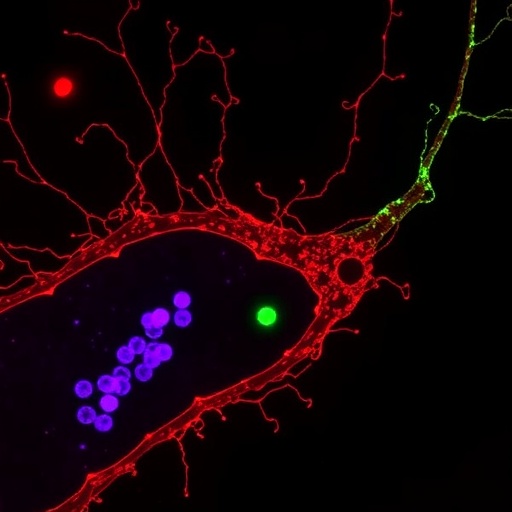
In a groundbreaking study published in Nature (2025), researchers have uncovered a nuanced interplay between ferredoxin-2 (FDX2) and frataxin (FXN) that significantly influences the synthesis of iron-sulfur (Fe–S) clusters, pivotal cofactors essential for myriad cellular processes. These findings not only deepen our understanding of Fe–S cluster biogenesis but also illuminate potential therapeutic angles for treating Friedreich’s ataxia, a devastating neurodegenerative disorder characterized by frataxin deficiency.
Elucidating the delicate cross-regulation between ferredoxin-2 and frataxin, the researchers explored the consequences of modulating their relative expression levels utilizing Drosophila melanogaster as an in vivo model system. Given the high conservation of frataxin across species, the fruit fly presents a versatile platform for studying Friedreich’s ataxia pathophysiology. The Drosophila model employed—termed fh-GAAs—harbors an insertion of 42 GAA trinucleotide repeats in the first intron of the fh gene, which closely mimics the genetic mutation observed in human patients and results in a drastic reduction of frataxin protein.
Intriguingly, the study revealed that fh-GAAs flies, with approximately 90% reduced frataxin expression, exhibited a pronounced upregulation of Fdx1, the Drosophila orthologue of human FDX2. Specifically, transcript levels of Fdx1 surged by 62% at the third instar larval stage and escalated by 80% in adult flies where fh expression was suppressed to a mere 3% of control levels. This upregulation underscores a possible compensatory or pathological response in the context of frataxin deficiency, potentially amplifying the competitive dynamics involved in Fe–S cluster synthesis.
Building on these observations, the researchers embarked on an ambitious endeavor to manipulate Fdx1 expression via RNA interference (RNAi). Rather than complete knockdown, which previously yielded lethality at larval stages, an inducible GeneSwitch system using the RU486 hormone was employed to fine-tune Fdx1 transcript levels. This precise modulation allowed them to assess dose-dependent effects of partial Fdx1 suppression on fly viability and lifespan without disrupting essential developmental processes.
Results from these controlled knockdown experiments were striking. Administering RU486 at concentrations of 2 µg ml^-1 during development and 10 µg ml^-1 during adulthood led to a significant lifespan extension—approximately 31% increase in mean survival—for frataxin-deficient flies. Conversely, higher doses during development did not yield further benefits and diminished lifespan gains, signifying the existence of an optimal Fdx1 expression window required to ameliorate frataxin deficiency effects. These findings collectively suggest a deleterious role of Fdx1 overexpression in the context of frataxin impairment.
Mechanistically, the research team hypothesizes that elevated ferredoxin levels may exacerbate the competitive interference with frataxin in regulating the mobile loop of NFS1, a cysteine desulfurase critical in the initial step of Fe–S cluster assembly. The resultant imbalance impairs efficient Fe–S cluster synthesis, a hallmark of Friedreich’s ataxia pathology. By dampening Fdx1 to an optimal threshold, the restraint on NFS1’s mobile loop appears alleviated, thus rejuvenating cluster biosynthesis even under frataxin-deficient conditions.
The team meticulously validated the specificity of their RNAi approach, excluding off-target effects on Fdx2, the other Drosophila ferredoxin homolog corresponding to human FDX1. This specificity reinforces the conclusion that the observed phenotypic improvements are due to selective modulation of the Fdx1-frataxin axis. Notably, the tightly regulated GeneSwitch system permitted temporal control over gene silencing, allowing researchers to infer that modulation during developmental stages is particularly critical for phenotypic rescue.
Importantly, controls confirmed that the RU486 inducer alone does not influence lifespan in frataxin-deficient flies lacking the RNAi construct, ruling out nonspecific RU486 effects. Moreover, incremental analyses revealed that even sub-threshold decreases in Fdx1 transcript levels could positively impact survival, underscoring the finely balanced nature of this regulatory network and opening avenues for therapeutic dosing strategies.
These compelling results provide a fresh perspective on the molecular underpinnings of Friedreich’s ataxia, highlighting the deleterious consequences of unbalanced ferredoxin-frataxin stoichiometry. They suggest that therapeutic strategies aimed not solely at augmenting frataxin levels but also at correcting associated ferredoxin dysregulation may yield superior outcomes.
From a broader vantage point, this study exemplifies the power of model organisms such as Drosophila in unraveling the complex gene regulatory circuits involved in mitochondrial biogenesis and iron homeostasis. It bridges the gap between molecular insights gleaned in vitro and tangible phenotypic benefits observed in vivo, reinforcing the translational relevance of these findings.
Beyond Friedreich’s ataxia, the refined understanding of Fe–S cluster assembly regulation has implications for other mitochondrial disorders and diseases arising from defective iron-sulfur protein maturation. By expanding the therapeutic toolkit to include modulation of ferredoxin levels, future efforts may harness this cross-regulatory pathway to ameliorate a spectrum of metabolic and neurodegenerative diseases.
Ultimately, this research underscores a novel paradigm in mitochondrial biology: that the intricacies of protein-protein interactions and competitive binding within biosynthetic complexes can profoundly influence disease outcome. The finely tuned balance between ferredoxin-2 and frataxin emerges as a crucial determinant of mitochondrial health and organismal survival, warranting further exploration into targeted modulation strategies.
In conclusion, the study not only advances our understanding of fundamental mitochondrial genetics but also opens promising therapeutic avenues by demonstrating that partial reduction of ferredoxin-2 in a frataxin-deficient organism can markedly extend lifespan. This sophisticated cross-regulation of [2Fe–2S] cluster synthesis reveals potential targets to mitigate the progression of Friedreich’s ataxia and related diseases, potentially transforming patient care paradigms.
Subject of Research:
Cross-regulation of iron-sulfur cluster synthesis involving the interplay between ferredoxin-2 and frataxin proteins.
Article Title:
Cross-regulation of [2Fe–2S] cluster synthesis by ferredoxin-2 and frataxin.
Article References:
Want, K., Gorny, H., Turki, E. et al. Cross-regulation of [2Fe–2S] cluster synthesis by ferredoxin-2 and frataxin. Nature (2025). https://doi.org/10.1038/s41586-025-09822-1
Image Credits:
AI Generated
DOI:
https://doi.org/10.1038/s41586-025-09822-1
Keywords:
Ferredoxin-2, frataxin, iron-sulfur clusters, Friedreich’s ataxia, mitochondrial biogenesis, Drosophila melanogaster, RNA interference, gene regulation.


