

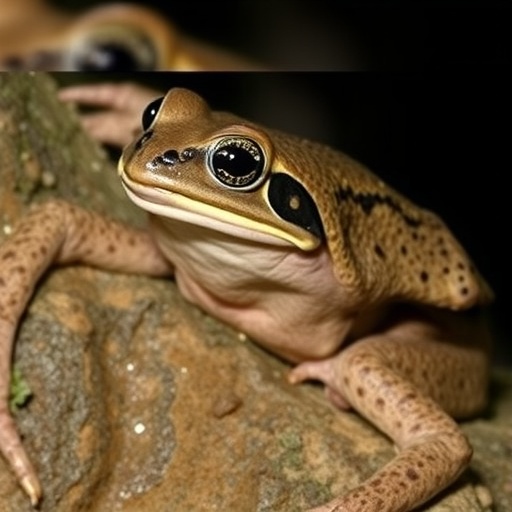
In the dense mountain rainforests of Malaysian Borneo, a remarkable scientific breakthrough challenges long-held perceptions about biodiversity and species discovery. Traditionally, discovering a new species conjures images of an intrepid explorer navigating uncharted territories. However, recent advances in genetic analysis reveal a more complex and less cinematic truth. Chan Kin Onn, a herpetologist at Michigan State University, explains that the majority of new vertebrate species identifications are not the result of physical expeditions into wilderness but emerge from sophisticated reevaluations of known populations using cutting-edge genomic tools.
The subject of this transformative research is a peculiar group of amphibians known as Bornean fanged frogs, named for the distinctive tooth-like projections on their jaws. Among these, the species Limnonectes kuhlii was first described in 1838, yet what was once classified as a single species is now understood to potentially encompass as many as 18 genetically distinct lineages. Such revelations highlight the phenomenon of cryptic species—organisms that appear morphologically similar but are genetically divergent. Chan’s work underscores the critical role of genomics in unveiling biodiversity that remains hidden beneath superficial resemblance.
By extracting DNA from specimens collected across varied locations within Borneo’s mountainous rainforests, Chan and his colleagues performed comprehensive genomic analyses spanning over 13,000 genes across the frog genomes. Published in the prestigious journal Systematic Biology, their findings paint a nuanced picture; rather than confirming 18 distinct species, the data suggest there are approximately six or seven genetically differentiated clusters that merit species status. This discovery challenges simplistic taxonomic categorizations and introduces the concept of a speciation continuum or “gray zone” where species boundaries blur due to ongoing evolutionary processes.
The implications of recognizing or ignoring cryptic species extend far beyond academic categorization. Amphibians globally are experiencing precipitous declines, with a recent study of 8,000 species revealing that nearly 40% face extinction threats. This troubling reality elevates the importance of precise species identification, as conservation strategies hinge on understanding true species diversity and distribution. If species elude discovery, they risk vanishing unnoticed, disappearing before their ecological significance can be fully appreciated or preserved.
However, there is a conservation paradox at play. Over-splitting species based on genetic markers may misleadingly narrow perceived geographic ranges and inflate extinction risk assessments. Such misclassifications could divert precious conservation resources away from genuinely imperiled species or habitats. As Chan cautions, conservation prioritization demands careful taxonomic scrutiny to avoid bolstering the number of named species in ways that may not reflect biological reality or conservation necessity.
A salient factor complicating species delineation is the extensive gene flow detected among the Bornean fanged frog populations. The interbreeding between lineages contributes to fuzzy genetic boundaries, underscoring that speciation is not an instantaneous event but a prolonged phase where populations gradually diverge genetically and ecologically. This complex evolutionary dance challenges the conventional Linnaean approach to species as discrete units and invites a reevaluation of species concepts in light of genomic evidence.
The phenomenon observed in Bornean frogs is not isolated. Across animal taxa—from insects and fish to birds and mammals—genetic research is unveiling a staggering prevalence of cryptic species. Estimations of biodiversity once constrained to about 8.7 million species on Earth now face reassessment, with some models proposing that actual species numbers may be multiples or even hundreds of times higher. This revelation prompts a reevaluation not only of biodiversity estimates but of our understanding of evolutionary and ecological processes shaping life on Earth.
Crucially, this study illuminates the challenges of navigating the “gray zone” of speciation, where evolutionary divergence is incomplete and genetic distinctions are subtle. The research highlights how both biological realities and methodological choices affect species designation. As genomic technologies progress, scientists must adopt nuanced criteria that integrate genetic data, ecological context, and reproductive isolation to more accurately reflect the dynamic nature of species formation.
The insights derived from the Bornean fanged frog investigation emphasize the importance of integrating molecular genetics with classical taxonomy in conservation biology. Identifying cryptic species through comprehensive genomic studies can refine conservation priorities and strategies, ensuring that resources are targeted where they are most needed. At the same time, the research reveals potential pitfalls inherent in taxonomic inflation and the need for a balanced approach that recognizes evolutionary continuums.
This groundbreaking work draws on substantial support from grants awarded by the U.S. National Science Foundation, reflecting the significance and urgency of understanding biodiversity in the age of global environmental changes. As amphibian populations worldwide continue to decline at alarming rates, precision in species identification will be indispensable for crafting effective conservation responses.
Ultimately, the revelations surrounding Bornean fanged frogs are a testament to the transformative power of genomic science. They underscore that species discovery today is increasingly an endeavor conducted within laboratories and through data analysis rather than solely in the field. This paradigm shift not only enhances our comprehension of biodiversity but also redefines how biologists and conservationists confront the complex realities of species evolution and survival.
Subject of Research: Animals
Article Title: A Genomic Perspective on Cryptic Species Reveals Complex Evolutionary Dynamics in the Gray Zone of the Speciation Continuum
News Publication Date: 14-Jan-2026
Web References: https://academic.oup.com/sysbio/advance-article/doi/10.1093/sysbio/syag001/8425371
References: Chan, K.O., Neokleous, D.N., Anuar, S., Brown, R.M., Hutter, C.R., Das, I., Hertwig, S.T. (2026). A Genomic Perspective on Cryptic Species Reveals Complex Evolutionary Dynamics in the Gray Zone of the Speciation Continuum. Systematic Biology. DOI: 10.1093/sysbio/syag001
Image Credits: Chan Kin Onn, Michigan State University
Keywords: Biodiversity conservation, Conservation biology, Biodiversity loss, Species diversity, Species richness, Species


