

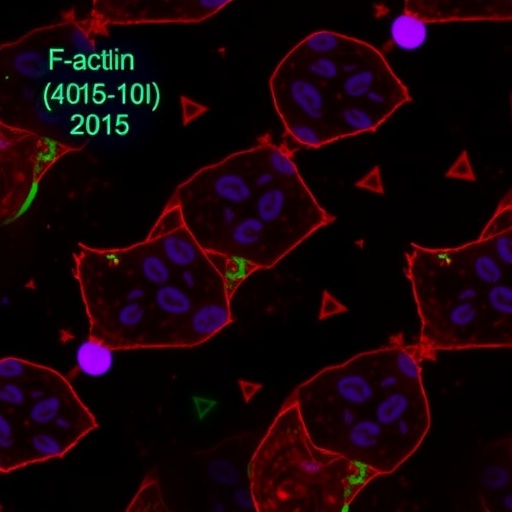
In a groundbreaking advancement at the intersection of cytoskeletal biology and regenerative medicine, researchers have unveiled a novel mechanism that significantly accelerates the differentiation of pluripotent stem cells into pancreatic islet cells by targeting the dynamics of the actin cytoskeleton. The study, conducted by Hogrebe, Schmidt, Augsornworawat, and colleagues and recently published in Nature Communications, reveals that the deliberate depolymerization of filamentous actin (F-actin) enhances the exit from pluripotency, optimizing the efficiency of stem cell-derived islet differentiation. This finding not only deepens our understanding of stem cell biology but also paves the way for improved therapeutic strategies for diabetes.
Central to this discovery is the modulation of the cytoskeletal F-actin network, a dynamic polymer composed of actin monomers that orchestrates critical cellular processes including morphology, migration, and intracellular signaling. While previous studies have established the role of cytoskeletal remodeling in cell differentiation, the precise influence of actin filament turnover on pluripotency and lineage commitment remained ambiguous until now. By employing methods to depolymerize F-actin selectively, the researchers demonstrated a marked acceleration in pluripotent stem cell exit, triggering a more rapid and efficient transition toward pancreatic endocrine lineage adoption.
Pluripotent stem cells possess the remarkable ability to differentiate into any cell type, maintaining a fine balance between self-renewal and lineage specification. The decision to exit pluripotency—a state characterized by gene expression networks supporting self-renewal—and commit to a terminally differentiated fate involves an intricate interplay of signaling cascades and epigenetic modifications. The cytoskeleton, particularly actin filaments, has been hypothesized to play a signaling role beyond mere structural support, yet direct causal mechanisms linking F-actin dynamics to pluripotent state modulation were elusive. This research elegantly bridges that knowledge gap through a series of rigorous experiments.
The investigators began by manipulating actin filament stability pharmacologically, utilizing agents known to disrupt F-actin polymerization such as latrunculin B. This intervention resulted in the dismantling of the filamentous network, effectively increasing the pool of globular (G-actin) monomers within the cell. Intriguingly, this shift was correlated with a downregulation of core pluripotency markers including OCT4, SOX2, and NANOG, suggesting that the physical state of the cytoskeleton can feedback onto transcriptional programs dictating cell fate.
Delving deeper, the team elucidated that the depolymerization of F-actin induced changes in mechanotransduction pathways that are intimately linked to nuclear architecture and gene expression. The cytoskeleton connects to the nucleoskeleton via the LINC (Linker of Nucleoskeleton and Cytoskeleton) complex, facilitating mechanical signal transduction. Disruption of actin filaments altered nuclear tension and consequently favored chromatin remodeling conducive to differentiation. This mechanobiological perspective brings a fresh lens to understanding how physical forces and cytoskeletal integrity govern epigenetic landscapes during stem cell differentiation.
The accelerated exit from pluripotency achieved by F-actin depolymerization had profound implications for pancreatic islet differentiation, a process vital for cell replacement therapies in type 1 diabetes. Pancreatic islets, particularly insulin-producing β-cells, are notoriously challenging to generate efficiently in vitro. By shortening the pluripotency phase and synchronizing differentiation cues, the team significantly enhanced the yield and functional maturity of stem cell-derived islet-like clusters. Electrophysiological assays and insulin secretion tests confirmed that these cells more closely mimicked native islets than previously derived equivalents.
Importantly, the manipulation of F-actin was transient and reversible, allowing cells to proceed through standard differentiation protocols without permanent cytoskeletal compromise. This temporal control is critical to ensure that the cells maintain viability and functional competence after the initial acceleration phase. In this regard, the study underscores a delicate balance between cytoskeletal remodeling and cellular health, advocating for precise modulation strategies rather than wholesale disruption.
Beyond the immediate impact on pancreatic lineage differentiation, these findings suggest broader applicability across diverse stem cell differentiation paradigms. Since cytoskeletal dynamics contribute globally to mechanosensing and regulatory signaling, similar strategies could potentially enhance directed differentiation toward other therapeutically relevant cell types such as neurons, cardiomyocytes, or hepatocytes. This cross-lineage potential sets the stage for a paradigm shift in regenerative medicine protocols.
Moreover, the study opens avenues for the development of small molecule modulators targeting actin dynamics as adjunctive tools to traditional growth factors and genetic engineering techniques. Such molecules could serve as fine tuning agents that prime stem cells for differentiation, reducing the time and cost associated with cell therapy manufacturing. This could accelerate clinical translation and improve the scalability of autologous and allogeneic stem cell products.
At a fundamental biology level, the work challenges the traditional view of the cytoskeleton as a passive scaffold and highlights its active role as a regulatory hub interfacing cellular mechanics with transcriptional regulation. This insight encourages further exploration into cytoskeletal-associated proteins and their post-translational modifications as additional levers to control stem cell behavior.
The study’s rigorous experimental design incorporated single-cell RNA sequencing, confocal microscopy, and functional assays, ensuring that observed phenomena were robust and reproducible across different cell lines and differentiation stages. Such comprehensive validation is essential to overcome the inherent variability in pluripotent stem cell cultures and underscores the translational potential of the findings.
Concluding their work, Hogrebe and colleagues emphasize the importance of integrating biomechanical cues with biochemical signals to refine stem cell differentiation protocols. Their discovery that targeted depolymerization of F-actin facilitates a more efficient and synchronized exit from pluripotency offers a blueprint for future innovations in tissue engineering and regenerative therapies, especially in the quest to develop reliable sources of insulin-producing cells for diabetic patients.
As this novel approach gains traction, it may inspire a reevaluation of existing differentiation paradigms across the scientific community. The ability to modulate the cytoskeleton as a means to dictate stem cell fate transitions heralds a promising frontier, where the physical state of the cell becomes as manipulable and informative as its genetic and epigenetic composition.
In essence, this study not only advances our comprehension of the cytoskeletal role in stem cell biology but also translates this basic science insight into a practical framework to enhance regenerative medicine outcomes. The future of diabetes treatment, and indeed of many other degenerative conditions, may be significantly shaped by this fundamental revelation at the crossroads of cell mechanics and differentiation.
Subject of Research: Stem cell biology and regenerative medicine focusing on cytoskeletal dynamics and pancreatic islet differentiation
Article Title: Depolymerizing F-actin accelerates the exit from pluripotency to enhance stem cell-derived islet differentiation
Article References:
Hogrebe, N.J., Schmidt, M.D., Augsornworawat, P. et al. Depolymerizing F-actin accelerates the exit from pluripotency to enhance stem cell-derived islet differentiation. Nat Commun (2026). https://doi.org/10.1038/s41467-026-71324-z
Image Credits: AI Generated


