

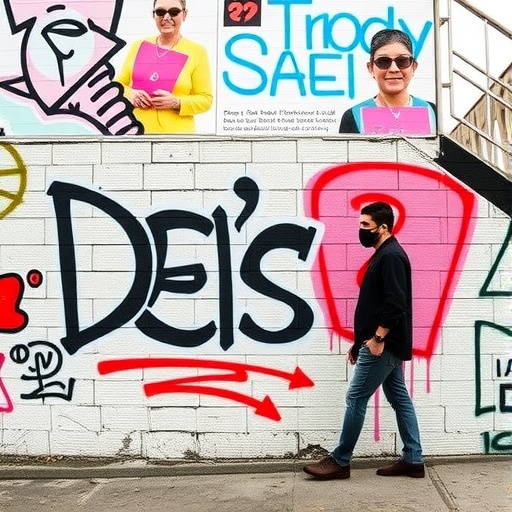
In the contemporary discourse surrounding public art and urban expression, graffiti is frequently relegated to the realm of illicit vandalism, dismissed amid charges of destruction or simple dirtiness. However, groundbreaking research from the Filipino Department at Ateneo de Manila University challenges these reductive views by framing graffiti as a poignant form of literature—an expressive outcry emerging from profound inequalities in access to space and public speech. By venturing beyond legalistic denunciations, this research unveils graffiti and latrinalia—known in Filipino as banyulatin—as vital testimonials reflecting socio-political tensions and marginalized voices seeking visibility in urban landscapes.
Public spaces conventionally considered neutral grounds for civic interaction are, in reality, fraught with complex layers of socio-political negotiation. Power dynamics inherent to these spaces dictate whose narratives are amplified and whose dissenting voices are relegated to obscurity. The marginal corners of bathrooms and neglected walls become, paradoxically, sanctuaries for suppressed speech. In these liminal zones where governmental and institutional oversight is diminished, graffiti thrives as an alternative narrative mechanism, functioning both as a site of resistance and a repository of collective consciousness.
Harvey James G. Castillo, a dedicated faculty researcher, rigorously examines these marginalized voices embedded in walls and stalls, asserting that graffiti and banyulatin transcend mere acts of defacement. Rather, they embody intentional, articulate endeavors to reclaim unheard stories in environments where dominant powers suppress open dialogue. Castillo’s methodological observational approach pays close attention to the semiotic layers within these inscriptions, revealing graffiti’s complex role at the intersection of repression and expression. Here, literature is implicated not merely as a domain of aesthetic concern but as a potent field of socio-political engagement.
The research delineates how spatial struggle underpins the creation and meaning of graffiti, underscoring the inherent risks borne by those who mark these contested surfaces. Emotions manifesting as anger, humor, political critique, and despair animate these physical texts, effectively filling the void left by traditional public forums that are ill-equipped—or unwilling—to accommodate dissenting voices. Through these illicit inscriptions, public walls morph into performative stages, spotlighting narratives often excluded from dominant discourses privileging progress and civility, thereby disrupting hegemonic state-cleared spaces.
A significant revelation from Castillo’s study lies in the nuanced politics governing spatial legitimacy: some spaces are conditionally sanctioned by the state only upon strict narrative control, while others are criminalized outright. This bifurcation creates a layered front-and-back spatial dynamic where elite names and sanctioned histories dominate visible public forums, while informal writings by marginalized populations recede into obscurity. Bathrooms—frequently overlooked in spatial analysis—emerge as crucial semi-private arenas where anonymity and looser authority structures permit freer expression, transforming banyulatin into a living archive of collective social anxieties and intermittent conversations.
Legal frameworks typically address graffiti with punitive measures aimed at eradication, a strategy analyzed critically in this research. Castillo turns instead to Philippine literature as a liberating lens, situating graffiti within historical trajectories marked by dictatorship, class conflict, and pervasive surveillance. Through this literary contextualization, graffiti transcends its criminalized label, attaining interpretive status as testimonial evidence. This reframing critiques simplistic legal treatments and argues for appreciation of graffiti’s enduring voice, which resonates long after physical surfaces are repainted and sanitized.
The methodology emphasizes close observational scrutiny of graffiti as a text, analyzing linguistic patterns, symbolic motifs, and contextual references to decode layers of meaning. This approach reveals that graffiti functions simultaneously as spontaneous discourse and embedded social critique. Its persistence underscores an ongoing struggle for recognition and inclusion, highlighting how urban surfaces become stages for silent contests over memory and identity. The research’s cross-disciplinary nature—merging literary studies, sociolinguistics, and spatial politics—broadens understanding of public expression beyond conventional categorizations.
Furthermore, the study highlights the transformative capacity of graffiti to convey hope and defiance in the face of erasure. Walls, often perceived as static, become dynamic archives, encapsulating dialogic encounters that resist hegemonic silencing. The research delineates graffiti as a medium that straddles the material and semiotic worlds: simultaneously a physical inscription and a symbolic act that challenges dominant narratives. Through this duality, graffiti reveals the enduring tensions between survival, resistance, and the quest for belonging in urban environments.
In the context of digital age suppression and regulated public discourse, graffiti asserts itself as a vital intervention—a counter-narrative channel enabling marginalized groups to assert presence and agency. Castillo’s work unpacks the spatial politics of voice, illustrating how the city’s architecture mediates conflict and habitation. The visibility and invisibility of inscriptions mirror societal hierarchies, emphasizing that control over space equates to control over narrative. This insight calls for reconsideration of urban governance and rehabilitation policies that too often erase contestatory expressions under the guise of order and cleanliness.
Engaging directly with Philippine literature allows the research to capture the fluid interplay between written texts and physical inscriptions. This synergy highlights how literary works not only represent but also vindicate the experiences expressed through graffiti. By embedding these writings within localized socio-historical frameworks, the research fosters deeper appreciation for vernacular voices, linking ephemeral urban expressions to broader cultural and political currents. Such literary roots enrich understanding of graffiti’s function as a form of embodied resistance embedded in communal memory.
The study challenges policymakers and cultural institutions to rethink normative approaches to graffiti, advocating for a paradigm shift from criminalization toward contextualization. Recognizing graffiti as living literature demands preservation strategies that honor the political and cultural significance of these inscriptions rather than merely removing perceived blight. This reframing has implications for urban planning, legal frameworks, and artistic expressions, expanding possibilities for inclusive public dialogue and democratic participation.
Ultimately, this research affirms that graffiti should not be relegated to noise or mere visual pollution. Instead, it is a powerful form of social commentary and testimony deserving rigorous exploration within humanities scholarship. By validating the voices etched in neglected urban spaces, Castillo’s work enriches contemporary conversations on freedom of expression, spatial justice, and cultural memory. In doing so, it positions graffiti as a necessary and transformative element in ongoing struggles for voice and belonging in Philippine society and beyond.
Subject of Research: Graffiti, vandalism, and latrinalia (banyulatin) in Philippine literature as expressions of marginalized voices and spatial politics.
Article Title: Tinig-Karakter sa mga Pader: Graffiti, Bandalismo, at mga Banyulatin sa Piling Panitikang Filipino (Character-Voices on Walls: Graffiti, Vandalism, and Latrinalia in Select Philippine Literature)
News Publication Date: December 2025
References:
Castillo, Harvey James G. “Tinig-Karakter sa mga Pader: Graffiti, Bandalismo, at mga Banyulatin sa Piling Panitikang Filipino.” Humanities Diliman: A Journal on Philippine Humanities, December 2025.
Keywords:
Graffiti, Vandalism, Banyulatin, Philippine Literature, Public Space, Spatial Politics, Freedom of Expression, Marginalized Voices, Urban Studies, Cultural Memory, Latrinalia, Social Resistance


