

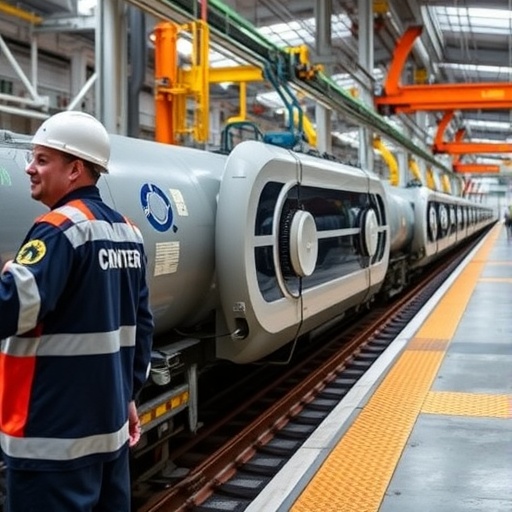
In a groundbreaking study published in 2025, researchers Wu, Zhang, and Sun et al. delved into the intricate dynamics of vibration responses prevalent in comprehensive transportation hubs subjected to multiple-source excitations. These transportation hubs are essential arteries in modern urban settings, facilitating the movement of people and goods. However, they also represent areas where mechanical innovations must coincide with safety protocols and design principles. This pioneering research creates a significant framework for understanding how to manage and mitigate vibrations amidst the hustle and bustle of urban transport systems.
The vibration response within such hubs can stem from numerous sources, including vehicular traffic, seismic activities, and operational machinery. Each of these factors contributes uniquely to the overall vibrational environment, creating challenges for urban planners and engineers who seek to ensure structural integrity and passenger comfort. The researchers focused on measuring these vibrations accurately and formulating an effective vibration attenuation model that takes into consideration the complex interactions of these multiple excitations.
Through their comprehensive study, which involved extensive field testing and theoretical simulations, the team developed a model that highlights how various sources of vibration impact transportation hub structures. The research outlined specific parameters, such as frequency ranges, amplitude, and duration of vibration, that are critical for engineers to address when designing resilient transportation infrastructures. Engineers must weigh the implications of their designs against these parameters to achieve a balance between functionality and durability, especially in earthquake-prone regions.
Crucially, Wu and co-authors conducted a series of laboratory and field experiments that subjected prototype models of transportation hubs to simulated multi-source excitations. By capturing real-time data, they were able to advance an innovative framework that accurately depicts the complex vibrational responses of various materials and structures. This critical work serves as a pivotal contribution to the field of earthquake engineering and vibration dynamics, especially as cities continue to expand and evolve.
One of the study’s most striking findings indicates the significance of material selection and architectural design on vibration attenuation characteristics. The researchers revealed that certain material combinations could drastically enhance a hub’s resistance to vibration, paving the way for new construction methodologies that emphasize sustainable and robust building materials. This aspect emphasizes the convergence of material science with civil engineering in developing buildings that can withstand both regular use and unforeseen seismic activities.
Further, the research highlighted how transportation hubs can be retrofitted using select materials and design strategies to improve their vibrational performance without radically altering their architectural aesthetics. This is particularly important for historical or landmark structures where the visual heritage might clash with modern engineering solutions. By utilizing innovative vibration-damping technologies, older hubs can attain higher standards of safety and functionality, proving that engineering advancements need not come at the expense of history.
The implications of this work extend beyond just buildings; the resonating effects of vibrations can influence various aspects of urban living, including public health and environmental concerns. Prolonged exposure to vibrations can lead to discomfort for passengers and can potentially impair the integrity of sensitive equipment housed within transportation centers. Thus, the researchers’ findings are timely and crucial as cities continue to integrate more complex systems that demand careful consideration of not only architectural design but also human factors.
Policy-makers and urban planners can glean valuable insights from this research to inform future designs and renovations of transportation hubs. The study presents a compelling argument for the need to prioritize resilience in the design process, recognizing that the vibrational impacts must be mandatorily addressed in building codes and regulations moving forward. As new technologies emerge, this research could catalyze the adoption of advanced vibration mitigation measures, aligning with broader sustainability goals.
Moreover, Wu and colleagues stressed the importance of cross-disciplinary collaborations, weaving together expertise from fields such as civil engineering, material science, and urban planning. This integrated approach ensures that various perspectives are incorporated into the development of better urban infrastructures. Collaborative efforts are vital for creating solutions that are not only technically sound but also socially responsible, as urban areas must cater to the well-being of their inhabitants.
Any ambitious engineering venture in contemporary urban environments must contemplate the multifaceted nature of vibration responses and attenuation models presented in this study. The findings offer a robust foundation for future academic discourses and professional practices aimed at addressing the critical problems posed by urban vibrational dynamics. As metropolitan areas evolve, incorporating these insights will be crucial in ensuring that the infrastructure can handle the severe demands of modern transportation while maintaining the safety and comfort of the public.
As more researchers embark on similar quests to understand dynamic responses within architectural infrastructures, it is anticipated that a wealth of knowledge will be produced, contributing to the universal goal of creating safer and more efficient urban spaces. The discourse surrounding vibration response and attenuation is expected to grow, leading to new innovations and methodologies that can better meet the challenges faced by 21st-century cities.
In summary, the study conducted by Wu, Zhang, and Sun et al. marks a significant advancement in the field of earthquake engineering and vibration dynamics. Their systematic approach unveils critical aspects of transportation hub design and operation under multi-source excitations, providing a framework that could redefine future construction practices. As urban populations continue to swell, the significance of understanding and mitigating vibrational impacts will undoubtedly grow in importance.
The findings of this research will empower engineers, architects, and urban planners, equipping them with the necessary tools and knowledge to enhance the resilience of vital transportation hubs. Through careful design and innovative methodologies, it is possible to innovate urban infrastructures that can withstand the challenges of an ever-evolving urban landscape, ultimately leading to enhanced safety and quality of life for all citizens.
By advancing our understanding of how multiple-source excitations affect transportation systems, Wu and colleagues have opened new avenues for research, enabling more robust designs and fostering a culture of safety that is crucial for urban development. The study signifies that with creative solutions and multidisciplinary approaches, we can engineer urban environments that thrive amidst challenges, ensuring a safer future for generations to come.
Subject of Research: Vibration response and vibration attenuation model of comprehensive transportation hubs under multiple-source excitations
Article Title: Research on vibration response and vibration attenuation model of comprehensive transportation hub under multiple-source excitations
Article References:
Wu, Q., Zhang, Q., Sun, J. et al. Research on vibration response and vibration attenuation model of comprehensive transportation hub under multiple-source excitations. Earthq. Eng. Eng. Vib. 24, 527–545 (2025). https://doi.org/10.1007/s11803-025-2320-x
Image Credits: AI Generated
DOI:
Keywords: Vibration response, transportation hubs, earthquake engineering, urban planning, multi-source excitations, vibration attenuation, structural integrity.


