

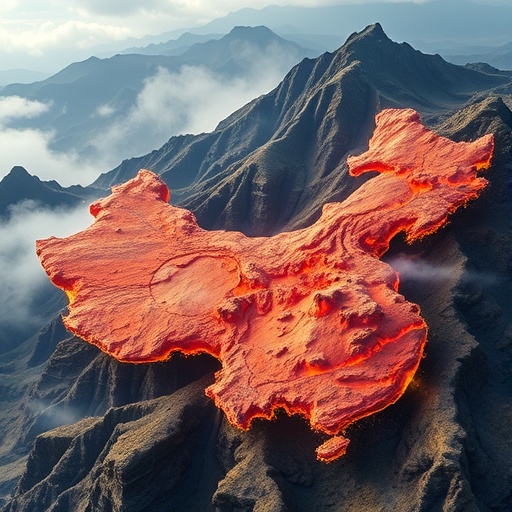
In a groundbreaking study published in Commun Earth Environ, researchers Han, Qian, Yin, and their colleagues delve deep into the enigmatic evolution of the North China Craton during the pivotal geological eras of the Neoarchean to Paleoproterozoic. This research illuminates critical aspects concerning the thermal state and the tectonic dynamics that have shaped one of Earth’s most complex geological features. The significance of this study lies not only in its geological implications but also in its potential to reshape our understanding of continental formation processes and plate tectonics.
The North China Craton, which stands as a testament to Earth’s ancient geological history, has for long been an area of intrigue for geologists and Earth scientists alike. Understanding the thermal history and tectonic framework of the Craton includes investigating the conditions under which it formed and evolved. The study proposes that this cratonic region underwent significant thermal variations, which in turn influenced its tectonic activities. Such insights unveil the intricate relationship between thermal dynamics and plate movements during formative geological periods.
At its core, the craton’s evolution can be ascribed to the interactions of various geological processes including mantle convection, crustal thinning, and plate tectonics. The authors emphasize that the thermal state of the North China Craton is not static; rather, it has undergone diverse phases of heating and cooling which correlate with global tectonic events. Detailed geophysical models reveal that these thermal changes played a central role in shaping the region’s lithospheric properties and its subsequent geological evolution.
An intriguing aspect discussed within this study is the interplay between thermal states and the lithospheric mantle’s composition. The research posits that variations in thermal gradients influence the weakness and strength of the lithosphere, thereby impacting tectonic activity. These insights are instrumental in illustrating how localized thermal states can lead to regional tectonic responses, such as uplift or subsidence. Given that cratonic regions are often viewed as stable, these new revelations challenge preconceived notions and instigate a re-evaluation of the stability of cratons in general.
Further examinations within the study assess the mechanisms underlying the craton’s thermal evolution throughout the Neoarchean to Paleoproterozoic. Data derived from geochronological investigations and isotopic analyses suggest that periods of intense magmatism, driven by subduction processes, significantly contributed to the heating of the crust. This led to a reorganization of the crustal architecture and facilitated the establishment of plate boundaries, altering the tectonic landscape of the region.
The findings also underscore the impact of mantle plumes on the thermal state of the craton. The authors argue that the ascent of hot mantle material has the potential to radically alter surface tectonics. This perspective aligns with the concept of mantle dynamics influencing surface processes, which has gained traction in recent geological studies. By reconstructing the thermal history, the authors provide an explanation for various geological features observed in the North China Craton today, including the distribution of ore deposits and mineralization.
Moreover, the research delves into the methods employed to acquire a comprehensive understanding of the thermal state of the craton. Integrating seismic data, thermal modeling, and geological mapping, the authors present a multidisciplinary approach to deciphering the complexities of the region. This convergence of techniques highlights the necessity of employing modern technological advancements to enhance geological assessments.
As the study unfolds, it also takes into account the wider implications of understanding cratonic evolution. The North China Craton serves as a window into planetary processes that could reflect similar dynamics on other celestial bodies. The principles derived from this research could pave the way for comparative studies with other ancient cratons or even extrapolate insights regarding exoplanetary geology. Hence, the implications of this work transcend Earth, beckoning for interplanetary geological considerations.
In light of their findings, the researchers advocate for further exploration and monitoring of the North China Craton. They implore the scientific community to prioritize investigations that could elucidate the intricate history of such cratonic regions. A greater understanding of their thermal and tectonic histories not only enriches geological knowledge but could also enhance predictive models related to natural hazards associated with tectonic movements.
This comprehensive analysis reinforces the importance of interdisciplinary collaboration in unraveling the complexities of Earth’s geological history. It calls upon geologists, geophysicists, and climatologists alike to draw connections between disciplines, suggesting that the evolution of cratons cannot be viewed in isolation but must be contextualized within the broader geological framework of Earth’s history.
In conclusion, the recent research into the thermal state and tectonics of the North China Craton during the Neoarchean to Paleoproterozoic is a pivotal stepping stone in Earth sciences. It not only provides a detailed account of the geological processes that have shaped this cratonic region but also encourages ongoing discourse and investigation into ancient continental dynamics. Thus, this study not only redefines the geological narratives of the North China Craton but also paves the way for future explorations, potentially unraveling more enigmas buried deep within Earth’s crust.
Subject of Research: The thermal state and plate tectonics in the North China Craton during the Neoarchean–Paleoproterozoic.
Article Title: Development of thermal state and plate tectonics in the North China Craton during Neoarchean–Paleoproterozoic.
Article References:
Han, X., Qian, J., Yin, C. et al. Development of thermal state and plate tectonics in the North China Craton during Neoarchean–Paleoproterozoic. Commun Earth Environ (2025). https://doi.org/10.1038/s43247-025-03131-1
Image Credits: AI Generated
DOI: 10.1038/s43247-025-03131-1
Keywords: North China Craton, thermal history, tectonics, Neoarchean, Paleoproterozoic, mantle dynamics, geological evolution, craton stability, plate boundaries, interdisciplinary research.


