

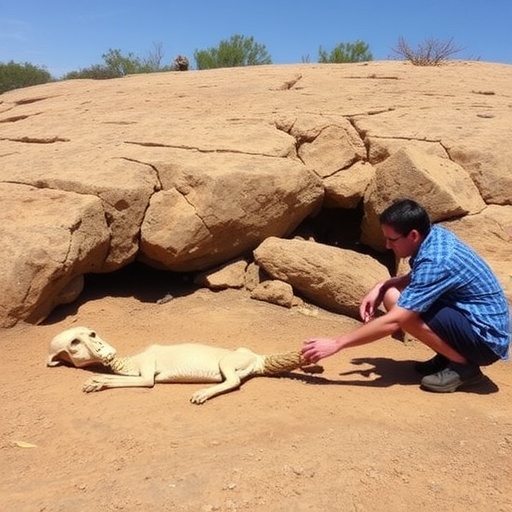
In the heart of the Limpopo Valley in South Africa, a remarkable discovery has emerged from the site known as Ratho Kroonkop. This site has been the focus of intense archaeological scrutiny, particularly due to its unique rain-controlled environment, which has distinctly influenced the preservation and taphonomic patterns of the artifacts found there. The research conducted by Croll, Reynard, Badenhorst, and their team offers groundbreaking insights into the interactions between climatic conditions and the archaeological record, revealing a complex narrative of human activity and environmental change over millennia.
Taphonomy, which examines how organisms decay and become fossilized, plays an essential role in understanding archaeological contexts. At Ratho Kroonkop, the preservation conditions are unlike anywhere else, largely due to the site’s unique hydrological characteristics. These conditions facilitate the retention of organic materials that are often lost in more arid or disturbed environments, thereby offering an exceptionally rich tapestry for researchers to analyze. By investigating the physical and chemical factors influencing taphonomic processes here, the study elucidates how these dynamics can inform our understanding of past human behaviors and environmental interactions.
As researchers delved into the sediment deposits at Ratho Kroonkop, they encountered a stratigraphic record that speaks volumes about climatic fluctuations over time. Each layer of sediment unveils a period of the site’s history, illustrating how rainfall patterns have varied dramatically and how these changes impacted the resources available to prehistoric communities. This stratification underscores the pivotal role that environmental changes play in shaping human settlement patterns, subsistence strategies, and ultimately, cultural development in the region.
Moreover, the interdisciplinary approach undertaken by the research team highlights the value of integrating paleoclimatology with archaeology. By correlating environmental data with archaeological findings, the researchers have begun to construct a comprehensive picture of life at Ratho Kroonkop. They have tapped into geological, botanical, and faunal analyses, revealing how ancient peoples adapted to their shifting surroundings. This collaboration across disciplines paves the way for future archaeological investigations, emphasizing the interconnectedness of humans and their environments throughout history.
The findings from Ratho Kroonkop also contribute significantly to our understanding of cultural resilience amidst climatic change. The artifacts uncovered at the site, ranging from tools to remnants of possibly ritualistic activities, indicate that ancient communities demonstrated remarkable adaptability. The study argues that such resilience is a testament to human innovation and resourcefulness in the face of environmental challenges, providing valuable lessons for contemporary societies grappling with climate-related issues today.
Another critical element of this research is the ecological context. The team analyzed fossilized flora and fauna remains to reconstruct past ecosystems and their dynamics. This ecological reconstruction helps illuminate the relationships between human populations and the natural environment, revealing how landscapes were manipulated and managed. It suggests that humans were not merely passive recipients of environmental changes but rather active agents who modified their habitats to optimize their livelihoods.
As the research progresses, the implications of these findings extend beyond academic curiosity. Understanding taphonomic patterns and human adaptability in response to environmental changes at Ratho Kroonkop can inform modern conservation strategies. They might provide insights into sustainable practices rooted in historical contexts, thereby enriching contemporary discourse on environmental management and preservation.
In conclusion, the research conducted at Ratho Kroonkop stands as a pivotal contribution to both archaeological scholarship and our understanding of human history. The intricate interplay between climatic conditions and human activity revealed through this study showcases the profound influence of the environment on societal development. This research not only enriches our historical narrative but also fosters a deeper appreciation for the complexity and resilience of human cultures in the face of ongoing climatic shifts.
Through the lens of Ratho Kroonkop, we explore a microcosm of human experience amid oscillating environmental conditions—an experience that resonates powerfully in our present-day dialogue on climate change and its manifold impacts on societies globally. As archaeologists continue to decode the stories written in the soil of Ratho Kroonkop, they also open doors to a broader understanding of the past that is intrinsically linked to our future.
By acknowledging the lessons embedded within ancient taphonomic records, we gain insights that transcend time, urging us to reconsider our relationship with the environment and the legacy we leave for generations to come. This research serves as a clarion call to both the scientific community and the public to engage with our planet’s past, as we collectively navigate the complexities of its present and future.
Subject of Research: Taphonomic Patterns at Ratho Kroonkop
Article Title: Taphonomy Patterns at Ratho Kroonkop, a Rain-Control Site in the Limpopo Valley, South Africa.
Article References: Croll, K., Reynard, J., Badenhorst, S. et al. Taphonomy Patterns at Ratho Kroonkop, a Rain-Control Site in the Limpopo Valley, South Africa. Afr Archaeol Rev (2026). https://doi.org/10.1007/s10437-025-09645-5
Image Credits: AI Generated
DOI: https://doi.org/10.1007/s10437-025-09645-5
Keywords: Taphonomy, Archaeology, Climatic Change, Limpopo Valley, Human Adaptability, Environmental Interaction, Paleoclimatology, Cultural Resilience.


