

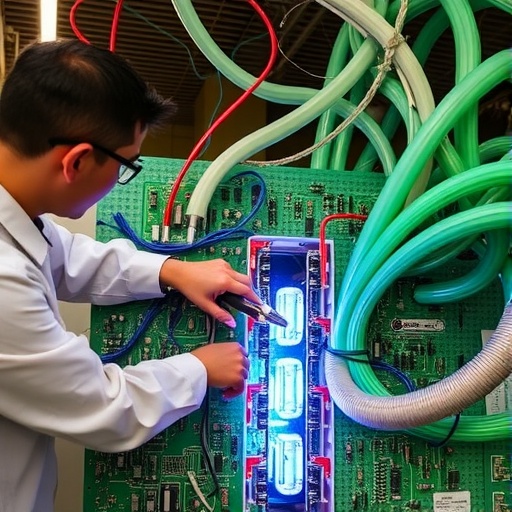
The emerging field of electronic waste management is becoming increasingly relevant, particularly as the world grapples with the growing volume of discarded printed circuit boards (PCBs). A recent study by Chen, Zhan, and Xu has delved into the complex interaction of self-catalytic processes and phase boundary dynamics within the pyrolysis kinetics of wasted printed circuit boards. Their work provides significant insight into the intricate nature of co-existing materials and the atmospheric conditions that influence the degradation of these electronic components.
The pyrolysis of PCBs involves a thermal degradation process that converts solid materials into gaseous and liquid fuels while extracting valuable metals and compounds. As electronic products become more sophisticated, the materials within PCBs have diversified, leading to heterogeneous compositions that complicate thermal degradation processes. The researchers aimed to uncover how these different material phases interact under thermal stress, which is crucial for optimizing recycling processes and reducing environmental impacts.
In their investigation, the authors employed advanced analytical techniques to characterize the thermal behavior of PCBs at various temperatures. By closely monitoring the evolution of gases and the formation of solid residues, the study provides insights into the mechanisms that underpin pyrolysis. One of the key findings was the role of self-catalysis in enhancing the breakdown of complex polymers within PCBs. The presence of certain metals and other components catalyzes the decomposition of organic materials, ultimately leading to more efficient energy recovery during pyrolysis.
Furthermore, the research highlights the importance of phase boundaries in the pyrolysis process. As the temperature increases, different materials within the PCB structure begin to melt or evolve into gaseous forms at varying rates. This differential behavior can lead to significant variations in the overall kinetics of the degradation process. Understanding these phase interactions allows for better predictions and control strategies in the recycling of electronic waste, particularly in designing more effective pyrolysis reactors.
The authors also examined the impact of atmospheric conditions during pyrolysis, noting that the presence of oxygen, nitrogen, or inert gases can profoundly influence the product distribution. For instance, pyrolysis conducted in an inert atmosphere yielded different byproducts compared to those carried out in an oxygen-rich environment. Such findings can be pivotal for industries looking to maximize the recovery of valuable materials from electronic waste while minimizing harmful emissions.
In terms of practical applications, this research sheds light on potential methods for improving the efficiency of PCB recycling operations. By optimizing pyrolysis conditions based on the specific composition of the waste material and the desired end products, recycling facilities can enhance their operational efficiency. This is particularly relevant as international regulations increasingly mandate the responsible handling of electronic waste.
Another significant aspect of this study is its contribution to the broader conversation surrounding sustainability and environmental protection. As the problem of electronic waste becomes more acute, understanding the dynamics of pyrolysis contributes to developing technologies that can mitigate pollution associated with disposal and incineration. The emphasis on self-catalytic and phase boundary-driven processes may lead to innovative strategies that pave the way for more sustainable waste management solutions.
The interdisciplinary approach taken by the researchers also demonstrates the value of collaboration between materials science, environmental engineering, and chemistry. By integrating expertise from these fields, the study not only reveals fundamental insights into material behavior under thermal stress but also sets a foundation for future research aimed at enhancing electronic waste recovery.
As the demand for electronic devices continues to soar, the quantity of waste generated from PCBs is expected to rise dramatically. Consequently, the development of efficient pyrolysis technologies will be of paramount importance in addressing the challenges associated with electronic waste disposal. This research provides a scientific basis for advancing these technologies, emphasizing the need for continued innovation in the field.
Looking ahead, the findings from this study suggest numerous avenues for further research. For instance, future investigations could explore how different additives or process conditions influence the pyrolysis kinetics of PCBs. Such insights could contribute to optimizing recycling processes that not only recover metals but also minimize toxic byproducts.
In conclusion, the work by Chen, Zhan, and Xu sheds light on the complex nature of pyrolysis kinetics in wasted printed circuit boards. By focusing on self-catalytic and phase boundary-driven interactions, the study provides valuable insights that could enhance the recycling of electronic waste. As society continues to rely heavily on electronic devices, understanding these processes becomes increasingly critical for sustainable resource management.
Subject of Research: Pyrolysis kinetics of waste printed circuit boards and their interaction with atmospheric conditions.
Article Title: Uncovering self-catalytic and phase boundary-driven interactions in the pyrolysis kinetics of wasted printed circuit boards: co-existing materials and the atmosphere.
Article References:
Chen, Z., Zhan, L. & Xu, Z. Uncovering self-catalytic and phase boundary-driven interactions in the pyrolysis kinetics of wasted printed circuit boards: co-existing materials and the atmosphere.
Front. Environ. Sci. Eng. 19, 151 (2025). https://doi.org/10.1007/s11783-025-2071-y
Image Credits: AI Generated
DOI: 23 August 2025
Keywords: Pyrolysis, Printed Circuit Boards, Electronic Waste, Environmental Science, Material Interaction, Sustainability.


