

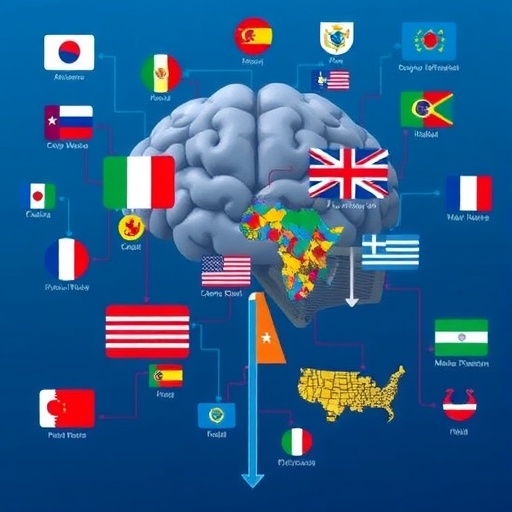
Recent research has delved into the intricate relationship between personality traits and cognitive abilities, focusing on how these elements interact across different national contexts. In a groundbreaking study by Rammstedt, Vogel, Roth, and colleagues, published in the journal Large-scale Assess Educ, the authors provide a nuanced analysis that explores the links between the Big Five personality traits and cognitive functioning. This study is particularly significant as it not only evaluates broad personality dimensions but also considers finer facets that might elucidate the differences found in cognitive abilities.
The Big Five personality traits, which include openness, conscientiousness, extraversion, agreeableness, and neuroticism, have long been used to characterize individual differences. However, their relationship with cognitive abilities, often measured through intelligence tests, has remained somewhat ambiguous. This research aims to demystify this connection, offering a fresh perspective that breaks down personality into more specific components, or facets, which can help clarify how these traits influence cognitive performance.
One of the study’s notable contributions is its cross-national approach, which examines the personality-cognitive ability links across various cultural backgrounds. This feature is crucial as it allows for a comprehensive understanding of how personality traits might interact differently depending on socio-cultural context. The researchers employed a diverse sample from multiple countries, ensuring that the insights gathered reflect a broad spectrum of human experience and reducing the likelihood of culturally biased conclusions.
Statistical techniques, such as structural equation modeling, were employed to understand the relationships between personality facets and cognitive abilities deeply. The findings indicate that while higher levels of certain traits, such as conscientiousness, often correlate with better cognitive performance, the relationship is not universally linear. For instance, facets such as emotional stability within the Big Five framework can also play a significant role in how cognitive abilities are expressed and utilized in real-world contexts.
In addition to presenting these intriguing correlations, the study also addresses potential implications of these findings for educational practices. Understanding the nuances of personality-related cognitive functioning can inform teaching methodologies, curriculum designs, and assessment strategies in diverse educational settings. It highlights the importance of not only nurturing cognitive skills but also fostering positive personality development to enhance overall learning outcomes.
Moreover, this research provides a vital lens through which human behavior in professional settings can be understood. In the increasingly collaborative work environments of today, the ability to work effectively with others is essential. Personality traits such as agreeableness and social warmth can augment cognitive abilities, enhancing teamwork and productivity. The implications for organizational behavior and human resources practices are profound, suggesting that hiring and training processes could benefit significantly from integrating personality assessments.
The researchers also caution against oversimplifying the relationships uncovered in their study. While certain personality traits may generally predict cognitive abilities, the interplay can be complex and influenced by numerous external factors, including stress levels, motivation, and even environmental conditions. This reminder underscores the importance of a holistic approach when considering personality in the context of cognitive performance.
Further, understanding the role of personality and cognition has broader societal implications. It can help in addressing issues related to mental health, as traits like neuroticism have been linked to adverse psychological outcomes. Therefore, incorporating personality assessments into therapeutic practices may provide clinicians with deeper insights into their patients’ cognitive behaviors and general mental well-being.
In light of these findings, the study encourages future research to continue to unravel the complexities of the personality–cognitive ability relationship. Longitudinal studies that track individuals over time could yield further insights, revealing how personality and cognitive abilities evolve and interact throughout a person’s life.
The richness of this research lies not only in its findings but also in the questions it raises about how personality traits can shape educational outcomes, career paths, and even interpersonal relationships. As the understanding of this duality deepens, society can better address and leverage personality and cognition to cultivate a more adaptive and successful populace.
In conclusion, this cross-national study highlights the nuanced interactions between personality facets and cognitive abilities, presenting a compelling case for their interconnectedness. It stands as a crucial step toward understanding the broader implications of personality in everyday life, spanning education, work, and mental health. As we continue to explore these links, the potential to enhance cognitive development through personality-informed approaches becomes increasingly apparent, promising a synergistic future for psychology and education.
Subject of Research: The relationship between personality traits and cognitive abilities as analyzed through the Big Five model across various cultural contexts.
Article Title: Unpacking the personality–cognitive ability link: a cross-national facet-level analysis of the Big Five.
Article References: Rammstedt, B., Vogel, V., Roth, M. et al. Unpacking the personality–cognitive ability link: a cross-national facet-level analysis of the Big Five. Large-scale Assess Educ 14, 6 (2026). https://doi.org/10.1186/s40536-026-00281-2
Image Credits: AI Generated
DOI: https://doi.org/10.1186/s40536-026-00281-2
Keywords: Personality, Cognitive Abilities, Big Five, Cross-National Study, Educational Outcomes, Organizational Behavior, Psychological Well-being.


