

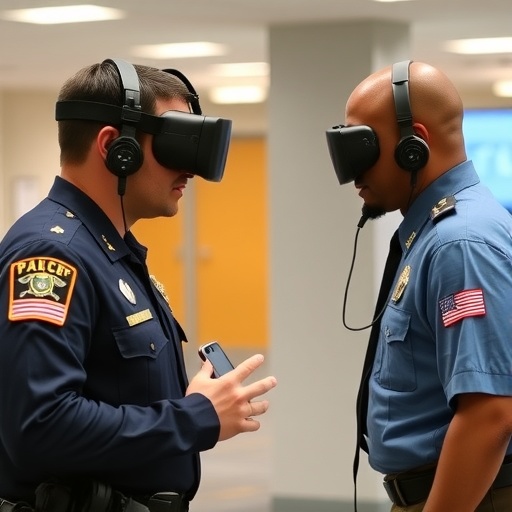
In a groundbreaking study led by researchers Powelson, McLean, and Miller, the use of virtual reality (VR) emerges as a promising tool to analyze and enhance officer decision-making in police co-response interactions. The paper, published in the American Journal of Criminal Justice, explores innovative methodologies that employ immersive technology to simulate real-world policing scenarios. This research is particularly relevant as law enforcement agencies seek to improve training protocols that address the complexities of armed interactions, mental health crises, and community relations.
In recent years, there has been a significant shift in how police departments approach training—moving away from traditional methods that may not accurately reflect the realities officers face. Virtual reality technology offers a unique opportunity to create controlled, replicable environments where trainees can encounter various scenarios in a safe yet impactful manner. This approach not only helps officers prepare for high-stress situations but also allows for detailed analysis of their choices and reactions, thereby facilitating safer practices in the field.
One of the key concerns in policing today is the need for officers to make quick, effective decisions under pressure. The VR simulations developed by the research team incorporate various unpredictable elements that can occur in real-life scenarios, such as encountering an armed suspect or managing a mental health emergency. This form of training can significantly enhance decision-making skills, allowing officers to practice their responses in a situation that closely mimics real life without the associated risks.
Moreover, the study delves into how VR can be a critical tool in understanding the cognitive processes involved in decision-making. By observing how officers navigate complex situations within a virtual environment, the research team aims to identify the factors that influence their choices. These insights could inform future training modules, helping to tailor approaches based on empirical data rather than anecdotal experiences alone.
The implications of their findings extend beyond training. By utilizing virtual reality, departments can also analyze the effectiveness of various strategies for community engagement and crisis resolution. The research suggests that real-time feedback can be integrated into these simulations, allowing officers to refine their skills based on performance metrics generated during training sessions. This kind of data-driven approach could lead to more effective methods of policing by better preparing officers for real-world challenges.
As mental health issues become a predominant concern in many communities, the ability to equip officers with the tools to effectively manage these interactions is crucial. The incorporation of VR into training regimens presents an opportunity to highlight the importance of empathy, communication, and de-escalation strategies. Through immersive experiences, officers can develop a deeper understanding of the individuals they encounter, thereby fostering more positive interactions and reducing the likelihood of confrontations escalating.
The researchers involved in this study also recognize the potential for VR technology to evolve alongside advancements in artificial intelligence and machine learning. By integrating AI, training simulations could become increasingly personalized, adapting to the individual officer’s learning style and response tendencies. This combination could ultimately enhance the officer’s readiness for a range of unpredictable circumstances they may face on duty.
Another pivotal aspect of the research focuses on the ethical considerations surrounding the use of such technology in police training. Ensuring that virtual scenarios are realistic and grounded in community concerns is vital to prevent desensitization and reinforce the importance of ethical decision-making. The study emphasizes the necessity of continuous evaluation and adjustment of VR scenarios to stay current with the evolving landscape of law enforcement.
Furthermore, the findings from this research also have implications for broader discussions on police reform and community trust. As departments increase their reliance on technology, there is a pressing need to prioritize systemic changes that align with community values and expectations. By using VR to train officers in situational awareness and cultural competence, agencies can work towards building a policing model that reflects the needs and voices of the communities they serve.
As the landscape of law enforcement continues to evolve, studies like this highlight the importance of innovation and adaptability within police training practices. The research by Powelson, McLean, and Miller represents a critical step towards creating a more informed and proficient police force equipped to handle the challenges of modern-day policing. Their work not only contributes to academic discourse but also lays the groundwork for practical applications that could reshape officer training for years to come.
The discourse surrounding police training often lacks comprehensive research, making this study a vital contribution to the field. By demonstrating the effectiveness of VR in training contexts, it adds weight to the argument for modernizing police educational methods. It could potentially become a catalyst for further research initiatives that explore technology-integrated solutions across various areas of law enforcement and criminal justice.
In summary, the investigation into virtual reality’s role in officer decision-making marks a significant advancement in understanding how technology can be harnessed to improve police practices. The implications of enhanced decision-making, ethical considerations, and the potential for reform indicate a promising avenue for future investigations. As agencies explore innovative training methodologies, this research could lead to a generation of officers who are not only better trained but also deeply engaged with the communities they serve, fostering trust and understanding in policing.
Advancements in technology are reshaping the foundations of training within law enforcement, and initiatives like those led by Powelson, McLean, and Miller will likely provoke a reevaluation of how departments train their officers. The integration of virtual reality is not merely a trend but rather a reflection of an urgent need to adapt policing approaches to better meet the demands of an ever-changing society. Future studies and implementations of these findings could be the precursors to a more effective, respectful, and responsive policing framework across the globe.
In conclusion, the study underscores the potential for VR technology to revolutionize how police interact with the communities they serve while adequately preparing them for the challenges they face on the job. As research continues to evolve in this space, the hope is that enhanced training protocols will ultimately transform law enforcement into a more empathetic and understanding system that acknowledges the complexities surrounding public safety.
Subject of Research: Virtual Reality and Officer Decision-Making in Police Co-Response Interactions
Article Title: Using Virtual Reality to Examine Officer Decision-Making in Police Co-Response Interactions
Article References:
Powelson, C.R., McLean, K.D. & Miller, B.L. Using Virtual Reality to Examine Officer Decision-Making in Police Co-Response Interactions.
Am J Crim Just 50, 822–847 (2025). https://doi.org/10.1007/s12103-025-09831-w
Image Credits: AI Generated
DOI: https://doi.org/10.1007/s12103-025-09831-w
Keywords: Virtual Reality, Police Training, Officer Decision-Making, Community Policing, Mental Health, Crisis Intervention, Law Enforcement Technologies, Ethical Policing, Police Reform


