

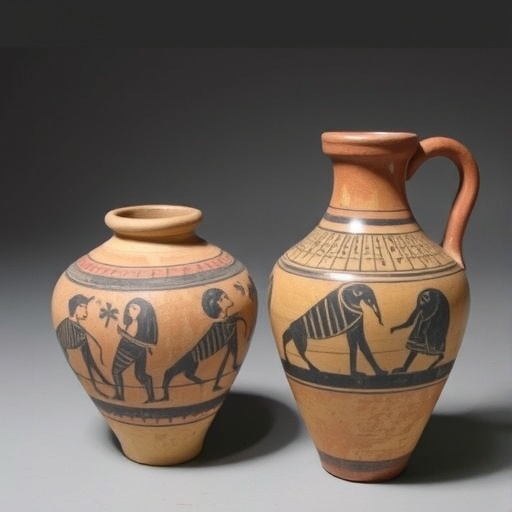
Recent research sheds new light on the complex social dynamics of ancient communities through the analysis of pottery technology, specifically focusing on the Predynastic community of Nag el-Qarmila in Egypt. Bajeot, Ownby, and Gatto’s study opens a window into the past, showcasing how artifacts, particularly ceramic assemblages, can inform our understanding of social structures, trade, and cultural exchanges among early populations.
The researchers dive deep into the fascinating world of pottery, revealing that the various ceramic styles found at the site represent more than mere functional items. They argue that these mixed ceramic assemblages are key to understanding the localized identities and social hierarchies that prevailed before the unification of Egypt. The findings direct scholars to rethink preconceived notions about cultural homogeneity in ancient communities, suggesting a more nuanced picture of social interactions across the region.
Among the highlights of their work, the authors describe the methodology behind their analysis. By employing modern archaeological techniques, they meticulously catalog numerous pottery fragments, each bearing unique characteristics that speak to its origin, use, and cultural significance. This rigorous scientific approach allows them to assert that pottery styles reflect the social networks that once existed, providing insight into the relationships that shaped the daily lives of the community.
Furthermore, Bajeot and colleagues detail the various types of ceramics discovered at Nag el-Qarmila, including utilitarian wares and more prestigious forms adorned with intricate designs. The dichotomy between everyday and ornamental pottery suggests a complex socio-economic system, where wealth and status may have influenced access to specific styles and functions. This not only highlights the technological skills of the potters but also positions them at the center of social stratification.
The authors also discuss how trade and exchange were likely essential to these early communities. The presence of foreign pottery styles within the mixed assemblages suggests that Nag el-Qarmila was not an isolated entity but rather part of a broader network of trade. The authors argue that such interactions fostered cultural exchange and innovation, which ultimately enriched the local pottery traditions, signaling the complexity of relationships between neighboring communities.
In addition to the physical attributes of the ceramics, the research examines the symbolism embedded within the pottery. Decorative motifs found on certain pieces may have conveyed identity, religious beliefs, or social status, highlighting how pottery served not just a practical purpose but also acted as a medium for self-expression and communal ties. This perspective underscores the need for a holistic understanding of how ancient peoples represented themselves and their beliefs through their material culture.
Interestingly, the research emphasizes the role of technology in the production of ceramics. The authors carefully analyze the clay compositions and firing techniques used at Nag el-Qarmila, revealing how advancements in pottery-making influenced social dynamics. As techniques improved, the potential for creating more varied and intricate ceramics increased, leading to greater communal participation and possibly more structured social hierarchies.
Moreover, the implications of this research extend beyond pottery into the realm of social theory. The authors invoke a critical discourse in archaeology that challenges the traditional approaches to the study of ancient communities. By incorporating technology, production practices, and social contexts, they advocate for a more integrated standpoint to comprehend ancient societal structures as dynamic entities rather than static hierarchies.
This analysis of the Nag el-Qarmila ceramics opens doors for further research and encourages archaeologists and historians alike to consider the interplay between technology, culture, and social identity across ancient Egypt. Such inquiries could inspire more comprehensive studies of other archaeological sites, potentially revealing common threads that define early human experiences across time and geography.
The study significantly raises essential questions regarding the influence of external factors on local traditions. How did migration, trade, and technological diffusion shape the ceramic practices at Nag el-Qarmila? And how did these practices, in turn, reflect or influence broader social relations and identity? Each question bears the weight of unraveling the complex tapestry of human interaction over millennia.
As the authors conclude, the mixed ceramic assemblage of Nag el-Qarmila acts not merely as a collection of artifacts but as a lens through which we can examine the broader social implications of ceramic technology. Their work underscores the importance of ceramics in archaeological discourse and encourages continued exploration into their roles in shaping the communities of the past.
This research promises to ignite further scholarly conversation about the significance of material culture in understanding ancient human societies. It proposes that pottery is not just a vessel for storage or consumption; it is a crucial artifact laden with meaning, history, and social relevance that invites civilians into the lived experiences of ancient peoples.
With its innovative approach to understanding the social implications of ceramic assemblages, this study paves the way for more interdisciplinary research, merging archaeology, sociology, and anthropology. Such collaboration may lead to revolutionary insights into the complexities of human interaction, identity formation, and the evolution of societies through time while showcasing how artifacts serve as vital communicators of cultural narratives.
In summary, the findings presented by Bajeot, Ownby, and Gatto highlight the intricate connections between technology, identity, and community structures in Predynastic Egypt. The multiplication of interpretations derived from these ancient ceramics offers a refreshing perspective, reinforcing the notion that the artifacts of the past are alive with stories waiting to be told.
This research not only enriches our understanding of a specific ancient community but also invites us to reconsider how we perceive and interpret the remnants of human ingenuity that have shaped our shared history.
Subject of Research: The social implications of ceramic technology in Predynastic Egypt.
Article Title: The Social Implication of a “mixed” Ceramic Assemblage: Understanding the Predynastic Community of Nag el-Qarmila (First Nile Cataract, Egypt) Through Pottery Technology.
Article References:
Bajeot, J., Ownby, M. & Gatto, M.C. The Social Implication of a “mixed” Ceramic Assemblage: Understanding the Predynastic Community of Nag el-Qarmila (First Nile Cataract, Egypt) Through Pottery Technology. Afr Archaeol Rev 41, 443–475 (2024). https://doi.org/10.1007/s10437-024-09602-8
Image Credits: AI Generated
DOI: https://doi.org/10.1007/s10437-024-09602-8
Keywords: Ceramic technology, social dynamics, Predynastic Egypt, Nag el-Qarmila, cultural exchange, material culture.


