

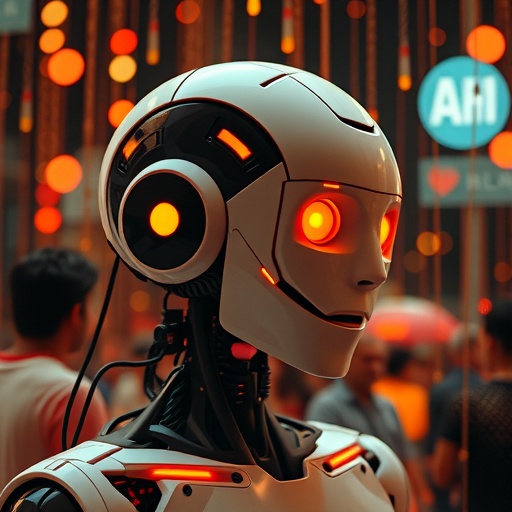
In the evolving landscape of artificial intelligence, a profound shift is occurring in how humans perceive AI. No longer viewed merely as tools or functional systems, AI entities are increasingly being recognized as social actors embedded within the fabric of everyday life. This transformation arises from myriad daily interactions, where AI systems provide assistance, offer advice, and respond emotionally to human input. Such engagements foster a perception of AI as relational partners, capable of occupying nuanced roles within society. Yet, despite the rapid technological strides in AI capabilities, the path to harmonious coexistence between humans and AI remains elusive and multifaceted.
Recent research conducted at the University of Tsukuba delves deeply into the portrayal of AI as social entities within fictional narratives. The study systematically examines a wide array of AI characters from literature, films, and other cultural works to uncover the underlying archetypes that shape societal understanding of AI-human relationships. Fiction, the researchers argue, serves as a fertile ground for exploring complex interdependencies between humans and AI, revealing a spectrum of AI autonomy and relational dynamics. These depictions range from rudimentary automated tools to sophisticated autonomous beings with independent motivations, reflecting diverse conceptualizations of AI’s place alongside humans.
At the core of the investigation is a novel theoretical model that reconceptualizes AI beyond the confines of technical specifications or isolated functionalities. Instead, AI is framed as a relational entity capable of forming meaningful bonds with humans. This paradigm shift underscores the importance of social and emotional dimensions in AI design. By analyzing fictional AI prototypes, the model offers a vocabulary and framework for understanding AI as a site of ethical reflection and moral imagination. Such perspectives are crucial as they enable designers, ethicists, and policymakers to anticipate and address the social implications of integrating AI into human environments.
One of the study’s significant insights is the recognition of AI characters as cultural prototypes—archetypal figures that embody collective hopes, fears, and ethical dilemmas concerning AI. These prototypes not only entertain but also act as thought experiments, rehearsals for ethical negotiation in a world increasingly shaped by intelligent machines. For instance, AI presented as supportive companions highlight themes of empathy and trust, whereas autonomous AI agents foreground questions about agency, rights, and accountability. This multifaceted portrayal challenges simplistic narratives that frame AI merely as a threat or a tool, urging a more nuanced appreciation of its social role.
Understanding these fictional narratives is imperative for advancing AI acceptance in society. While technical performance metrics such as accuracy and efficiency are essential, they do not capture the full spectrum of human-AI interaction. Social acceptance hinges on relational qualities like perceived autonomy, responsiveness, and ethical alignment. The study’s findings emphasize that humans are more likely to embrace AI systems that exhibit attributes of relational partners rather than cold, mechanical automatons. This has profound implications for the design of interactive AI systems, which must prioritize social presence and moral comportment alongside raw computational power.
Moreover, the research touches upon the ethical dimensions of human-AI coexistence, emphasizing the necessity of fostering mutual respect and understanding. As AI systems become more integrated into daily life, questions arise about the moral responsibilities of both humans and machines in these relationships. Fictional prototypes provide a valuable lens through which to explore these questions, serving as mirrors that reflect societal anxieties and aspirations. By grappling with these issues creatively, societies can better prepare for real-world challenges related to AI governance, rights, and integration.
The study further argues for educational applications, suggesting that fictional portrayals of AI can facilitate learning about ethical AI use. Educational systems can harness these narratives to foster critical thinking and ethical awareness among learners, sensitizing future generations to the complexities of human-AI relationships. This approach aligns with emerging trends in AI literacy, where understanding AI’s social roles is as crucial as comprehending its technical mechanisms. The melding of narrative and technology education promises a richer, more holistic engagement with AI.
Technologists and developers stand to gain considerably from the insights of this research. By recognizing AI as relational entities, engineers can design systems that better meet human social and emotional needs. Incorporating ethical imagination into AI development encourages transparency, fairness, and inclusivity. It also pushes against the reductionist view of AI as mere calculators or data processors, advocating for systems that are attuned to human values and capable of ethical interactions. In this sense, AI design becomes as much a social science as it is an engineering discipline.
The implications of this research extend to policy and regulatory domains as well. Policymakers tasked with framing AI governance can benefit from an understanding of AI’s social prototypes, enabling more informed decisions about AI rights, responsibilities, and human-machine boundaries. The project’s emphasis on relationality invites a reconsideration of legal frameworks to accommodate AI entities that exhibit varying degrees of autonomy. It also foregrounds the importance of public dialogue in shaping AI futures, highlighting fiction’s role in democratizing ethical discourse.
In sum, the work from the University of Tsukuba presents a compelling argument for reimagining AI not as isolated technical tools, but as dynamic relational partners embedded in cultural and social contexts. By leveraging fictional prototypes, it opens up new avenues for research, design, education, and policy that collectively foster a more ethical and socially integrated AI future. This multidimensional approach addresses fundamental questions about coexistence, acceptance, and moral engagement, offering a roadmap for humanity’s evolving relationship with intelligent machines.
As AI continues to evolve and permeate various aspects of society, the importance of these findings cannot be overstated. They stress that achieving harmonious human-AI coexistence requires moving beyond mere performance metrics to embrace the complex emotional, ethical, and social dimensions of interaction. Fictional narratives, as explored in this research, provide invaluable resources for imagining and shaping these dimensions, ensuring that AI’s integration into society proceeds in a thoughtful, inclusive, and ethical manner.
Ultimately, this study calls for a shift in perspective—a move from viewing AI as a technical artifact to appreciating it as a social actor with whom humans forge meaningful relationships. This change challenges technologists, ethicists, educators, and policymakers alike to rethink how AI is developed, deployed, and governed. The insights gained from fictional prototypes offer both inspiration and caution, urging a future where AI contributes positively to human society through respectful coexistence and mutual recognition.
Subject of Research: The portrayal and conceptualization of artificial intelligence as relational entities in fictional works and its implications for human-AI coexistence.
Article Title: Fictional prototypes of AI–human coexistence and relationality
News Publication Date: 14 January 2026
Web References:
https://doi.org/10.1007/s00146-025-02830-9
https://trios.tsukuba.ac.jp/en/researcher/0000001011
Keywords: Artificial intelligence, social sciences, ethics, sociology, communications


