

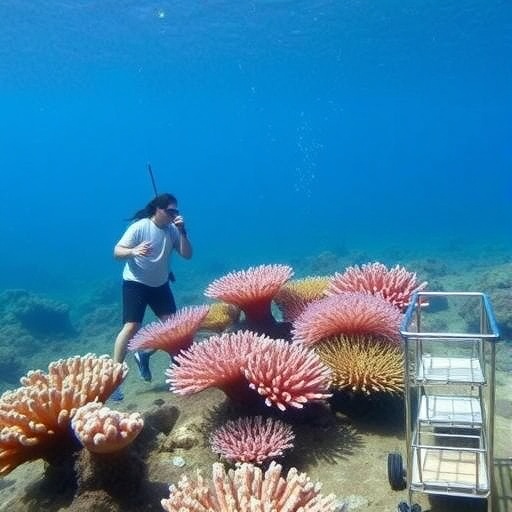
In a groundbreaking study shedding light on the intricate lives of marine organisms, researchers have unveiled stunning insights into the soft corals of the genus Sinularia, particularly in the unique ecological setting of the Red Sea. Through the innovative application of untargeted metabolomics, the research team has meticulously deciphered the environmental influences that shape the biochemical profiles of these fascinating corals. This novel approach not only illuminates the complex interactions within the marine ecosystem but also paves the way for understanding the resilience and adaptability of these organisms in a rapidly changing world.
The study highlights how the harsh and dynamic conditions of the Red Sea, characterized by extreme temperatures and salinity fluctuations, have a profound impact on the metabolites produced by Sinularia corals. By employing a metabolomic methodology that examines the complete set of small-molecule metabolites, the researchers could capture a holistic picture of the corals’ responses to their environment. This shift from traditional targeted methods to untargeted analysis represents a significant leap forward in marine biology.
In the face of global climate change, the health of coral reefs, including those harboring Sinularia species, is increasingly under threat. The researchers aim to bridge the knowledge gap regarding how these corals adapt to stressful environmental conditions. By decoding the subtleties embedded in the corals’ metabolic responses, the study opens new avenues for conservation strategies, highlighting the importance of these ecosystems not just as beautiful sights but as vital components of marine biodiversity.
One of the most exciting aspects of the study was the identification of unique metabolites linked to stress responses. These metabolites serve as bioindicators, offering a biochemical snapshot of the corals’ health and resilience. The implications of this finding extend beyond mere academic curiosity; they offer practical tools for monitoring coral health in real-time, enabling more effective management and conservation efforts in marine protected areas.
As part of their investigation, the team observed significant variations in metabolic profiles among different Sinularia species, which can be attributed to their specific adaptations to diverse environmental niches in the Red Sea. This observation underscores the adaptive capacity of these corals, suggesting that they may possess inherent mechanisms that enable them to thrive even as climate stresses intensify.
Moreover, the research emphasizes a need for further exploration into the relationships between corals and their surrounding environments. For instance, the study pointed to complex interactions with microbial communities, which can also influence metabolic output and overall health. Understanding these interactions is key to forming a comprehensive picture of coral ecosystems, as they rely heavily on symbiotic relationships with microorganisms.
The untargeted metabolomics framework employed in this research operates on the principle of analyzing all metabolites present in a given sample, rather than focusing on predefined compounds. This allows for the discovery of novel metabolites that might play crucial roles in coral physiology and ecology. By embracing this cutting-edge research methodology, scientists can uncover hidden layers of biological complexity that traditional methods may miss.
With coral reefs being among the most productive and diverse ecosystems on Earth, they hold immense ecological, economic, and social value. This research emphasizes the necessity of protecting such ecosystems, not only for the corals themselves but for the myriad species that depend on them for survival. Safeguarding these marine habitats against the challenges posed by climate change, pollution, and overfishing is more crucial now than ever before, as the findings from this study indicate.
Additionally, the insights gained from the metabolic analyses can serve to inform future studies aimed at enhancing coral resilience. By understanding which metabolites confer stress tolerance, researchers may be able to devise strategies for enhancing coral health through artificial propagation or even genetic engineering. This can become especially important when considering the potential for ecological restoration as natural reefs continue to decline.
The team also discussed the broader implications of their findings within the context of marine science, stressing the importance of interdisciplinary approaches that bring together molecular biology, ecology, and environmental science. Such collaboration is essential in crafting comprehensive solutions that address the multi-faceted threats to coral reefs globally.
In concluding their findings, the researchers reiterated the urgent call to action: understanding and protecting marine ecosystems is imperative not only for wildlife survival but also for human communities that rely on these resources. The pioneering work on Sinularia corals sets a precedent for future research, urging scientists to continue unraveling the mysteries of coral biology.
This study adds to a growing body of literature advocating for a greater appreciation of the resilience found within marine ecosystems. As climate-related challenges loom on the horizon, the need for innovative research and conservation efforts remains critical. The exploration of metabolic processes in organisms such as Sinularia provides hope that, with the right knowledge and action, we may still forge a path toward healthier and more sustainable ocean environments.
Thus, this research work not only unveils the intricate relationships between Sinularia corals and their surrounding environment but also serves as a clarion call for the preservation and careful stewardship of our oceans. The collaborative efforts of researchers aim to ensure that these vibrant ecosystems persist for future generations, offering both beauty and vital ecosystem services.
In summary, the study by Emam, Mohamed, and Al-Hammady captures the essence of marine ecological research, demonstrating the power of metabolomics to influence conservation strategies. As researchers continue to decode the complex biochemical language of corals, we are reminded of the interconnectedness of life in our oceans and the importance of taking action to safeguard these precious resources.
Subject of Research: Environmental influences on soft corals of the genus Sinularia in the Red Sea.
Article Title: Decoding environmental influences on soft corals of the genus Sinularia in the Red Sea: insights from untargeted metabolomics.
Article References:
Emam, M., Mohamed, T.A., Al-Hammady, M.A. et al. Decoding environmental influences on soft corals of the genus Sinularia in the Red Sea: insights from untargeted metabolomics.
Environ Sci Pollut Res (2025). https://doi.org/10.1007/s11356-025-37202-9
Image Credits: AI Generated
DOI: https://doi.org/10.1007/s11356-025-37202-9
Keywords: Coral, Sinularia, Red Sea, Metabolomics, Conservation, Climate Change.


