

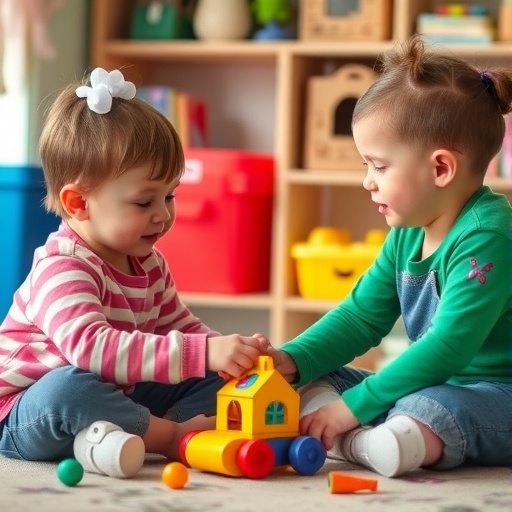
In recent years, the importance of pretend play in childhood development has gained significant attention among educators, psychologists, and parents alike. “Jump into a Child’s World” is a quintessential study that showcases these insights, shedding light on how educators view pretend play practices within early childhood settings. The findings of this mixed-method research study not only provide a comprehensive understanding of the educators’ perspectives on this critical aspect of developmental psychology but accentuate the benefits of imaginative play in fostering cognitive, social, and emotional growth among young children.
The research team, consisting of experts including Vasilopoulos, Karaolis, and Birrell, has extensively explored the influences and effectiveness of pretend play in educational settings. They argue convincingly that pretend play is more than just a leisure activity for children; it is a vital educational tool that helps children cultivate crucial skills they will utilize throughout their lives. The team conducted in-depth interviews and observations in various classrooms to gather qualitative data, bridging the gap between theoretical understanding and practical implementation.
A nuanced examination of these practices reveals that educators possess a spectrum of perspectives on the role of pretend play in their classrooms. Some view it as a fundamental activity that should be integrated into daily lesson plans, while others see it as ancillary—a bonus to structured learning. The recognition of pretend play’s potential to promote key competencies such as language development, empathy, and problem-solving abilities appears to be a common thread among respondents in the study. Educators reported observing transformative experiences where children engaged in storytelling, conflict resolution, and collaborative tasks through pretend play scenarios.
However, the study also highlights that not all educators feel equipped or supported in facilitating pretend play. Some expressed concerns regarding curriculum constraints and the pressure to meet academic benchmarks, which eventually led to deprioritizing play-based activities in their classrooms. This tension reflects a broader debate within early childhood education regarding the balance between structured learning and the flexibility needed for creative exploration. Through interviews, educators voiced that while they recognize the benefits of pretend play, systemic issues often impede their ability to incorporate it effectively.
Adding to this complexity, the study delves into how professional development plays a crucial role in empowering educators. Insights from the research emphasize that providing training specifically focused on the value and implementation of pretend play can significantly impact teaching practices. Educators who have benefited from targeted professional development programs report feeling more confident and skilled in facilitating pretend play, ultimately enriching children’s learning experiences. It underlines the need for continued emphasis on equipping educators with the necessary tools and knowledge.
An unexpected finding of the study was how educators themselves often engage in pretend play scenarios, albeit unintentionally. Many respondents admitted to being active participants in children’s imaginative worlds, which reinforces the idea that educators can foster an environment of creativity and spontaneity. This role not only helps in establishing a connection with children but also encourages a shared commitment to learning that transcends traditional teacher-student dynamics. Creating a culture that values play as an educational tool enables both children and educators to thrive.
Moreover, the impact of the educational environment on pretend play cannot be overlooked. During the research, it became evident that settings that are rich in resources—such as props, costumes, and flexible spaces—encourage more robust engagement in pretend play. Educators noted that when children have access to a variety of materials, their imaginations flourish, leading to more complex and meaningful play scenarios. Therefore, the physical layout of classrooms emphasizes the necessity of creating play-friendly environments as a key component of early childhood education.
The role of cultural context also surfaced as a crucial factor influencing educators’ perspectives on pretend play. The research highlights how cultural backgrounds significantly shape the beliefs and practices surrounding play. Certain cultures prioritize imaginative play as an integral part of childhood, while others may view it as frivolous or secondary to more academic pursuits. This cultural lens can lead to varying commitments to play-based learning, which is crucial for educators to understand as they develop curricula that resonate with the children in their care.
Furthermore, the study dives into the ways in which parents and caregivers can play a supporting role. Communication between educators and families regarding the importance of pretend play can create a comprehensive support system that values imaginative exploration both in the classroom and at home. Encouraging parents to engage in play with their children reinforces the notion that learning can occur through multiple avenues—not just through structured academic activities. This partnership fosters an ecosystem where children feel encouraged to explore and express themselves more freely.
As the findings of this critical research continue to ripple through the educational community, they serve as a clarion call to reexamine how pretend play is valued and integrated within early childhood education. The study advocates for a paradigm shift that embraces play as a serious and essential component of learning, allowing educators to reclaim their roles as facilitators of creativity. By recognizing the profound benefits of imaginative play, we can better support the holistic development of future generations of learners.
Ultimately, the implications of the research extend far beyond the classroom. As society increasingly recognizes the importance of early childhood development, the lessons gleaned from this study can shape policies and practices that promote play as a crucial element. Investing in teacher training, creating supportive classroom environments, and fostering strong partnerships with families can pave the way for a vibrant future where pretend play is not merely an accessory to learning but a core tenet of educational philosophy.
The journey of understanding the power of pretend play is just beginning. Educators, researchers, and policymakers must work collaboratively to elevate this discourse, ensuring that educators are equipped and empowered to embrace play as a pivotal component of early education. With continued exploration and advocacy, we can cultivate classrooms filled with joy, creativity, and learning—an opportunity for children to fully “jump into a child’s world.”
Subject of Research: Educators’ perspectives on pretend play practices in early childhood settings.
Article Title: “Jump into a Child’s World”: A Mixed Method Study Exploring Educators Perspectives on Pretend Play Practices in Early Childhood Settings.
Article References:
Vasilopoulos, F., Karaolis, O., Birrell, L. et al. “Jump into a Child’s World”: A Mixed Method Study Exploring Educators Perspectives on Pretend Play Practices in Early Childhood Settings.
IJEC (2026). https://doi.org/10.1007/s13158-025-00479-5
Image Credits: AI Generated
DOI: https://doi.org/10.1007/s13158-025-00479-5
Keywords: Pretend play, early childhood education, educators’ perspectives, play-based learning, imaginative play, professional development.


