

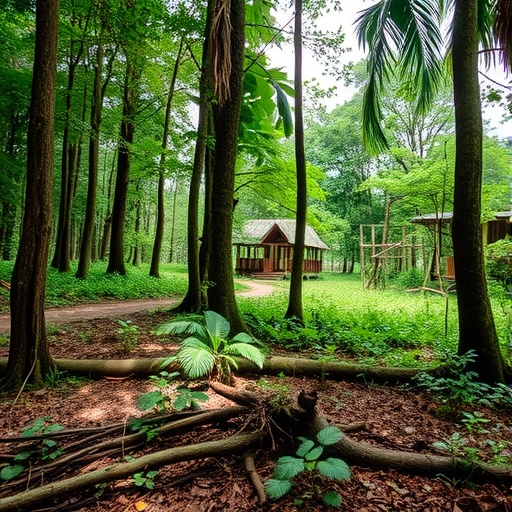
In a groundbreaking study, Matabaro, Badesire, Tiko, and their colleagues delve into the intricate dynamics of landscape changes alongside human-induced factors contributing to deforestation and forest degradation in various territories within the Sankuru Province of the Democratic Republic of the Congo (DRC). This research not only highlights the alarming rates of environmental change but also underscores the profound implications these alterations pose to local biodiversity, climate regulation, and the livelihoods of communities dependent on forest resources.
The study focused on the Lodja and Lomela territories, two regions whose rich ecosystems have long served as vital sources of sustenance and economic activity for local inhabitants. However, this wealth has increasingly come under threat due to anthropogenic activities ranging from logging, agricultural expansion, to mining. The authors meticulously document how these activities have created a ripple effect, influencing not only the physical landscape but also the social fabric of the communities reliant on the forests.
The scientific method employed in this research is particularly noteworthy. Utilizing extensive field surveys, satellite imagery, and Geographic Information System (GIS) technologies, the researchers were able to generate detailed maps that illustrate both historical and current land-use patterns. These tools enabled the identification of clear correlations between deforestation rates and specific human activities. For instance, the findings reveal that agricultural encroachment is among the leading causes of forest loss, directly linked to the demand for arable land as the population in these territories continues to grow.
Moreover, the study draws attention to the socio-economic dimensions of forest degradation. The infiltration of agricultural practices into forested landscapes not only contributes to carbon emissions but also threatens the delicate balance of local ecosystems. For example, the conversion of diverse forest areas into monoculture plantations significantly diminishes biodiversity. This loss of plant and animal species can irrevocably alter ecosystem services that are crucial for maintaining environmental health, such as pollination and soil fertility.
One of the most alarming aspects highlighted in the research is the rapid pace at which deforestation is occurring. The authors report an unprecedented rate of forest loss, raising urgent concerns over the sustainability of remaining forested areas. The impact of this loss extends beyond environmental degradation; it threatens the cultural practices of indigenous populations whose identities are closely tied to these natural landscapes. The study suggests that awareness and understanding of these cultural ties are critical in framing policies aimed at mitigating deforestation.
Climate change is another significant thread woven throughout the research. The authors articulate how deforestation exacerbates climate instability, citing that forested regions play a crucial role in sequestering carbon dioxide, the primary greenhouse gas. As forests are removed, not only is carbon stored within trees released back into the atmosphere, but the forest’s capacity to absorb future emissions is also diminished. This creates a vicious cycle, intensifying the already pressing challenges of climate change that the DRC and the global community face.
In response to these ongoing threats, the researchers advocate for integrated land management approaches that consider both environmental sustainability and local community needs. Practical measures such as promoting agroforestry practices—where farmers integrate trees into their agricultural systems—could serve as an effective countermeasure to combat deforestation while improving food security and enhancing livelihoods.
Furthermore, the study emphasizes the importance of engaging local communities in conservation efforts. The authors propose models of participatory governance or community-based natural resource management that empower local populations to take an active role in managing their ecosystems. By placing decision-making power in the hands of those most affected, the chances of successful conservation are markedly increased.
Education and awareness are also essential components of the solution. The research underscores the need for programs aimed at informing local communities about the long-term benefits of preserving their forests. This could help shift perspectives on land use and encourage more sustainable practices, fostering a culture of conservation that recognizes the intrinsic value of biodiversity.
International cooperation and support are critical to achieving these conservation goals. The authors urge for greater involvement from global organizations in assisting the DRC to implement effective policies and practices. Financial mechanisms, such as payment for ecosystem services, could incentivize locals to maintain forest cover, creating a win-win scenario that benefits both the environment and the economy.
As the research highlights, the consequences of deforestation and forest degradation extend beyond local borders, impacting global efforts to combat climate change. Therefore, the call to action is not only a local concern but a global one. International stakeholders must recognize the interconnectedness of their environmental policies with the dynamics observed in places like Sankuru Province, advocating for collaborative strategies that address forest conservation on a broader scale.
In conclusion, this seminal research by Matabaro and his colleagues serves as a critical wake-up call regarding the urgent need for sustainable management practices in the face of anthropogenic pressures. The findings call for decisive action to protect precious ecosystems, uphold the rights of local communities, and maintain the equilibrium of our planet’s climate systems. Now is the time for innovative solutions and global solidarity in the fight to safeguard our forests for future generations.
Subject of Research: Landscape dynamics and anthropogenic factors contributing to deforestation and forest degradation in Sankuru Province, DRC.
Article Title: Landscape dynamics and analysis of anthropogenic factors of deforestation and forest degradation in Lodja and Lomela territories in Sankuru Province, DRC.
Article References:
Matabaro, J.M., Badesire, L.A., Tiko, J.M. et al. Landscape dynamics and analysis of anthropogenic factors of deforestation and forest degradation in Lodja and Lomela territories in Sankuru Province, DRC.
Discov. For. 2, 1 (2026). https://doi.org/10.1007/s44415-025-00066-5
Image Credits: AI Generated
DOI: https://doi.org/10.1007/s44415-025-00066-5
Keywords: Deforestation, Anthropogenic Factors, Sustainability, Climate Change, Biodiversity, Community Engagement, Land Management.


