

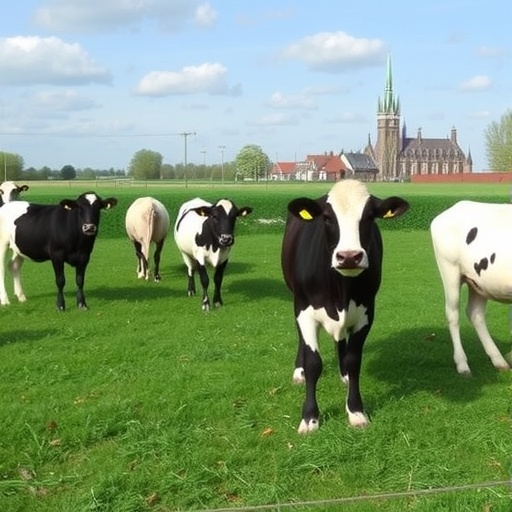
In a pioneering study published in npj Sustainable Agriculture, researchers have delved into the complex pathways of transitioning Belgium’s livestock sector towards sustainability. The comprehensive investigation, led by Riera, Vandevoorde, Squilbin, and colleagues, employs an innovative blend of narratives, trade-off analyses, and scenario modeling to elucidate the multifaceted challenges and opportunities inherent in reshaping livestock production systems within a major European context.
Belgium, a country emblematic of intensive livestock farming, faces mounting environmental, economic, and social pressures to recalibrate its agricultural paradigms. This transition is critical against the backdrop of global climate goals and mounting evidence underscoring livestock’s role in greenhouse gas emissions and biodiversity loss. The study intricately maps out plausible futures for Belgian livestock, capturing the interaction between technological innovation, policy frameworks, market demands, and consumer behavior.
At the heart of the research lies a methodology that merges qualitative and quantitative approaches. By constructing detailed narratives that reflect diverse stakeholder perspectives, the authors provide a vivid depiction of potential trajectories. These narratives are not mere speculative tools; they are systematically linked with scenario analysis that quantitatively assesses the impacts of various trade-offs, such as balancing productivity with environmental sustainability, or socioeconomic viability with animal welfare improvements.
One critical insight from the study is the identification of trade-offs that are not readily apparent in conventional policy debates. For instance, scenarios that push for rapid reduction in livestock numbers may offer clear environmental benefits but risk economic disruption and social resistance within rural communities. Conversely, incremental changes that emphasize technological efficiency gains might preserve economic structures but fall short in delivering meaningful ecological relief.
The research delves into the nuanced role of consumer behavior and market dynamics. The narratives illustrate how shifting consumer preferences towards plant-based diets or alternative proteins could accelerate the livestock transition, yet highlight the heterogeneity in acceptance across demographics. This variability underscores a fundamental uncertainty in modeling future food systems and stresses the need for adaptive governance frameworks that can respond to evolving social trends.
Technology also features prominently, with options ranging from improved manure management and feed efficiency to more radical interventions like cultured meat or insect protein integration. The scenarios assess the feasibility, scalability, and potential unintended consequences of deploying such technologies at national scale, providing stakeholders a grounded understanding of what innovation pathways may be viable under different regulatory and economic conditions.
Importantly, the study situates livestock transition in the broader context of Belgium’s commitments to the European Green Deal and international climate agreements. The authors argue that advancing towards sustainability in agriculture cannot be isolated from holistic food system transformations, including land use changes, supply chain redesign, and circular economy principles. This integrated perspective challenges siloed policy formulations and calls for cross-sectoral collaboration.
The multi-scalar analytical framework developed in the study captures local farm-level realities as well as national and global linkages. This layered approach reveals potential spillover effects, such as how shifting livestock practices in Belgium could influence feed import demand, global commodity markets, and ultimately, agricultural sustainability beyond national borders. These insights are vital for framing Belgium’s role in a globalized food system.
Another dimension explored is the social acceptability of various livestock transition pathways. The research highlights that public opinion, shaped by cultural heritage, animal welfare concerns, and health considerations, plays a decisive role in shaping feasible transition scenarios. Engaging stakeholders early and continuously emerges as a recommended strategy to navigate contested values and foster more inclusive decision-making.
The authors emphasize the adaptive capacity of livestock systems, underscoring flexibility as a design principle that enhances resilience to shocks such as climate extremes, market volatility, and policy shifts. The scenarios illustrating diversified farming systems with mixed crop-livestock operations suggest promising avenues for enhancing both ecological and economic sustainability.
From a methodological perspective, the integration of narrative and scenario analysis stands out as an exemplary model for future research in agricultural transitions. By bridging qualitative richness and quantitative rigor, the approach captures complexity without sacrificing clarity, thereby equipping policymakers, industry players, and civil society with actionable knowledge.
The findings have immediate implications for Belgian agricultural policy. Traditionally focused on yield maximization and export competitiveness, the sector is urged to pivot towards more nuanced performance metrics that incorporate ecosystem services, rural vitality, and social equity. This paradigm shift calls for novel policy instruments, including targeted subsidies, education, and participatory governance mechanisms.
Perhaps most compellingly, the study serves as a template for other countries grappling with similar livestock transition challenges. The carefully articulated narratives and trade-off frameworks can be adapted to different socio-economic and ecological contexts, facilitating comparative analyses and fostering international learning networks.
In conclusion, this pioneering investigation offers a holistic, scientifically grounded, and stakeholder-informed roadmap for navigating the complex livestock transition in Belgium. It underscores the imperative for integrated strategies that reconcile environmental imperatives with socio-economic realities and cultural sensitivities. As nations worldwide strive for sustainable agriculture amidst mounting global challenges, this work shines as a beacon of interdisciplinary innovation and pragmatic optimism.
Subject of Research: Not explicitly stated in the source, but inferred to be the sustainability transition of livestock systems in Belgium.
Article Title: Narratives, trade-offs and scenarios to explore the livestock transition in Belgium.
Article References:
Riera, A., Vandevoorde, N., Squilbin, A. et al. Narratives, trade-offs and scenarios to explore the livestock transition in Belgium. npj Sustain. Agric. 4, 16 (2026). https://doi.org/10.1038/s44264-025-00122-9
Image Credits: AI Generated
DOI: https://doi.org/10.1038/s44264-025-00122-9


