

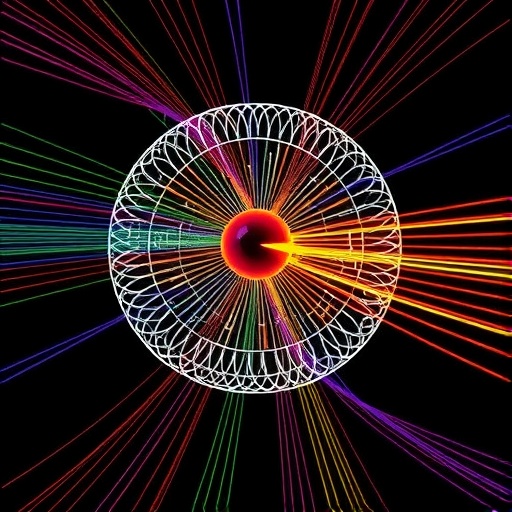
In the relentless quest to innovate electronic materials, researchers have long sought ways to transform the fundamental properties of these substances without the painstaking process of chemical substitution or elaborate structural engineering. A groundbreaking study spearheaded by Chief Researcher Masanori Kohno at the Research Center for Materials Nanoarchitectonics (MANA), National Institute for Materials Science (NIMS), showcases a revolutionary approach: dynamically reshaping the electronic landscape of materials through the direct manipulation of electron interactions using external perturbations such as light, electric fields, and magnetic influences.
Traditional semiconductor technology hinges on the occupancy of fixed energy bands by electrons; external fields typically influence only electron distribution across these bands, leaving the intrinsic band structure virtually untouched. This inherent rigidity constrains the development of devices that require responsive, tunable electronic properties. Kohno’s research, however, uncovers a sharply contrasting paradigm in the realm of strongly correlated materials, particularly Mott and Kondo insulators, known for their intense electron-electron interactions and complex many-body physics.
Strongly correlated insulators distinguish themselves by allowing electron spins and charges to decouple under specific conditions. In conventional band insulators, spin and charge excitations are tightly bound, limiting the system’s response to perturbations. By contrast, in correlated insulators, excitations that affect spins or charges—triggered by doping, magnetization, or irradiation—can spawn novel electronic states nestled inside the energy gap separating the valence and conduction bands. These emergent in-gap states serve as new conduits for electronic activity, fundamentally altering the material’s behavior.
The theoretical framework and numerical simulations presented in this study illuminate how collective excitations—involving large ensembles of spin flips or charge movements—can reorganize the band structure itself, not just its electronic population. This dynamic reconfiguration arises from the intricate interplay between spin and charge degrees of freedom inherent to these materials. As such, the induced electronic states possess considerable spectral intensity and robustness, signifying a substantial modification rather than a mere perturbative effect.
Kohno’s analysis leverages sophisticated modeling techniques to detail the microscopic mechanisms underpinning these phenomena. By solving many-body Hamiltonians that encapsulate strong electron correlations, the research delineates how spin-charge separation facilitates the formation of new dispersive states within the gap. This reinterpretation of band structure dynamics compels a reevaluation of electronic phase behavior in correlated systems and challenges the prevailing notions derived from conventional semiconductor physics.
This ability to “engineer” electronic bands on demand via external stimuli opens profound possibilities for future electronic components. For example, photovoltaic devices could exploit light-induced band reshaping to enhance solar energy conversion efficiencies dynamically. Moreover, spintronic applications stand to benefit immensely by harnessing spin excitations that alter transport and magnetic properties without permanent material modification.
Importantly, the research underscores that these transformations are reversible and controllable, facilitated by various experimental handles such as optical pulses or applied fields. This tunability promises adaptive devices capable of real-time reconfiguration, surpassing static semiconductor architectures. Such advances could revolutionize optoelectronic and quantum information technologies, where controlled manipulation of electronic states is paramount.
The study also sheds light on the broader implications of strong correlation physics, particularly how emergent quasiparticles and collective modes can redefine electronic ground states and excitations. These insights bridge condensed matter physics and materials engineering, offering a unified language to approach phenomena across disparate classes of materials from insulators to unconventional superconductors.
While many aspects of correlated insulator behavior remain conceptually challenging and experimentally demanding, Kohno’s results provide a compelling theoretical anchor. They pave the path toward rational design principles that exploit many-body interactions to achieve electronic functionalities unattainable in single-particle frameworks.
This research heralds a new era where the electrons within a material are not passive carriers but active participants capable of reconfiguring their environment in response to stimuli. By controlling these internal degrees of freedom, scientists can unlock unprecedented device functionalities, fostering innovations that will ripple across computing, energy harvesting, and sensing technologies.
As the scientific community continues exploring these phenomena, collaborations that integrate advanced spectroscopy, ultrafast optics, and computational physics will be crucial. Together, these efforts strive not only to validate and extend Kohno’s theoretical predictions but also to transition these concepts from the laboratory to practical applications.
Ultimately, this breakthrough points toward a future in which the boundaries between material structure and electronic functionality blur, empowering a new generation of adaptive, intelligent materials that respond dynamically to their operating environments. The strong electron correlations that were once deemed a challenge now stand as a gateway to transformative advances in material science and technology.
Subject of Research: Electronic behavior and band structure engineering in strongly correlated insulators, specifically Mott and Kondo insulators
Article Title: Electronic modes induced by spin and charge perturbations in Mott and Kondo insulators
News Publication Date: 3-Dec-2025
References: Research Center for Materials Nanoarchitectonics (MANA), National Institute for Materials Science (NIMS)
Image Credits: MANA, NIMS and Science Graphics. Co., Ltd.
Keywords
Physics, Materials science, Condensed matter physics, Electronics, Semiconductors, Spintronics, Nanotechnology, Optoelectronics, Theoretical physics


