

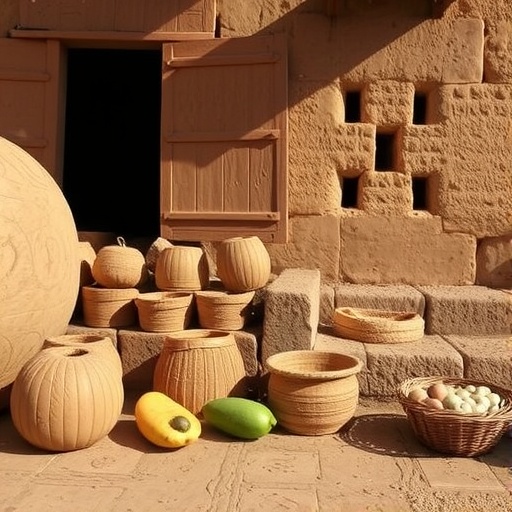
In the arid landscapes of Northern Sudan, within the historical boundaries of the Kingdom of Dongola, a fascinating study has been unearthed that shifts the focus to the dietary practices of the Nubians from the fourteenth to eighteenth centuries CE. Through meticulous research, scholars aim to provide an expansive insight into food crop storage methods, revealing not just the practices of the past, but also the cultural significance of these methods in the ongoing narrative of Nubian history. This investigation into ancient agricultural techniques highlights a key pillar of sustenance in a region often characterized by its harsh environment and limited resources.
Employing archaeological methodologies, the researchers meticulously excavated sites that housed remnants of what was once a bustling agrarian society. The findings are critical as they shed light on how ancient Nubians adapted their agricultural practices to thrive in a climate that posed numerous challenges. The artifacts discovered range from storage containers to remnants of various crops, each telling a story of resilience and ingenuity. The implications of these practices stretch far beyond mere survival; they offer clues to social structures, trade relations, and dietary preferences that defined this ancient civilization.
The methodology adopted in this study was comprehensive, involving both fieldwork and laboratory analyses that provided a multidimensional view of the agricultural history of Dongola. By examining the size, shape, and contents of storage facilities, researchers began to reconstruct the dietary habits of the Nubians. Notably, the identification of certain crops revealed a trend towards diversification in farming practices contrary to earlier assumptions of monoculture. This diversification indicates a sophisticated understanding of crop rotation and food storage that enhanced both nutrition and sustainability.
The role of climate in agricultural practices cannot be understated in this context. The Nubians faced a demanding environment where fluctuations in precipitation directly influenced farming outcomes. The study reveals how ancient communities planned their agricultural cycles around these climatic variations, employing traditional knowledge passed down through generations. This understanding allowed them to master water management techniques, making them more resilient to the vicissitudes of their environment.
What truly stands out is the cultural resonance of food within Nubian society. The research highlights how food was not merely sustenance but an integral part of social identity and community values. Festivals and communal meals connected people, reinforcing social bonds and illustrating the importance of agriculture in their cultural framework. This anthropological lens adds depth to the understanding of the Nubian diet, transforming it from a mere pragmatism of survival into a rich tapestry of social interplay and historical context.
The implications of this research extend into the present day, as understanding the nutritional past of a civilization can inform contemporary agricultural practices. The resilient techniques of the Nubians offer lessons in sustainability, particularly relevant in today’s context of climate change and food security. The insights reveal methods of adaptation and resource management that, if revisited, could enrich modern approaches to agricultural challenges.
Moreover, the findings challenge preconceived notions about ancient agricultural societies. Often, these societies are depicted as primitive or underdeveloped; however, the advanced understanding of crop storage and diversification presents a paradigm shift in how we interpret the capabilities of ancient civilizations. This research contributes to the ongoing conversation surrounding the complexity of historical societies, emphasizing that intelligence and innovation are not exclusive to modernity.
In the larger scope of archaeological research, such studies are pivotal. They illustrate how food and agriculture serve as vital lenses through which we can examine human behavior, social organization, and cultural development. By creating a narrative that bridges the ancient and modern worlds, this study elevates the discourse around Nubian history and provides a framework for richer, more informed discussions about the interplay between environment, agriculture, and society.
As the study progresses, the integration of various scientific methods such as phytolith analysis and carbon dating will refine our understanding of the timelines and conditions of crop cultivation in the region. These approaches promise further revelations about the agricultural practices over centuries, contributing to a more detailed and comprehensive understanding of historical diets.
Furthermore, the interdisciplinary collaboration between archaeologists, botanists, and historians underscores the value of collective expertise in unraveling the complexities of past human life. Each discipline brings unique insights to the table, fostering a richer dialogue that can lead to groundbreaking discoveries. The success of this research exemplifies the importance of collaboration in the pursuit of knowledge, demonstrating how multifaceted inquiries can lead to a more nuanced understanding of history.
As the team continues their work, they remain committed to sharing their findings with the broader community. Engaging the public and fellow researchers through articles, lectures, and interactive forums will ensure that these important narratives of the Nubian diet and agricultural practices reach a wide audience. By doing so, they hope to inspire a renewed appreciation for the sophistication of ancient societies and their lasting contributions to our understanding of cultural heritage.
Ultimately, this research serves as a reminder of the profound connections between diet, culture, and environment. It allows us to appreciate how ancient societies such as the Nubians navigated the challenges of their time with ingenuity and resilience—a legacy that resonates with contemporary challenges in food security and sustainability. The story of the Nubian diet is not merely an exploration of what was consumed but also an invitation to reflect on how we, as a global community, can learn from the past to inform our future.
Through this lens, the narrative not only enriches our understanding of Nubian history but also invites us to engage critically with our current agricultural practices and dietary choices. The lessons drawn from the past are evergreen, providing vital insights that encourage sustainability, cultural respect, and a deeper appreciation for the complex interplay of forces that shape human societies across time.
Subject of Research: Ancient Nubian Diet and Agricultural Practices
Article Title: A Window into the Nubian Diet: A Case Study of Food Crop Storage in the Kingdom of Dongola (Fourteenth to Eighteenth Centuries CE), Northern Sudan
Article References:
Nasreldein, M., Riehl, S., Deptuła, A. et al. A Window into the Nubian Diet: A Case Study of Food Crop Storage in the Kingdom of Dongola (Fourteenth to Eighteenth Centuries CE), Northern Sudan. Afr Archaeol Rev 42, 259–290 (2025). https://doi.org/10.1007/s10437-025-09622-y
Image Credits: AI Generated
DOI: https://doi.org/10.1007/s10437-025-09622-y
Keywords: Nubian diet, agricultural practices, food storage, Dongola, sustainability, ancient civilization, archaeology, cultural heritage.


