

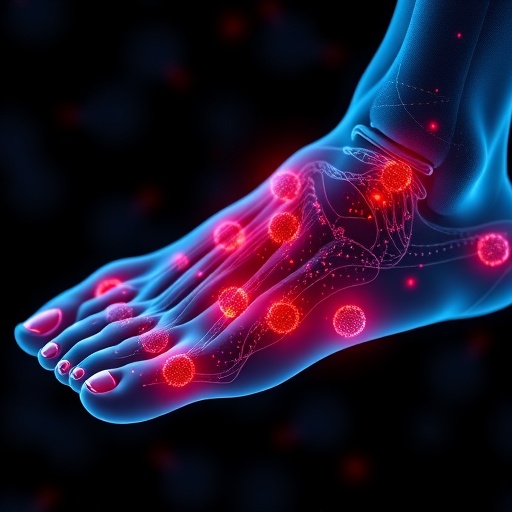
In a groundbreaking study, researchers led by Wang et al. have unveiled a revolutionary approach to diabetic foot regeneration, emphasizing the role of trace elements and novel exosome modules. Published in Military Medicine Research, this pioneering research highlights the interplay between a self-adaptive dual-network hydrogel and intricate biological pathways including complement activation, mitochondrial function, and autophagy. This study is set to change the landscape of diabetic wound healing, particularly for patients affected by diabetic foot ulcers, a common and debilitating complication of diabetes.
Diabetic foot ulcers represent a significant and growing global health concern, afflicting millions of individuals worldwide. The challenges in managing these wounds stem from their complex and chronic nature, often resulting in severe complications such as infections, amputations, and decreased quality of life. Traditional treatment methodologies have faced criticism for their inadequacies, thus necessitating the exploration of innovative solutions. The research group demonstrates how trace element-dictated exosome modules can serve as fundamental units in regeneration, fostering a pathway toward renewed tissue formation.
At the heart of this investigation lies the dual-network hydrogel, a unique biomaterial that adapts dynamically to its environment. This hydrogel is engineered to respond to physiological conditions, making it suitable for use in an array of wound types. It encapsulates exosomes enriched in therapeutic trace elements, enhancing their release and effectiveness at the site of injury. Such hydrogels not only provide a physical scaffold conducive to cellular migration and growth but also harness the natural regenerative properties of exosomes derived from mesenchymal stem cells.
Exosomes, which are nano-sized extracellular vesicles, have gained prominence for their role in cell-to-cell communication. The trace element-enriched exosomes discussed in this research serve a dual purpose; they facilitate not only the delivery of critical bioactive molecules but also modulate the wound healing microenvironment. The researchers pointed out that certain trace elements are essential for mitochondrial function, influencing metabolic processes crucial in regenerating damaged tissues.
The comorbid interplay between complement activation, mitochondria, and autophagy forms a triad of biological processes pivotal in mediating tissue repair. Complement proteins, part of the immune response, play a critical role in facilitating inflammation and regeneration. Mitochondrial health is equally indispensable, as these organelles are the powerhouses of the cell, providing adenosine triphosphate (ATP) needed for cellular activities. Through the regulation of autophagy, the body can dispose of damaged organelles and proteins, promoting cellular rejuvenation. Collectively, these pathways orchestrate a harmonious response to injury, optimizing the repair process.
What sets this study apart is the exhaustive assessment of the functional mechanisms through which the hydrogel interact with various cellular populations, including fibroblasts and macrophages. The adaptability of the hydrogel allows it to not only maintain moisture and provide cushioning but also to release trace elements and exosomes in a controlled manner. As the wound continues to heal, the material gradually degrades, leaving behind regenerated tissue that boasts similarities to native skin architecture.
The researchers employed a combination of in vitro and in vivo models to validate their hypothesis, exhibiting convincing evidence of enhanced wound closure and improved tissue architecture in treated groups. Histological analyses confirmed that the hydrogel had effectively orchestrated a more nuanced and accelerated healing process compared to both control groups and traditional treatment modalities. These findings drive home the potential for translating this research into clinical practice, offering hope for effective diabetic foot ulcer management.
Moreover, this innovation paves the way for personalized medicine, where diabetic patients could receive treatments tailored to the specific trace elements and biological signals their bodies require. This adaptability exemplifies the future of regenerative medicine, where therapies are not one-size-fits-all but rather customized to optimize outcomes based on individual physiological response.
As we venture into an era defined by technological advancement in biomedicine, the implications of Wang et al.’s findings cannot be overstated. This research underlines the significance of understanding the microenvironment of healing tissues and the pivotal role that innovations in biomaterials can play in drastically improving patient outcomes. The integration of trace elements into a robust hydrogel framework exemplifies how multidisciplinary approaches can yield transformative solutions to long-standing health issues.
In conclusion, the synergistic effect of trace elements and engineered exosome modules presents a viable pathway for enhancing diabetic foot regeneration. The future of diabetic care hinges on continued research in biocompatible materials and biological mechanisms, offering the promise of reducing the suffering of millions with better wound healing solutions. This study not only expands the scientific community’s understanding of wound healing but also inspires hope for diabetic patients facing the challenges of foot ulcers.
Ultimately, research such as this illustrates a significant step forward in addressing the diabolical problem of diabetic foot ulcers. The convergence of material science and biological understanding heralds a new dawn for patients; one marked by healing, restoration, and a return to the activities of daily living.
Subject of Research: Diabetic Foot Regeneration
Article Title: Trace element-dictated exosome modules and self-adaptive dual-network hydrogel orchestrate diabetic foot regeneration through complement-mitochondria-autophagy circuitry
Article References: Wang, SQ., Jin, MJ., Guo, ZK. et al. Trace element-dictated exosome modules and self-adaptive dual-network hydrogel orchestrate diabetic foot regeneration through complement-mitochondria-autophagy circuitry. Military Med Res 12, 71 (2025). https://doi.org/10.1186/s40779-025-00658-4
Image Credits: AI Generated
DOI: https://doi.org/10.1186/s40779-025-00658-4
Keywords: diabetic foot regeneration, exosomes, dual-network hydrogel, mitochondrial function, autophagy, tissue engineering


