

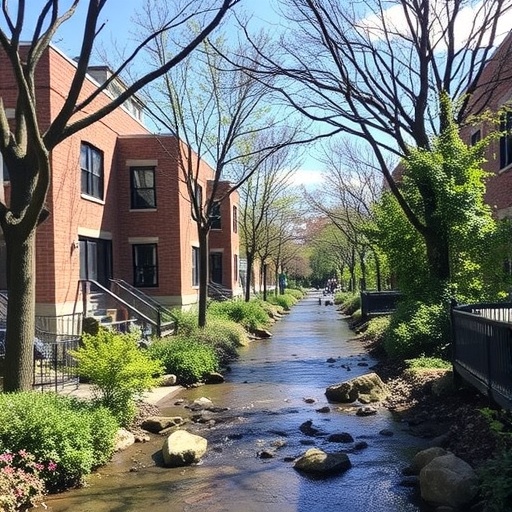
Urban environments are increasingly integrating nature-based solutions (NbS) in an effort to manage water resources effectively. As cities confront the challenges posed by climate change and urbanization, the importance of balancing ecological integrity with urban development is paramount. One critical area of study is the sensitivity of these urban aquatic systems to hydroclimate variability, a topic explored in a comprehensive research study led by Warter et al. This investigation employs stable water isotopes to dissect the complex interactions between urban ecosystems and changing hydroclimatic conditions.
Stable water isotopes are invaluable tools in environmental science, providing insights into water sources, movement, and fluxes in the environment. The study highlights how isotopic analysis can unravel the nuanced behaviors of urban aquatic systems, indicating responses to variations in precipitation, evaporation, and land use changes. Through this lens, researchers aim to assess the resilience of NbS, thereby enhancing our understanding of how these natural infrastructures can be optimized to withstand climatic fluctuations.
Historically, urban water management strategies have leaned heavily on gray infrastructure, which often fails to consider the ecological ramifications of water resource allocation. The distinctive approach of incorporating NbS intends to utilize natural processes to manage stormwater, improve water quality, and restore ecosystems. However, the effectiveness of these systems under variable hydroclimatic conditions requires thorough evaluation. The research led by Warter et al. serves as a foundational step in revealing how urban water systems respond to environmental stressors.
A critical aspect of the study is its focus on various urban settings, which collectively provide a broad spectrum of hydroclimate variability. This multi-site approach is essential for understanding how localized factors influence the sensitivity of NbS. By conducting fieldwork across different urban landscapes, the team captures a holistic view of how water isotopes can be indicators of sustainability and resiliency in urban planning.
Moreover, the paper elucidates the interplay between hydrology and urban design, emphasizing that NbS must be integrated thoughtfully into urban landscapes. Effective design will consider not only the ecological functions of these solutions but also their ability to adapt to changing climate conditions. The research underscores that urban planners and policymakers must take a proactive stance in embracing adaptive management strategies rooted in scientific findings to enhance the durability of NbS.
Another significant contribution of this study is the conceptual framework it offers for assessing the effectiveness of NbS under hydroclimatic variability. This framework connects theoretical concepts with empirical findings, promoting a robust dialogue between researchers and practitioners in the field. By translating complex data on stable water isotopes into actionable insights, the researchers foster a more profound understanding of the implications for urban water management.
The findings presented in this research will likely have far-reaching implications not only for future academic studies but also for urban policy-making. It highlights the importance of adaptive management in urban environments, particularly for systems that must respond to unpredictable climate-related challenges. The urgency of implementing resilient urban designs is echoed throughout the paper, calling for immediate action to safeguard ecological integrity amidst growing uncertainties.
Furthermore, the research stresses collaboration among various stakeholders, including scientists, urban planners, and local communities. Such partnerships are vital for the successful development and implementation of NbS, ensuring that diverse perspectives inform decision-making processes. Engaging local communities ensures that restoration practices resonate with the inhabitants’ needs, anchoring them in the social fabric of城市生活.
The investigation also delves into the technical methodologies employed, such as water sampling and isotopic analysis. By detailing these processes, Warter et al. shed light on the rigor and robustness of their approach, which reinforces the credibility of their findings. This transparency ensures that future research can build upon their methodologies, facilitating advancements in the field of urban aquatic systems.
As cities continue to grow, the adaptation of NbS must also be dynamic, mimicking the natural variability inherent in ecosystems. The research shows that with appropriate methodologies, urban planners can track changes in water isotopes over time, offering a predictive capability that could revolutionize urban water management. This predictive approach encourages cities to not only react to current conditions but also prepare for future atmospheric shifts.
In conclusion, Warter et al. offer a compelling blueprint for understanding the complex dynamics between urban aquatic nature-based solutions and hydroclimate variability. Their use of stable water isotopes provides a comprehensive window into the resilience of these systems, emphasizing the need for a collaborative, adaptive approach to urban planning. This research stands as a clarion call for urban environments to harness nature’s inherent resilience, ensuring the protection of urban water resources amidst the challenges posed by climate change.
The implications of this study stretch beyond mere academic interest; they present a critical reflection on our urban future and our responsibility to integrate ecological principles into urban design. As more urban areas face the specter of climate change, the lessons drawn from this research will be essential in guiding cities toward sustainable futures, effectively marrying ecosystem health with human development.
In essence, the research conducted by Warter et al. stands as a testament to the power of science in shaping urban resilience. By addressing the pressing challenges posed by hydroclimate variability, the study provides valuable insights that communities can leverage to create greener, more sustainable urban environments. As the world continues to grapple with an uncertain environmental future, the integration of nature-based solutions will be key to our survival and well-being in urban spaces.
Subject of Research: Sensitivity of urban aquatic nature-based solutions to hydroclimate variability.
Article Title: Assessing the sensitivity of urban aquatic nature-based solutions to hydroclimate variability using stable water isotopes.
Article References:
Warter, M.M., Soulsby, C., Vierikko, K. et al. Assessing the sensitivity of urban aquatic nature-based solutions to hydroclimate variability using stable water isotopes.
Environ Monit Assess 198, 20 (2026). https://doi.org/10.1007/s10661-025-14882-x
Image Credits: AI Generated
DOI: https://doi.org/10.1007/s10661-025-14882-x
Keywords: Urban ecosystems, nature-based solutions, hydroclimate variability, stable water isotopes, urban water management.


