

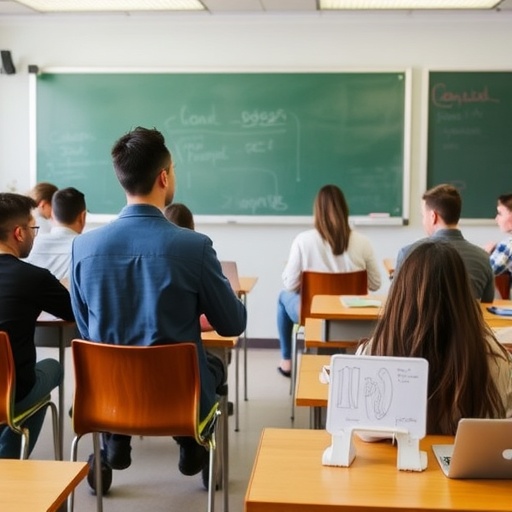
In a groundbreaking study by Kong, Dong, and Zhang, researchers explore the intersection of classroom behaviors and digital teaching quality through the lens of advanced computational methods. The work, published in the journal Discover Artificial Intelligence, introduces an innovative approach utilizing spatiotemporal graph neural networks (ST-GNNs) for a comprehensive analysis. This research not only sheds light on the intricate dynamics of classroom interactions but also proposes a novel framework for evaluating the effectiveness of digital teaching methods.
The authors begin by highlighting the rapid integration of digital tools in educational settings, which has transformed traditional teaching approaches. As classrooms evolve into more interactive and technology-driven environments, understanding the behavior of students and teachers becomes paramount. Through the lens of ST-GNNs, the researchers aim to capture the spatial and temporal aspects of classroom interactions, providing a richer understanding of the factors that influence learning outcomes.
At the core of this research is the utilization of spatiotemporal graph neural networks, which are particularly adept at handling complex data structures. Unlike conventional neural networks, ST-GNNs are designed to process data that varies in both space and time, making them well-suited for evaluating classroom dynamics. By modeling interactions as a graph, where nodes represent individuals and edges reflect relationships and communications, the researchers can analyze how different factors interrelate over time.
One of the fundamental findings of the study reveals that classroom behaviors significantly impact the quality of digital teaching. By employing ST-GNNs, the authors demonstrate that certain patterns of student engagement are correlated with higher academic performance. For instance, collaborative learning behaviors, where students actively engage with peers and instructors, positively correlate with increased retention of information and improved critical thinking skills. This insight underscores the importance of fostering a supportive and interactive classroom environment.
The researchers also address the challenges associated with traditional methods of classroom behavior analysis. Many existing approaches rely on qualitative assessments or simplistic quantitative measures, which often fail to capture the nuanced interactions that occur during lessons. By harnessing the power of ST-GNNs, this study opens new avenues for real-time analysis, enabling educators to adapt their teaching strategies based on the observed behaviors of students. This dynamic feedback loop creates an opportunity for continuous improvement in instructional methods.
Moreover, the study outlines practical applications of the ST-GNN framework within the classroom setting. For educators, this means the potential to tailor instructional materials to better engage students. For example, data derived from the ST-GNN analysis can inform teachers when to introduce collaborative activities or when to shift towards more individualized instruction. Such insights empower educators to make informed decisions that enhance the learning experience for all students.
In highlighting the implications of their findings, the authors suggest that integrating technology into teaching must go beyond mere implementation. Educators must consider how these tools facilitate interactions and engage students in meaningful ways. With the ability to analyze classroom behaviors through advanced computational techniques, teachers can become more attuned to the rhythms of their classroom and create an environment conducive to active learning.
As the education sector continues to adapt to the digital age, this research serves as a vital contribution to discussions on effective teaching practices. The findings provide evidence that when educators embrace data-driven methodologies, they can significantly elevate the quality of digital teaching. This transition towards a more analytical approach reflects a broader trend within academia, where technology is increasingly leveraged to optimize educational methods.
Additionally, one cannot overlook the role of institutional support in fostering such innovative practices. Schools and educational bodies must provide necessary training and resources for teachers to utilize these advanced technologies effectively. The research calls for a paradigm shift in teacher training programs, where educators are equipped with not only pedagogical skills but also an understanding of how to leverage data analytics to inform their teaching strategies.
Looking towards the future, the implications of this study extend beyond individual classrooms. By embracing spatiotemporal graph neural networks, the education ecosystem can create a larger narrative around enhancing student engagement and learning outcomes. Policymakers, educational leaders, and researchers must collaborate to develop frameworks that encourage the adoption of such innovative tools across various learning environments.
In conclusion, Kong, Dong, and Zhang’s research presents a compelling case for reimagining classroom behavior analysis and digital teaching evaluation. The application of spatiotemporal graph neural networks not only enhances our understanding of the intricate dynamics within educational spaces but also empowers educators to transform their teaching practices. This study paves the way for more data-informed approaches to education, ultimately cultivating an environment that prioritizes effective learning for every student.
As we stand at the intersection of technology and education, the insights presented in this research offer a glimpse into a future where classrooms are not only spaces for learning but also hubs of innovation, engagement, and continuous improvement.
Subject of Research: Classroom behavior analysis and digital teaching quality evaluation using spatiotemporal graph neural networks.
Article Title: Classroom behavior analysis and digital teaching quality evaluation based on spatiotemporal graph neural network.
Article References: Kong, Y., Dong, R. & Zhang, H. Classroom behavior analysis and digital teaching quality evaluation based on spatiotemporal graph neural network. Discov Artif Intell 5, 404 (2025). https://doi.org/10.1007/s44163-025-00623-z
Image Credits: AI Generated
DOI: https://doi.org/10.1007/s44163-025-00623-z
Keywords: Classroom behavior analysis, digital teaching quality, spatiotemporal graph neural networks, education technology, student engagement.


