

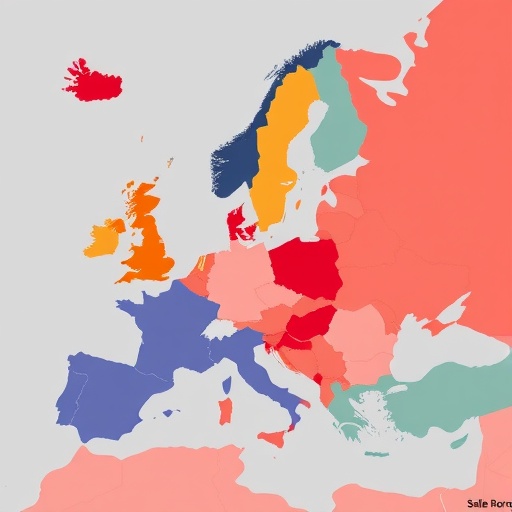
In a groundbreaking study poised to reshape our understanding of environmental health disparities across Europe, researchers at the Barcelona Institute for Global Health (ISGlobal), in collaboration with the Barcelona Supercomputing Center (BSC), have unveiled striking socioeconomic and energy-related factors that exacerbate vulnerability to air pollution-induced mortality. Published in the prestigious journal Nature Medicine, this comprehensive meta-analysis leveraged enormous datasets and cutting-edge machine learning methods to dissect the intricate interplay between poverty, renewable energy adoption, and air quality, revealing a layered narrative about public health, environmental justice, and policy effectiveness in the 21st century.
The scope of this study is unparalleled: analyzing nearly 89 million death records spanning 16 years across 653 contiguous regions within 31 European nations, it provides the most exhaustive examination to date of how environmental toxicity translates into premature mortality in diverse socioeconomic contexts. Employing sophisticated atmospheric models, the team meticulously estimated daily concentrations of key pollutants, including fine and coarse particulates (PM2.5 and PM10), nitrogen dioxide (NO2), and peak ozone levels (O3), which are known contributors to cardiovascular and respiratory morbidity and mortality.
What distinguishes this research is not simply the breadth of data but its integration with granular regional socioeconomic indicators and renewable energy consumption metrics. By interweaving these complex datasets through innovative epidemiological modeling, the researchers were able to parse out how vulnerability to airborne toxins is not a mere function of pollutant concentrations but fundamentally conditioned by wealth, education, healthcare infrastructure, and the pace of green energy transition. This multidimensional approach advances knowledge beyond traditional exposure assessments, emphasizing that the health burden of pollution is deeply entrenched in social determinants.
One of the most consequential revelations is the identification of stark health inequities correlated with socioeconomic status. Northern and Western European regions, characterized by higher GDP per capita, lower poverty prevalence, and longer life expectancy, consistently exhibited markedly lower mortality risks from air pollution exposure. Contrastingly, Southern and Eastern European areas, burdened by economic disadvantages and lagging social indicators, suffered disproportionately elevated risks—sometimes doubling those observed in better-off regions—underscoring the invisible toll of social deprivation in amplifying environmental hazards.
Temporal trends further illuminate the uneven progress across the continent. Prosperous regions have experienced significant declines in pollution-associated mortality risks for particulate matter and nitrogen dioxide from 2003 to 2019, reflecting successful policy interventions and systemic investments. In contrast, economically challenged regions have seen minimal improvements or even worsening vulnerabilities, highlighting systemic failures to equitably distribute the benefits of environmental health initiatives and suggesting deep-rooted barriers to protective measures.
By contextualizing health outcomes within regional infrastructure and governance, the research points to plausible mechanisms driving these disparities. Wealthier areas typically possess advanced healthcare systems, robust public health campaigns, heightened societal awareness of pollution’s impacts, and the institutional capacity to enact rigorous environmental regulations. These advantages translate into enhanced resilience against air quality detriments. Conversely, poorer regions grapple with fragmented health services, limited pollution control policies, and insufficient public participation, cumulatively exacerbating population susceptibility.
Crucially, the study also explores the role of renewable energy adoption not only as a means of reducing pollutant emissions but as an agent of broader societal transformation. Accelerated shifts towards clean energy sources are linked to measurable reductions—15% in fine particulates, 54% in coarse particulates, and 20% in nitrogen dioxide—leading to commensurate declines in mortality. Beyond air chemistry, these transitions often stimulate ancillary benefits such as improved urban design, enhanced public transport, and greener infrastructure, all contributing to diminished vulnerability and healthier living environments.
Nevertheless, the geographic pattern of renewable energy uptake reveals persistent divides. Northern Europe spearheads the clean energy movement, showcasing rapid growth and robust investment, while parts of Southern and Eastern Europe, including countries like Malta, Cyprus, Italy, and Poland, remain heavily reliant on fossil fuels. This uneven adoption reflects variations in economic resources, policy frameworks, and access to external funding, perpetuating environmental inequalities and impeding continent-wide progress toward sustainable health equity.
The profound implications of these findings resonate far beyond Europe. As the study’s authors caution, many low- and middle-income countries face similar socioeconomic stratifications coupled with accelerating urbanization and industrialization, often outpacing efforts to institute clean energy infrastructures and pollution controls. This scenario portends a global amplification of health disparities tied to environmental exposure unless proactive, equity-focused policies are enacted.
Experts involved emphasize that integrating health equity at the core of environmental policy is no longer optional but imperative. Targeting reductions in pollutant emissions in the most vulnerable regions, alongside strengthening public health systems, could drastically alter mortality patterns. The authors advocate for expansive environmental and health monitoring platforms that can detect disparities in real-time, inform precision interventions, and ensure that resources reach communities most at risk.
An innovative outcome of this research is its application in ‘Forecaster.Health,’ a pioneering impact-based early warning system. This platform harnesses the study’s air pollution models and epidemiological insights to provide timely alerts about mortality risks due to ambient air pollution and temperature extremes for vulnerable subpopulations. Such tools exemplify how big data and predictive analytics can be operationalized for public health, fostering adaptive responses at local and regional levels and ultimately saving lives.
The Barcelona Institute for Global Health, supported by the ”la Caixa” Foundation, and the Barcelona Supercomputing Center, with funding from European and Spanish institutions, have set a new benchmark in environmental epidemiology. Their approach demonstrates the necessity of combining environmental science, socioeconomic analysis, and energy transition metrics to unravel the multifaceted challenges of air pollution mortality. Notably, the researchers declare no conflicts of interest, reinforcing the integrity of their findings.
This seminal study not only quantifies the intertwined effects of poverty and energy decisions on air pollution-related deaths but also charts a compelling course toward more just and sustainable societies. As Europe—and the world—grapples with the twin crises of climate change and health inequities, integrating socio-environmental determinants into policy frameworks will be critical. The roadmap laid out by ISGlobal and BSC offers a visionary template for achieving healthier populations through equitable environmental stewardship and accelerated clean energy adoption.
Subject of Research: People
Article Title: Socioeconomic and energy transition disparities in air pollution-related mortality across Europe
News Publication Date: 19 March 2026
Web References:
EARLY-ADAPT Project
Forecaster.Health
References:
Chen, ZY., Achebak, H., Huang, W., Paniello-Castillo, B., Petetin, H., Méndez Turrubiates, RF., Pérez García-Pando, C., Ballester, J. Socioeconomic and energy transition disparities in acute air pollution–related mortality across Europe. Nature Medicine, 2026. DOI: 10.1038/s41591-026-04293-x
Keywords: Air pollution, Poverty, Social inequality, Renewable energy, Mortality risk, Environmental health, Socioeconomic disparities, Europe, Machine learning, Public health policy, Climate transition, Environmental justice


