

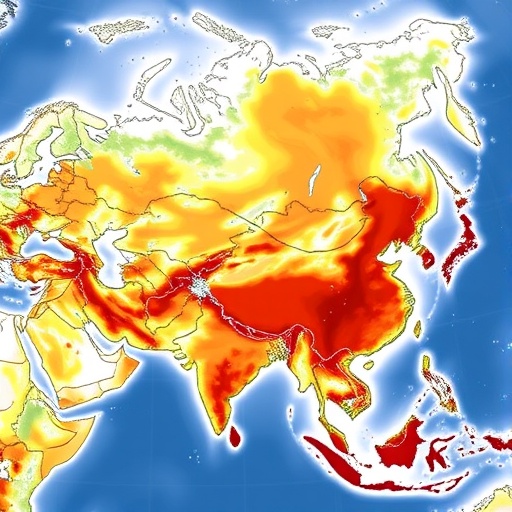
In a groundbreaking study poised to redefine our understanding of atmospheric dynamics, a team of climate scientists has documented an unprecedented pattern of variation in the Eurasian jet stream, revealing what they describe as a record-breaking emergence of zonal-consistent variation stretching from upstream to downstream regions. This remarkable discovery, published in Nature Communications in 2026, sheds new light on the complex, interconnected behavior of jet streams that drive weather and climate patterns across the Northern Hemisphere.
The Eurasian jet stream, a fast-flowing ribbon of air circulating high in the atmosphere, plays a pivotal role in shaping weather across large swaths of Europe and Asia. Typically, the jet stream is characterized by highly dynamic fluctuations that affect storm tracks, precipitation distribution, and temperature gradients. However, the study by Lin, Hu, Chen, and colleagues reveals an unprecedented level of coherence along the entire Eurasian jet axis, suggesting a far more synchronized behavior than previously recognized.
Employing decades of high-resolution atmospheric data combined with advanced climate modeling, the researchers detected a robust zonal-consistent variation—meaning that key features of the jet stream oscillated in a highly coordinated manner along the upstream and downstream segments. This type of variation extends longitudinally over tens of thousands of kilometers, implying that perturbations in one region could quickly propagate along the entire Eurasian corridor, influencing weather regimes thousands of kilometers away.
The team’s methodology involved integrating reanalysis datasets—which assimilate historical observations with numerical weather prediction models—and state-of-the-art machine learning algorithms capable of isolating subtle but persistent signals in jet stream variability. Their approach enabled them to distinguish this newly identified mode of variation from other well-documented patterns, such as the Arctic Oscillation or the Quasi-Biennial Oscillation, thereby establishing its unprecedented character.
A critical finding of this research is the mechanistic insight into the drivers of this zonal-consistent variation. According to the authors, it appears to be fueled by a complex interplay between tropospheric thermal contrasts, stratosphere-troposphere coupling, and large-scale wave dynamics. In particular, intensified land-sea temperature gradients across Eurasia during certain seasons amplify Rossby wave propagation, which in turn modulates the jet stream’s coherence and strength.
This enhanced coherence of the jet stream has profound implications for atmospheric predictability. Traditionally, the chaotic nature of upper-level winds limited the accuracy of weather forecasts beyond a week or two. But the discovery of stable, long-range zonal patterns suggests that certain aspects of Eurasian weather variability may be more predictable than anticipated, potentially improving seasonal forecasts with better lead times and reliability.
Moreover, the study addresses the consequences of this newfound dynamical feature on extreme weather phenomena. The researchers argue that the prolonged persistence and propagation of anomalies along the jet stream axis can foster the development of severe droughts or floods, depending on the phase of the variation. For example, periods of reinforced jet stream zonality could intensify heatwaves over Central Asia while simultaneously influencing cold outbreaks in Western Europe.
Perhaps most intriguingly, the team highlights how anthropogenic climate change may be modulating the strength and frequency of these zonal-consistent variations. Increasing greenhouse gas concentrations, along with altered snow cover and soil moisture patterns in Eurasia, appear to be shifting the baseline state and variability of the jet stream. This alteration implies that future climate scenarios could see more frequent or more extreme manifestations of these variations, with attendant impacts on global climate systems.
Further research is encouraged to explore the teleconnections linking this Eurasian phenomenon with atmospheric circulation in other parts of the globe, such as the North American and Pacific jet streams. Understanding whether similar zonal-consistent patterns emerge in other hemispheric jet streams would be critical for building a comprehensive theory of global atmospheric dynamics under a warming climate.
The authors stress the importance of enhancing global observation networks and modeling capabilities to capture these intricate phenomena. High-altitude weather balloons, satellite remote sensing technologies, and emerging AI-driven climate data analysis will be crucial in monitoring and predicting these jet stream variations moving forward.
This discovery not only deepens foundational atmospheric science but also informs societal resilience planning. Better anticipation of jet stream-driven extreme events may guide agricultural policies, water resource management, and disaster preparedness, particularly across vulnerable Eurasian regions where millions depend on predictable seasonal weather.
The study epitomizes the cutting-edge interdisciplinary approach blending meteorology, climate science, and data science, ultimately unraveling the hidden connectivity embedded within Earth’s atmosphere. By decoding this remarkable emergent behavior of the Eurasian jet stream, Lin and colleagues provide a new lens through which scientists and policymakers alike can navigate a rapidly changing environment.
In sum, the record-breaking emergence of upstream-downstream zonal-consistent variation in the Eurasian jet axis documented in this landmark study marks a paradigm shift in our comprehension of jet stream mechanics and their broader climatic impacts. As this research propels forward, it promises to unlock innovative pathways for forecasting, climate risk management, and understanding the evolving dynamics of the planet’s atmospheric circulation.
Subject of Research: Atmospheric dynamics, jet stream variability, Eurasian climate system.
Article Title: Record-breaking emergence of upstream-downstream zonal-consistent variation in the Eurasian jet axis.
Article References:
Lin, L., Hu, C., Chen, D. et al. Record-breaking emergence of upstream-downstream zonal-consistent variation in the Eurasian jet axis. Nat Commun (2026). https://doi.org/10.1038/s41467-026-68772-y
Image Credits: AI Generated


