

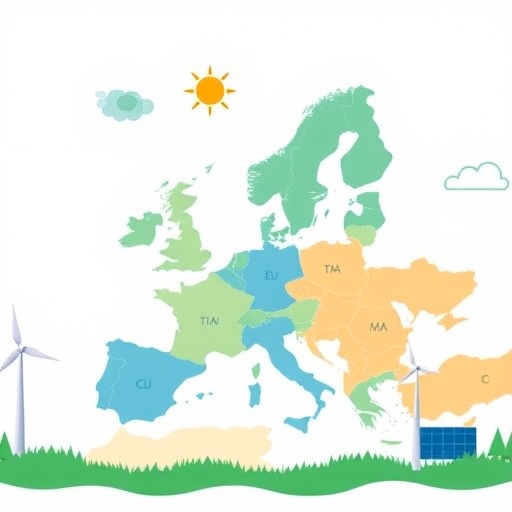
In an era marked by unprecedented challenges in both energy security and climate change mitigation, recent research spearheaded by Lal, Tavoni, Preuss, and colleagues presents a groundbreaking framework poised to realign the European Union’s energy trajectory. Published in Nature Communications, the 2026 study delves into the intricate balance between securing a stable energy supply and accomplishing aggressive climate targets through highly targeted transition strategies. This work situates itself at the confluence of policy, technological advancement, and economic restructuring, delivering detailed insights into how countries within the EU can strategically navigate the complex transition away from fossil fuels while safeguarding their population’s energy needs.
The research underscores the tectonic urgency of rethinking energy systems in light of geopolitical instability, particularly the disruptions highlighted by recent conflicts and economic sanctions that have jolted the European energy landscape. The authors meticulously map the vulnerabilities intrinsic to the traditional fossil fuel dependency, especially natural gas imports from geopolitically sensitive regions, illustrating the imperative for diversification and rapid deployment of renewable technologies. Their approach integrates advanced modeling of energy supply chains with climate impact projections, revealing opportunities for a dual enhancement of energy security and carbon reduction.
Central to the study is the concept of “targeted transition strategies,” a term the authors coin to describe tailored interventions that address distinct regional characteristics and resource availability across the EU member states. Unlike one-size-fits-all policies, these strategies emphasize leveraging national strengths, such as wind corridors in Northern Europe and solar potential in the Mediterranean basin, while addressing local socio-economic contexts. This nuanced approach enhances resilience by mitigating the risk of supply disruptions and fostering economic uplift through localized green investments.
Technically, the study harnesses sophisticated integrated assessment models (IAMs) that combine energy systems simulations with climate economics and policy scenarios. The IAM framework deployed here enables the researchers to quantify the trade-offs and synergies present when pursuing climate-neutral energy solutions alongside resilient infrastructure development. This allows policymakers to foresee the cascading effects of energy transitions on markets, employment, and carbon emissions, ensuring decisions are informed by a holistic understanding of systemic impacts.
The findings highlight that aggressive scaling of renewable energy sources—solar, wind, and emerging technologies such as green hydrogen—can concurrently bolster energy independence and meet decarbonization targets. Particularly noteworthy is the identification of hydrogen as a critical energy carrier, capable of buffering intermittent renewable generation and facilitating cross-border energy trade within the EU. Hydrogen infrastructure deployment, however, requires coordinated investment and regulatory frameworks, which the authors emphasize as non-negotiable for realizing the envisioned benefits.
Energy storage technologies also feature prominently in the research conclusions. The intermittency of renewable generation necessitates advanced storage solutions ranging from battery systems to pumped hydro and thermal storage. The study contends that improving storage efficiency and scalability is integral to smoothing demand fluctuations and ensuring grid stability, thereby making renewable energy a more reliable backbone of the European grid.
Coupled with infrastructural shifts, demand-side management emerges as a pivotal pillar for a secure and low-carbon energy future. The research discusses the role of smart grids and digital technologies that enable consumers to adapt their energy usage dynamically, contributing to a more balanced load profile and reducing peak stress on generation assets. These innovations, according to the authors, can significantly amplify the efficiency gains from renewable deployment.
Financing mechanisms are another critical dimension explored, with the study dissecting public and private sector roles in accelerating the energy transition. Targeted financial instruments, such as green bonds and climate risk insurance, are shown to mobilize capital while spreading risk, particularly in regions lagging in renewable infrastructure. The alignment of EU-wide funding programs with strategic priorities thus forms a cornerstone of the transition blueprint.
Policy coherence across EU institutions and member states is championed as a determinant for success. The study critiques fragmented approaches and advocates for integrated regulatory frameworks that incentivize innovation, harmonize standards, and remove barriers to cross-border energy trading. These governance reforms are portrayed as essential complements to technological advancements, reinforcing the structural robustness of the energy system.
Additionally, the research anticipates the socio-political dimensions of the energy transition, emphasizing inclusive strategies that protect vulnerable populations from energy poverty and job displacement. Retraining programs and social safety nets are proposed to smooth the labor market adjustments inherent to replacing fossil fuel industries with green sector employment, ensuring that the transition is equitable.
Environmental co-benefits extending beyond carbon emissions reductions are also detailed, including improvements in air quality and biodiversity preservation linked to reduced fossil fuel extraction and combustion. These ancillary advantages bolster the argument for a rapid transition, positioning it as a catalyst for a healthier, more sustainable European continent.
Methodologically, the study employs scenario analysis to test various pathways combining different technology mixes, policy instruments, and economic assumptions. This approach elucidates risk profiles and resilience under diverse external shocks, such as fluctuating global energy prices and climate extremes. The scenarios underscore that without decisive and coherent action, the EU risks locked-in dependencies and unmet climate objectives.
More than a mere academic exercise, the study serves as a clarion call to European policymakers, industry leaders, and civil society stakeholders, advocating for urgent, collaborative, and scientifically informed decision-making. The authors’ recommendations, rooted in data-driven projections and grounded in pragmatic feasibility, chart a viable path towards an energy-secure and climate-resilient Europe.
Intriguingly, their framework also offers transferable lessons for other regions grappling with similar dichotomies between energy security and sustainability goals, potentially informing global energy transition efforts. The EU’s experience, as mapped by this study, can become a model for balancing complex priorities through innovation and strategic planning.
In summary, Lal, Tavoni, Preuss, and colleagues articulate a compelling vision wherein the EU’s energy future is shaped by targeted, region-specific transition strategies that unite security and climate imperatives. Their comprehensive and technically rich analysis reveals a multipronged pathway leveraging renewables, storage, hydrogen, policy alignment, and social equity measures. This research not only advances academic discourse but also equips decision-makers with the insights necessary to navigate one of the most critical junctures in modern energy history.
Subject of Research:
Article Title:
Article References:
Lal, A., Tavoni, M., Preuss, N. et al. Aligning EU energy security and climate mitigation through targeted transition strategies. Nat Commun (2026). https://doi.org/10.1038/s41467-025-67595-7
Image Credits: AI Generated
DOI: 10.1038/s41467-025-67595-7
Keywords: energy security, climate mitigation, European Union, renewable energy, hydrogen, energy transition, integrated assessment models, energy storage, policy frameworks, green financing, smart grids, socio-economic equity


