

As coastal communities face the relentless advance of rising seas, the preservation of millennia-old human history becomes an urgent, complex challenge. Along Florida’s fragile Apalachicola Bay, this challenge has been met with an innovative blend of technology and community partnership, reshaping how archaeologists think about protecting cultural heritage in the face of climate change. Dr. Lindsey Cochran, an assistant professor of anthropology at East Tennessee State University (ETSU), has pioneered a visionary approach that combines cutting-edge predictive modeling with deep engagement with local communities. Her work, now nationally recognized with the Society for Historical Archaeology’s 2026 Mark E. Mack Community Engagement Award, illuminates a path forward for heritage preservation where science supports, and is informed by, the people most connected to the land.
The Apalachicola River and Bay system is a repository of over 12,000 years of human history, holding archaeological treasures that narrate the lives and stories of generations past. However, the threat of rising sea levels, driven by climate change, casts a long shadow over these cultural resources. Dr. Cochran’s work is rooted in a fundamental question: How can communities and researchers collaborate effectively to salvage what can be saved from an increasingly vulnerable coastline? Her answer begins with Geographic Information Systems (GIS) — digital tools that allow researchers to map and project the impacts of environmental changes with remarkable precision.
Through rigorous GIS modeling, Cochran’s team has developed detailed digital maps that forecast how rising seas will transform the coastal ecosystems and archaeological sites across Apalachicola Bay. These models are not simply static maps but temporal projections that categorize cultural heritage locations as threatened, damaged, or lost over various future timelines. This predictive approach reveals not only where and when disaster may strike but provides a framework to prioritize preservation efforts systematically. Yet, the true innovation of this project lies beyond the technical achievement; it is in the intentional return of this data to the community, fostering ongoing dialogue and integrating local voices into the preservation narrative.
Engaging with residents of Apalachicola, Dr. Cochran’s team found that historical and environmental concerns are deeply interwoven with the community’s identity and livelihoods. The region’s fisheries, iconic waterfront traditions, and historic architecture are living parts of a cultural landscape facing not only ecological stress but socioeconomic pressures that amplify vulnerability. By listening closely to local knowledge and concerns, Cochran’s research transcends academic modeling — it becomes a community-informed approach that aligns heritage preservation priorities with the lived realities of those who depend on this environment. This synergy of science and community insight presents a replicable model for other coastal regions confronting similar existential threats.
The impact of Dr. Cochran’s work extends beyond research; it reshapes how future archaeologists are trained. At ETSU, archaeology students engage hands-on with real projects that demand both analytical skills and physical fieldwork. Whether developing GIS models or assisting in artifact processing at research laboratories, these students gain a comprehensive education that prepares them for rapidly evolving professional demands. Furthermore, their involvement in community outreach projects — from hurricane recovery efforts to archaeological education for local youth — imbues their work with a tangible sense of purpose and societal contribution. This immersive training ensures that the next generation of archaeologists is equipped to meet climate-induced challenges with both technical competence and empathetic engagement.
The significance of Cochran’s award-winning work is underscored by support from ETSU leadership. Dr. Joe Bidwell, dean of the College of Arts and Sciences, highlights how this project exemplifies ETSU’s commitment to research that is both rigorous and community-centered. Provost Dr. Kimberly D. McCorkle emphasizes that such scholarship is integral to the university’s identity as the flagship institution of Appalachia, charged with addressing pressing regional challenges through collaborative solutions. Together, these perspectives affirm that Cochran’s work is not an isolated academic exercise but a vital contribution to a broader institutional mission of socially engaged science.
At its core, Dr. Cochran champions a vision of archaeology as a service discipline — one where the goal is not merely the publication of research but the empowerment of communities to protect their heritage against unprecedented threats. This philosophy is embedded in every aspect of her approach, from methodologies to student mentorship to public engagement. The recently accepted journal article detailing the People of the Apalachicola project guarantees that the lessons learned here will inform future heritage preservation initiatives far beyond Florida’s shores, providing a blueprint for integrating scientific modeling with community priorities.
The urgency behind this work cannot be overstated. As sea levels continue to rise and coastal erosion accelerates, archaeological sites worldwide are vanishing at alarming rates. Traditional preservation methods, often reactive and limited in scope, are insufficient to address the scale of loss anticipated. Dr. Cochran’s methodology introduces a predictive, proactive strategy that maximizes limited resources and amplifies the voices of those most impacted. This intersection of technology and human connection represents a promising frontier in archaeology and environmental stewardship — a model for how science can serve humanity in an era of rapid change.
Implementing a successful integration of GIS technology with community input requires careful attention to both data accuracy and social sensitivity. The project navigates the complexities of translating technical predictions into accessible, actionable insights for diverse stakeholders. Workshops, public forums, and sustained dialogue ensure that the knowledge generated is not confined to academic silos but becomes a shared resource empowering local decision-making. This commitment to inclusivity and transparency is critical in building trust and achieving meaningful outcomes in heritage management.
Moreover, the interdisciplinary nature of this work — spanning anthropology, environmental science, geography, and community development — highlights the importance of breaking down academic boundaries. Cochran’s team collaborates widely to synthesize scientific data with historical context and current social dynamics, yielding insights that single-discipline approaches might miss. This holistic perspective reflects a growing recognition in environmental and archaeological sciences that complex problems demand multifaceted solutions grounded in both empirical evidence and cultural understanding.
In the context of global climate change, Dr. Cochran’s project in Apalachicola stands as a beacon of how localized research can have profound international implications. Coastal communities from the Gulf of Mexico to Southeast Asia face parallel threats to their cultural landscapes, making this research timely and broadly relevant. As policymakers, conservationists, and scholars seek effective strategies to safeguard heritage, models like Cochran’s offer valuable lessons in balancing scientific innovation with grassroots engagement.
Ultimately, the story of Dr. Lindsey Cochran’s work is one of resilience and hope. By harnessing advanced modeling technologies and fostering authentic community partnerships, her approach transforms the threat of rising seas into an opportunity for collaborative stewardship. In doing so, it ensures that the rich tapestry of human history embedded in vulnerable coastlines has a fighting chance to endure, to educate, and to inspire future generations.
Subject of Research:
Archaeological heritage preservation under threats posed by rising sea levels using Geographic Information Systems (GIS) and community engagement.
Article Title:
(Information not explicitly provided)
News Publication Date:
(Information not explicitly provided)
Web References:
- People of the Apalachicola System: https://www.researchsquare.com/article/rs-7753414/v1.pdf?c=1760813118000
- ETSU Flagship of Appalachia: https://www.etsu.edu/marketing/flagship-of-appalachia.php/
References:
Research article pending publication summarizing People of the Apalachicola project (details forthcoming).
Image Credits:
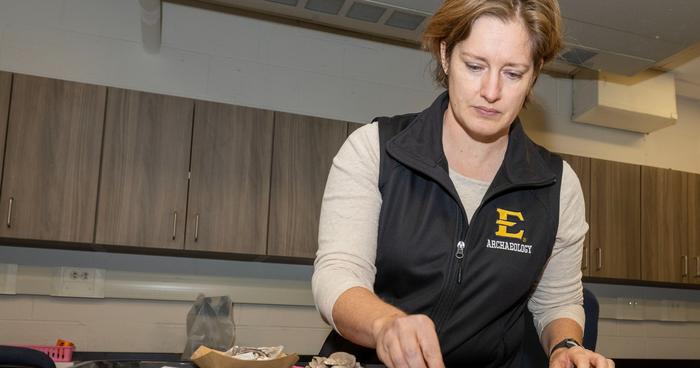
Credit: ETSU (photo of Dr. Lindsey Cochran at work in her laboratory).
Keywords:
Archaeology, Coastal heritage preservation, Sea level rise, GIS modeling, Community engagement, Apalachicola Bay, Climate change adaptation, Anthropological research, Environmental impact, Archaeological education, East Tennessee State University, Historical Archaeology


