

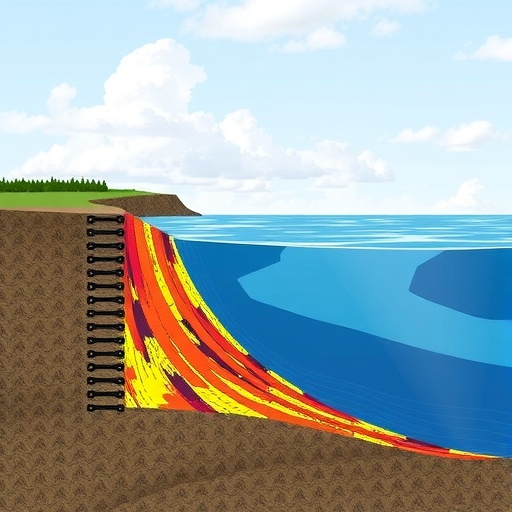
In a groundbreaking study published in Communications Earth & Environment, researchers unveil the critical importance of incorporating rapid sediment redistribution into models estimating tectonic coastal uplift. This revelation challenges longstanding assumptions in geophysical sciences, reshaping how tectonic processes are understood in the context of dynamic coastal environments. The intricate interplay between sediment dynamics and sea-level changes emerges as a pivotal factor influencing the accuracy of uplift estimations, with profound implications for coastal hazard assessments and geological reconstructions.
Tectonic uplift along coastlines—the vertical rise of the Earth’s surface due to plate movements or fault activity—has long been estimated through a combination of geological markers, radiometric dating, and relative sea-level records. Traditionally, scientists have relied on static assumptions regarding sediment distribution, treating deposits as relatively stable over time when correlating uplift signals. However, Ho and colleagues illuminate how swift, large-scale sediment movements can artificially simulate or obscure tectonic signals, effectively blurring the line between sediment-induced sea-level variations and tectonic displacement.
At the heart of this paradigm shift is the recognition that sediment deposition and erosion occur rapidly and heterogeneously in coastal zones, driven by storm surges, river discharge fluctuations, and anthropogenic activity. These sedimentary processes generate local sea-level fingerprints that can fluctuate independently of global mean sea levels or the gradual tectonic forces at play. Ignoring these sediment-driven alterations risks misinterpreting uplift magnitudes and timelines, leading to inaccurate reconstructions of geological history and misjudged predictions of future coastal behavior.
The research team employed sophisticated numerical modeling techniques synergized with in-situ observational data to quantify the scale and temporal dynamics of sediment redistribution. Their approach emphasized a coupling between sediment transport models and sea-level change simulations, allowing them to parse out the relative contributions of tectonics versus sediment dynamics in vertical land movement records. This multidisciplinary methodology not only improved the fidelity of coastal uplift assessments but also underscored the necessity for integrated sedimentary and tectonic frameworks in earth science research.
One particularly illuminating case study detailed in their work focuses on regions characterized by high sediment flux, such as deltaic environments and tectonically active coastlines with prolific sediment sources. In these areas, the sediment-induced variations in relative sea level can reach magnitudes comparable to or even exceeding the uplift caused by tectonic processes during short geological intervals. The researchers argue that previous uplift estimates derived without accounting for these sedimentary effects likely over- or underestimated the true tectonic signals, thus warping our understanding of regional geodynamics.
Key implications of this study extend to seismic risk management and coastal resilience planning. Accurate tectonic uplift quantification informs assessments of fault activity, tsunami hazard potential, and subsidence trends that underpin disaster preparedness strategies. By refining uplift models to incorporate sedimentary influences, policymakers and engineers can better anticipate future landscape evolution and infrastructure vulnerabilities along vulnerable coastlines.
Moreover, the findings open new avenues for reevaluating paleoclimate and sea-level change records preserved in coastal stratigraphy. Misinterpretations arising from sedimentation-related sea-level fluctuations could potentially skew reconstructions of past climate epochs, misinforming models of ice volume change and oceanic circulation patterns. Thus, the research bridges sedimentology and tectonics with broader climatological and environmental inquiries, promoting an integrated Earth system science perspective.
The study also highlights the challenges inherent in disentangling the overlapping signals of sediment redistribution and tectonic uplift, given their similar spatial extents and temporal scales. The team advocates for enhanced field campaigns combining high-resolution topographic mapping, sediment core analysis, and geodetic measurements to validate and calibrate their hybrid numerical models. Such integrative efforts will prove essential for developing robust, transferable methodologies capable of adapting to diverse coastal settings worldwide.
Technologically, this research leverages cutting-edge computational tools including finite element and finite difference modeling frameworks optimized for sediment transport dynamics under variable hydrodynamic regimes. Coupling these with precise geochronological techniques enables a more nuanced depiction of sediment accumulation rates relative to tectonic uplift timelines. The resultant dataset not only captures complexity but also empowers predictive simulations tailored to anticipate future shifts under climate change and anthropogenic impact scenarios.
A critical takeaway from this pioneering work is how rapidly accumulating sediment layers can mask tectonic uplift signals by creating apparent relative sea-level rises or falls through autogenic sedimentary processes. This insight upends prior interpretations of coastal stratigraphic sequences commonly used as proxies for tectonic activity. Consequently, reexamination of key geological sites with the inclusion of sediment redistribution effects is warranted to reassess tectonic histories accurately.
Beyond methodological innovations, these findings solemnly remind us of the complex, interwoven systems governing Earth’s surface processes. Coastal regions are not mere passive recorders of tectonic movements but dynamic arenas influenced by multifaceted sediment and hydrological fluxes. Recognizing this complexity enhances our capacity to decipher Earth’s evolving landscapes, fostering more resilient societies attuned to the subtleties of natural change.
This nuanced understanding also catalyzes future research directions focused on quantifying feedback loops between sediment transport, tectonics, sea-level variability, and ecosystem dynamics. For example, sediment-mediated modification of coastal elevation affects habitat distribution and carbon sequestration potential, linking geological processes with biospheric influences. Integrative studies incorporating geomorphology, sedimentology, tectonics, and ecology will enrich our comprehension of coastal Earth system resilience.
In closing, Ho et al.’s study marks a seminal advancement in geosciences by revealing key sedimentary controls previously overlooked in tectonic coastal uplift estimation. The implications resonate across disciplines—from hazard mitigation to paleoenvironmental reconstruction—emphasizing comprehensive, interdisciplinary approaches to landscape analysis. As climatic and anthropogenic perturbations intensify sediment dynamics globally, these insights underscore the urgent necessity for refining models that critically account for rapid sediment redistribution’s role in shaping coastal elevation records.
With coastal communities facing increasing threats from sea-level rise and tectonic hazards, integrating sediment redistribution dynamics into uplift assessments represents a scientific leap with tangible societal benefits. This research not only recalibrates fundamental tectonic narratives but also empowers stakeholders with more accurate tools for anticipating and adapting to Earth’s ever-shifting shorelines. Moving forward, collaboration across sedimentologists, tectonicists, geodesists, and environmental scientists will be paramount in building on this transformative foundation.
Subject of Research: Estimation of tectonic coastal uplift considering rapid sediment redistribution effects on sea-level variations.
Article Title: Estimating tectonic coastal uplift requires accounting for sea-level variations caused by rapid sediment redistribution.
Article References:
Ho, A., Shyu, J.B.H., Tan, E. et al. Estimating tectonic coastal uplift requires accounting for sea-level variations caused by rapid sediment redistribution. Commun Earth Environ (2026). https://doi.org/10.1038/s43247-026-03302-8
Image Credits: AI Generated


