

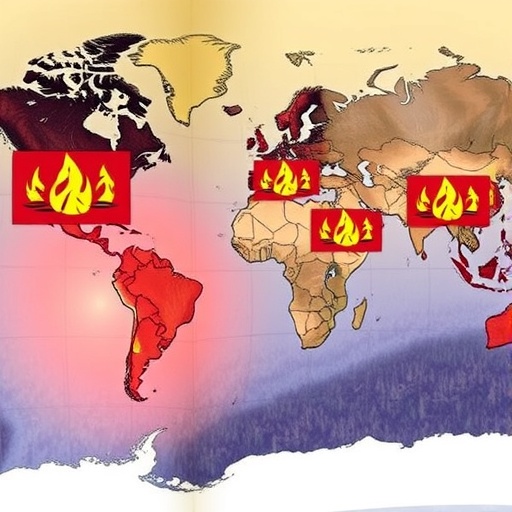
In recent decades, the prevalence of extreme fire weather conditions has undergone a marked global intensification, raising profound concerns about the increasing difficulty of managing wildfires on multiple continents simultaneously. New research conducted collaboratively by investigators from the University of East Anglia (UEA) and the University of California, Merced (UC Merced) reveals a worrying trend: the synchronisation of high-risk fire weather days across geographically disparate regions has substantially increased since 1979. This emergent pattern, defined by a concurrence of excessively warm, dry, and often windy meteorological conditions conducive to fire ignition and propagation, is not merely a reflection of localised intensification but rather a widespread phenomenon that transcends regional boundaries.
The study specifically differentiates between two distinct forms of synchronisation: intra-regional and inter-regional synchronicity. Intra-regional synchronisation occurs when numerous localities within a single defined area simultaneously endure extreme fire weather, whereas inter-regional synchronisation refers to multiple distant regions experiencing these hazardous conditions concurrently. The latter poses unique logistical and strategic challenges, as it drastically limits the operational flexibility of firefighting organizations to reallocate resources, personnel, and equipment where most needed. Such dynamics impose far greater strain on international and interstate firefighting cooperation frameworks, such as those historically active between the United States, Australia, Canada, Europe, and South Africa.
Utilising comprehensive global meteorological datasets from 1979 to 2024, the researchers rigorously calculated daily Fire Weather Index (FWI) values, which integrate parameters such as temperature, relative humidity, wind speed, and precipitation to quantify the potential for wildfire ignition and spread. This robust analytical approach allowed for an unprecedented quantification and spatial visualisation of synchronous extreme fire risk days on a planetary scale. Overlaying this data with real-world fire outcomes, including burned areas and atmospheric particulate matter concentrations associated with wildfire smoke, the team established clear correlations between these synchronised fire conditions and exacerbated fire activity and deteriorated air quality.
The causative drivers underpinning the intensification and synchronicity of extreme fire weather include both anthropogenic climate change and natural climate variability. According to the study’s quantitative attribution analyses, over half of the observed global increase in synchronous fire weather days can be ascribed to human-induced climate forcing, particularly elevated greenhouse gas concentrations contributing to rising global temperatures. Natural climate phenomena such as the El Niño-Southern Oscillation further modulate these patterns, producing episodic amplifications of synchronicity, especially within equatorial and subtropical regions.
The ramifications of these findings extend beyond environmental disturbance, directly impacting public health, emergency services logistics, and international cooperation mechanisms. As same-day extreme fire weather events become more frequent across multiple continents, the collective “window” for mutual aid contracts and resource sharing among nations constricts, leaving firefighting entities more vulnerable to overwhelming fire seasons. The study cites the current cooperation frameworks as effective but increasingly strained under the pressures of simultaneously emergent mega-fires.
One stark example highlighted is the increase in overlapping extreme fire weather days between nations such as the United States and South Africa, where the annual average number of these days has risen by over one per decade. Similar trends in southern Europe, particularly across Portugal and Spain, demonstrate an alarming rise in synchronised extreme fire weather days by more than twelve days annually since 1979, signaling a dramatic escalation in regional fire risk concurrency. These trends forecast a future where the geographic breadth and temporal frequency of extreme fire events may outpace existing firefighting capabilities.
Moreover, the amplified occurrence of synchronous extreme fire events contributes significantly to the degradation of air quality due to increased wildfire smoke emissions. This compound effect is especially pronounced in boreal regions, equatorial Asia, Africa, and South America, where heightened particulate pollution from fire outbreaks poses serious respiratory and cardiovascular health risks to exposed populations. For instance, European exposure to fire-related air pollutants nearly doubles during years exhibiting the highest frequency of synchronous fire risk days.
The research methodology uniquely integrates climate science, atmospheric chemistry, and wildfire ecology, combining state-of-the-art statistical analyses with satellite and ground-based observations. By distinguishing the relative influences of anthropogenic climate forcing and natural variability, the authors provide a nuanced understanding of the mechanistic pathways driving increasing fire weather synchrony. Such insights are crucial for devising adaptive and anticipatory wildfire management systems adapted to the emerging reality of multi-regional fire crises.
Given these findings, the authors advocate for strengthened international collaboration frameworks focused on improving early warning systems, adaptive resource allocation, information sharing, and integrated response protocols. Enhanced communication channels between firefighting agencies, coupled with investment in scalable firefighting technology and workforce capacity, are deemed essential for maintaining operational resilience against increasingly synchronous and severe wildfire seasons exacerbated by escalating climatic stressors.
The study, published in Science Advances on February 18, 2026, underscores the urgent need for the global scientific community, policymakers, and emergency management sectors to reconceptualise wildfire risk from a fragmented local challenge to a coordinated transboundary crisis. The increasing synchronicity of extreme fire weather conditions — driven by the compounded effects of anthropogenic warming and natural climate oscillations — threatens to redefine how societies anticipate, prepare for, and respond to wildfire hazards in an era of accelerating environmental change.
Subject of Research:
Not applicable
Article Title:
Increasing synchronicity of global extreme fire weather
News Publication Date:
18-Feb-2026
Image Credits:
Dr Cong Yin
Keywords:
Wildfires, Natural disasters, Earth sciences, Geography, Climatology, Climate change, Climate systems, Earth climate, Global temperature, Climate change effects, Meteorology, Weather


