

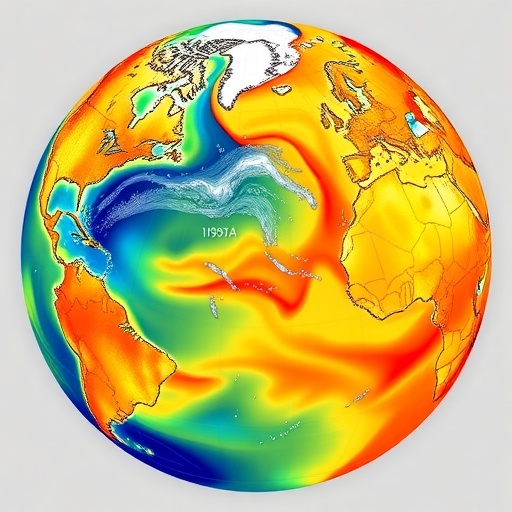
In a groundbreaking study poised to reshape our understanding of past climate dynamics, researchers Yang, Dang, Xu, and colleagues have unveiled compelling evidence that the transfer of upper-ocean heat from the Southern Ocean towards the equator played a pivotal role in amplifying global warming during interglacial periods. Published in Nature Communications, this research provides unprecedented insights into the oceanic mechanisms that governed Earth’s climate fluctuations over millennia, bringing clarity to the complex interplay between ocean currents and atmospheric temperatures during warm intervals separating ice ages.
The team’s investigation centers on the Southern Ocean, a vast and turbulent body of water encircling Antarctica, long recognized as a critical driver of global ocean circulation and heat distribution. Previous studies have acknowledged the Southern Ocean’s role in sequestering carbon and modulating Earth’s climate, but this latest work adds a novel dimension: the identification of intense, large-scale heat transport from these frigid southern latitudes toward the equator during interglacial epochs. Such equatorward heat flux effectively supercharged warming trends at lower latitudes, contributing significantly to the pronounced warmth characteristic of these transitional eras.
At the heart of this discovery lies sophisticated oceanic modeling combined with paleoclimate proxy data analysis. The researchers harnessed cutting-edge climate models that simulate complex ocean-atmosphere interactions under varying greenhouse gas concentrations and orbital configurations mimicking past interglacial conditions. By integrating sediment core records and temperature proxies from multiple locations across the Southern Ocean and tropical regions, the team reconstructed a cohesive picture of how heat content shifted within the upper ocean layers over thousands of years. The findings reveal patterns of intensified meridional (pole-to-equator) heat transport substantially exceeding earlier estimates.
One of the study’s key revelations is the mechanism through which surface waters warmed by melting Antarctic ice and solar radiation were funneled northward by robust currents such as the Subantarctic Front and Antarctic Circumpolar Current. This process not only redistributed thermal energy but also influenced the stratification and deep-water formation critical to the global thermohaline circulation. The enhanced heat movement effectively mitigated the tempering effects of oceanic cold pools in midlatitudes and tropics, thereby accentuating regional temperature increases beyond what atmospheric CO2 forcing alone would predict.
This oceanic conveyance of heat was also shown to be closely linked with shifts in wind patterns and atmospheric pressure systems over the Southern Ocean. The researchers noted an associated intensification of westerly winds during interglacials, which bolstered equatorward Ekman transport—the wind-driven surface current responsible for pushing warmer waters northward. The synergy between atmospheric dynamics and ocean currents highlights the intricate feedback loops governing Earth’s climate system and underscores the Southern Ocean’s function as a catalyst rather than a passive reservoir in interglacial warming phases.
Moreover, the study indicates that these heat transport processes were not uniform over time but varied in response to orbital forcing that altered Earth’s insolation patterns. Variations in Earth’s axial tilt and precession cycles modulated Antarctic ice sheet melt rates and surface wind strengths, thereby influencing the periodic intensity of equatorward heat fluxes. Such findings provide crucial evidence that natural climate variability linked to Earth’s orbital parameters was amplified by dynamic ocean processes, leading to the pronounced warm intervals seen in paleoclimatic records.
The implications of this research extend beyond reconstructing past climates: understanding these oceanic heat transport mechanisms offers invaluable perspectives for predicting future climate responses. As modern anthropogenic warming progresses, changes in Southern Ocean circulation may similarly affect global heat distribution patterns, potentially exacerbating or modulating regional warming trends. This study therefore lays groundwork for improved ocean-atmosphere coupled models that incorporate these critical heat redistribution pathways, enhancing the accuracy of long-term climate projections.
Interestingly, the enhanced upper-ocean heat transport from polar to equatorial regions may also have contributed to accelerated melting of ice sheets and glaciers during interglacials by delivering warmth into critical transition zones. The researchers postulate that this feedback could have intensified sea level rise episodes, linking oceanic thermal redistribution directly to cryospheric stability. This coupling adds new complexity to the understanding of ice-ocean interactions and highlights the importance of investigating such processes in climate evolution narratives.
Equally noteworthy is the study’s innovative use of proxy data, which triangulated temperature reconstructions from multiple ocean basins to trace the trajectory of heat movement. Using isotopic signatures from foraminifera shells, sediment color variations, and trace metal concentrations, the authors were able to generate a spatially resolved map of upper-ocean temperature trends consistent with their modeling outputs. This integration of empirical and modeled data strengthens the robustness of their conclusions and sets a precedent for future interdisciplinary paleoclimate investigations.
The authors emphasize that their findings challenge simplified conceptual models of interglacial climates that predominantly frame warming as a function of greenhouse gases and solar radiation alone. Instead, the dynamic role of ocean currents and heat transport pathways emerges as an essential, and previously underappreciated, lever influencing climate trajectories. This paradigm shift encourages the scientific community to rethink the ocean’s thermodynamic contribution to climate transitions at millennial timescales.
From a broader perspective, this study illuminates the Southern Ocean’s importance in Earth’s climate system as a complex heat engine that dynamically interacts with atmospheric and cryospheric elements. The identification of equatorward upper-ocean heat transport as a driver of interglacial warm phases opens new avenues for research into past climate variability and the ocean’s capacity to regulate global temperatures. It further underscores the necessity for sustained observation and modeling efforts focused on Southern Ocean processes under future climate scenarios.
In conclusion, the work by Yang and colleagues represents a significant leap forward in our understanding of interglacial climate dynamics. By revealing the integral role of the Southern Ocean in funneling upper-ocean heat toward tropical latitudes, their research adds crucial nuance to the mechanisms underpinning past global warming events. This enhanced comprehension of oceanic heat redistribution enriches both paleoclimate scholarship and modern climate model development, with important ramifications for forecasting how Earth’s climate may evolve in the coming centuries.
Collectively, this research reaffirms the ocean’s central function as a conveyor of climate signals and energy, intricately linking diverse planetary reservoirs over vast spatial and temporal scales. As the impacts of climate change become ever more pronounced, unraveling such deep-time ocean-atmosphere interactions will be fundamental to devising strategies for mitigation and adaptation. The Southern Ocean, with its profound influence on upper-ocean heat transport, stands as a vital piece in the puzzle of Earth’s climatic past and future.
Subject of Research:
Oceanic heat transport mechanisms in the Southern Ocean and their impact on interglacial climate warming.
Article Title:
Equatorward upper-ocean heat transport from the Southern Ocean boosted interglacial warming.
Article References:
Yang, C., Dang, H., Xu, J. et al. Equatorward upper-ocean heat transport from the Southern Ocean boosted interglacial warming. Nat Commun (2026). https://doi.org/10.1038/s41467-026-71829-7
Image Credits: AI Generated


