

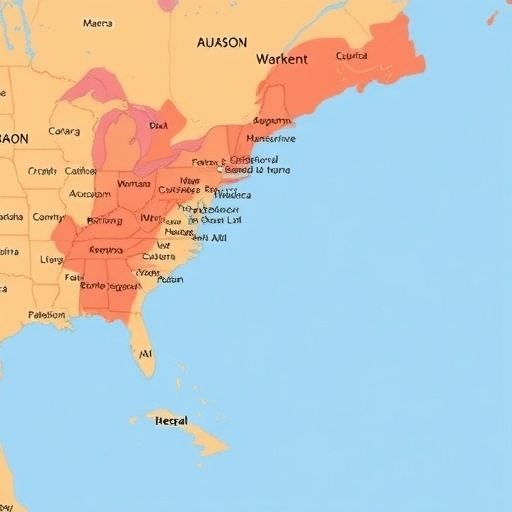
In a striking revelation that challenges prevailing assumptions about environmental justice enforcement in the United States, recent research led by sociologists at Washington State University and Clemson University has unveiled that the most severe federal environmental enforcement actions disproportionately target wealthier counties rather than the most heavily polluted or disadvantaged communities. This finding forces a reevaluation of how environmental laws are applied and raises critical questions about equity and efficacy in environmental crime prosecution.
The study, published in the prestigious journal Nature Sustainability, undertook a comprehensive analysis of criminal prosecutions initiated by the U.S. Environmental Protection Agency (EPA) between 2011 and 2020. Researchers examined over 700 federal environmental criminal cases across more than 400 counties nationwide. Unlike civil penalties, these criminal prosecutions carry serious consequences including potential incarceration, hefty fines, and tax penalties, reflecting the government’s most formidable enforcement tool to deter and punish environmental violations.
Contrary to what many might expect, the investigation did not find a positive correlation between the EPA’s most serious enforcement actions and the level of local pollution or environmental degradation. Using the EPA’s Environmental Quality Index as a benchmark, counties with worse air and water quality were not more likely to face criminal prosecution. Intriguingly, areas with relatively better land quality and higher socioeconomic status – measured through indicators such as income, education, and overall economic well-being – were more frequently the sites of federal prosecutorial activity.
This pattern held steady across two distinct presidential administrations. Whether during the Obama presidency, which emphasized environmental justice in regulatory priorities, or the early years of the Trump administration, the skew toward wealthy counties in criminal case enforcement persisted with surprising consistency. Specifically, counties ranking in the 84th percentile on socioeconomic measures prosecuted criminally by the EPA saw about 24% more enforcement actions compared to median counties. This implies substantial variation in federal enforcement based on community wealth and education rather than strictly on environmental harm.
The study carefully notes that these findings do not imply a lack of environmental violations in poorer or more polluted areas but rather highlight a disparity in the federal government’s approach to crime prosecution. The researchers emphasize that many environmental crimes are underreported and rarely escalate to the level of criminal charges, complicating efforts to fully assess where enforcement efforts are most needed or effective.
One possible explanation advanced by the authors is the evolving focus of regulators toward individuals and smaller companies within better-resourced communities. Major industrial polluters, generally responsible for a disproportionate share of pollution, often have the legal and financial means to negotiate settlements or avoid criminal prosecution outright. This dynamic could inadvertently concentrate EPA criminal enforcement in locales where offenders have less capacity to mount robust legal defenses.
Institutional and organizational factors appear to play a significant role as well. Geographic proximity to EPA criminal enforcement offices, agency resource limitations, and shifting leadership priorities can all influence where and how vigorously the federal government applies criminal sanctions. For example, counties situated far from enforcement hubs consistently recorded fewer criminal cases, suggesting that logistical challenges constrain the reach of federal prosecutions.
Lead author Pierce Greenberg, an assistant sociology professor at Clemson University and former WSU doctoral graduate, notes that these patterns may not stem from explicit bias or intentional neglect but rather arise from complex systemic and procedural factors within the EPA and the broader legal enforcement framework. His team’s work aims to unpack these underlying influences to better understand the forces shaping environmental law enforcement geography.
These insights compel a reconsideration of the foundational goals of environmental legislation such as the Clean Air Act and Clean Water Act, which prioritize protecting vulnerable populations and communities disproportionately burdened by pollution. The current enforcement regime may be inadvertently reinforcing socioeconomic disparities by focusing prosecutorial resources on wealthier counties with more political or legal leverage to press for action.
Erik Johnson, sociology professor and co-author of the study at WSU, stresses that the reality of enforcement is intricately tied to the wider context of growing income inequality and social stratification in the United States. “Is enforcement responding objectively to pollution levels, or is it shaped by community capacity to advocate and pressure for legal action?” Johnson asks. The implicit suggestion is that political and economic clout may be as decisive in triggering criminal prosecutions as the severity of the environmental violations themselves.
This research adds a nuanced dimension to environmental justice scholarship by empirically demonstrating the spatial and socioeconomic biases present in federal regulatory practices. It invites policymakers and advocates to critically assess how enforcement mechanisms can be calibrated to ensure they effectively address environmental harms across all communities, particularly those most vulnerable and burdened by pollution but least able to influence regulatory priorities.
Going forward, increased transparency, resource allocation, and strategic reforms may be needed to transform the EPA’s enforcement landscape. Equipping enforcement offices closer to under-resourced counties, providing support for reporting and investigation of violations in marginalized communities, and scrutinizing the legal stratagems that allow major polluters to evade criminal charges are potential avenues for reducing disparities.
In sum, this comprehensive study unveils that federal environmental criminal prosecution patterns in the United States are shaped more strongly by social and economic factors than by environmental conditions themselves. The implications challenge regulators and society to rethink how justice and environmental protection can be evenly applied, especially in an era marked by widening economic divides and persistent environmental inequalities.
Subject of Research: Analysis of socioeconomic and environmental factors influencing patterns of federal environmental crime prosecutions in U.S. counties.
Article Title: Social factors shape federal environmental crime prosecution patterns in the USA
News Publication Date: January 6, 2026
Web References: http://dx.doi.org/10.1038/s41893-025-01736-0
References: Original research article published in Nature Sustainability
Keywords: environmental justice, EPA enforcement, criminal prosecutions, socioeconomic status, pollution, environmental inequality, Clean Air Act, Clean Water Act, federal regulations, institutional factors, geographic disparities, environmental crime


