

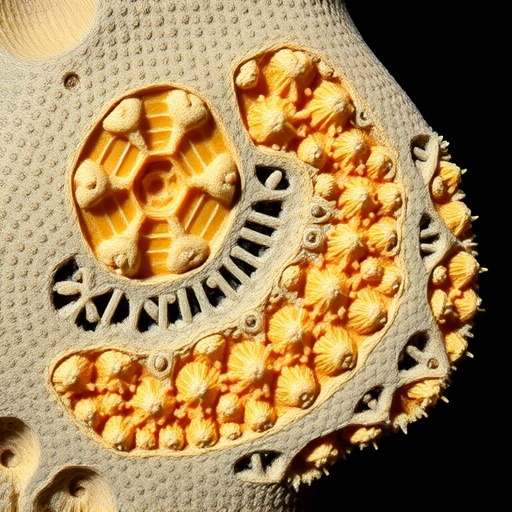
In a groundbreaking study published in Nature Communications, a team of international researchers has unveiled unprecedented insights into the marine ecological transformations that occurred during the Eocene-Oligocene transition, approximately 34 million years ago. The investigation, spearheaded by Lu, Z., Xue, K., Deng, Y., and their colleagues, leverages an extensive global foraminiferal record to decipher the complex responses of marine ecosystems during this pivotal period of Earth’s history. This comprehensive analysis not only deepens our understanding of ancient climate dynamics but also raises compelling questions about the resilience and adaptability of marine life to rapid environmental shifts.
The Eocene-Oligocene boundary marks a critical juncture characterized by profound climatic cooling and the onset of Antarctic glaciation, events that dramatically reshaped Earth’s oceanography and ecosystems. Despite its significance, the ecological responses of marine communities during this interval have remained incompletely understood due to limitations in high-resolution, globally representative datasets. The present study addresses this gap by analyzing fossil records of foraminifera—microscopic marine protists known for their sensitivity to environmental changes and their utility as paleoceanographic indicators—across multiple ocean basins.
Central to the research is the synthesis of foraminiferal assemblage data derived from sediment cores collected globally, which together form one of the most comprehensive datasets ever assembled for this epoch. By employing cutting-edge statistical and geochemical techniques, the scientists reconstructed shifts in species composition, diversity patterns, and ecological niches, uncovering a suite of interrelated biological responses linked to alterations in temperature, ocean circulation, and nutrient dynamics. Their findings reveal a non-linear and spatially heterogeneous ecological restructuring that challenges prior simplistic models of marine biotic turnover during the Eocene-Oligocene transition.
One of the pivotal discoveries highlighted in the study is the asynchronous nature of marine ecological change across different latitudes and oceanic regions. While polar and subpolar foraminiferal communities exhibited sharp declines in diversity correlated with cooling and increased ice volume, tropical and subtropical assemblages showed more complex trajectories involving both losses and emergences of new taxa. This nuanced pattern underscores the differential impact of climatic forces and the intricate interplay between global environmental drivers and localized habitat conditions.
The investigation further elucidates the mechanisms underpinning marine ecosystem restructuring by integrating isotopic analyses of oxygen and carbon isotopes from foraminiferal shells with ecological data. These proxies provide key insights into past seawater temperatures, ice sheet dynamics, and carbon cycle variations. The juxtaposition of these data sets allowed the researchers to link fluctuations in ocean chemistry with corresponding shifts in foraminiferal community structure, reinforcing the notion that abiotic changes acted as primary catalysts for biological turnover.
Moreover, the study delves into the ramifications of ocean circulation reorganization during the Eocene-Oligocene interval. The authors propose that modifications in deep-water formation and thermohaline circulation patterns, driven by glacial inception and sea-level changes, facilitated altered nutrient distributions and habitat connectivity. These oceanographic shifts triggered cascading effects on foraminiferal biodiversity, with some taxa adapting to emerging niches while others faced extinction. This perspective contributes critical evidence to ongoing debates regarding the role of ocean circulation in shaping ancient marine environments.
The research also emphasizes the role of ecological resilience and adaptability amidst environmental perturbations. Despite the scale of climatic upheaval, certain foraminiferal groups persisted and even radiated into newly available habitats, demonstrating evolutionary flexibility. Conversely, sensitive taxa declined sharply, highlighting the selectivity of extinction processes. This differential survival pattern sheds light on the drivers of marine biodiversity change and informs predictions about contemporary and future biotic responses to global climate change.
Importantly, the authors address the implications of their findings for understanding long-term carbon cycle feedbacks. Foraminifera contribute significantly to biogenic calcite fluxes and, consequently, to carbon sequestration in the ocean. The observed ecological shifts during the Eocene-Oligocene transition likely influenced carbon export efficiency and global carbon reservoirs, with potential feedback effects on atmospheric CO2 levels. By reconstructing these dynamics, the study advances our grasp of Earth system processes during critical boundary events.
The methodological advances underpinning this research merit special attention. The integration of high-resolution stratigraphic correlation, quantitative paleoecological modeling, and geochemical proxy calibration represents a state-of-the-art approach in paleoceanography. This interdisciplinary framework enhances temporal and spatial fidelity in capturing ecosystem changes, permitting robust reconstructions that transcend previous limitations. Such methodological rigor sets a new benchmark for future investigations of deep-time biotic responses to environmental change.
Furthermore, the collaborative nature of the project, involving specialists in paleontology, geochemistry, climate modeling, and marine ecology, exemplifies the importance of interdisciplinary approaches in deciphering complex Earth history phenomena. This synergy not only facilitated comprehensive data interpretation but also fostered the development of novel hypotheses regarding marine ecosystem dynamics across the Eocene-Oligocene boundary. The study thus serves as a model for integrated paleoenvironmental research initiatives.
The researchers also highlight the potential parallels between past and present marine ecosystem transformations. The complex, spatially variable, and multi-causal nature of foraminiferal responses during the Eocene-Oligocene transition echoes contemporary challenges facing ocean biota amid anthropogenic climate change. Lessons gleaned from this deep-time analog may inform predictive models and conservation strategies, emphasizing the urgency of mitigating rapid environmental alterations to preserve marine biodiversity.
Moreover, the study’s findings resonate beyond the marine realm, offering insights into the coupling between oceanic and atmospheric systems. The feedback loops involving ocean circulation, carbon cycling, and climate regulation illuminated by the foraminiferal record have broad implications for understanding the interconnectedness of Earth’s spheres. Elucidation of these linkages contributes to refined reconstructions of paleoclimate and enhances predictive capacities for future climate dynamics.
In the context of the broader geological timeframe, the Eocene-Oligocene transition represents a cornerstone event heralding the modern icehouse Earth. Through the lens of foraminiferal ecology, this study provides a detailed narrative of how microscopic organisms reflect and respond to planetary-scale transformations. This enhanced understanding enriches the scientific narrative of Earth’s climatic evolution and underscores the significance of microfossil records in paleoclimate research.
Looking forward, the authors advocate for continued expansion of global foraminiferal databases and the incorporation of emerging analytical techniques such as genomic analyses of fossil DNA and advanced imaging methodologies. Such innovations promise to refine resolution and enable deeper exploration into evolutionary processes and environmental sensitivities over geological timescales, ultimately illuminating the mechanisms driving ecological resilience and collapse.
In conclusion, this landmark study reshapes our comprehension of marine ecological dynamics during one of Earth’s most significant climatic transitions. By revealing complex, spatially differentiated, and multi-layered responses encoded in the foraminiferal fossil record, it sets a new paradigm in paleoceanographic research. The implications reverberate from fundamental Earth history inquiries to urgent contemporary environmental challenges, marking it as a seminal contribution with the potential to catalyze future scientific endeavors and public engagement alike.
Subject of Research: Marine ecological responses and foraminiferal analyses during the Eocene-Oligocene transition.
Article Title: Complex marine ecological response during the Eocene-Oligocene revealed by global foraminiferal record.
Article References:
Lu, Z., Xue, K., Deng, Y. et al. Complex marine ecological response during the Eocene-Oligocene revealed by global foraminiferal record. Nat Commun (2026). https://doi.org/10.1038/s41467-026-70541-w
Image Credits: AI Generated


