

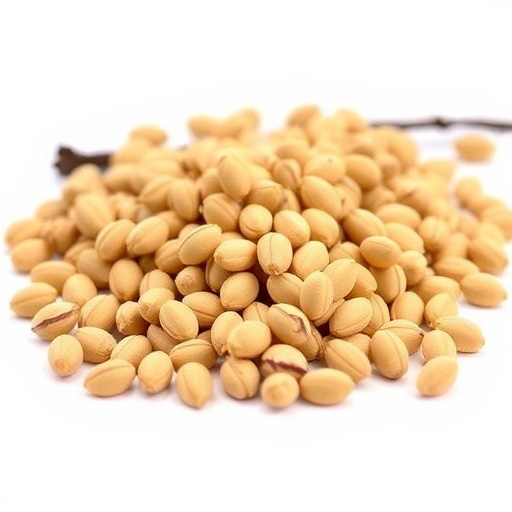
In a groundbreaking advancement poised to reshape the landscape of functional food ingredients, researchers have unveiled an innovative enzymatic methodology for the extraction and refinement of isomalto-oligosaccharides (IMOs) derived from Ginkgo biloba seeds. This pioneering study not only expands the horizon of natural oligosaccharide sources but also meticulously characterizes the resultant IMOs, highlighting their potential for diverse applications in nutrition and health.
The essence of these findings lies in the enzymatic conversion process that ingeniously harnesses the complex carbohydrate matrix within Ginkgo biloba seeds. Traditionally overshadowed by their use in traditional medicine, these seeds have now been spotlighted as a novel substrate capable of yielding functional oligosaccharides with promising prebiotic properties. The research team employed a tailored enzymatic protocol that optimized hydrolysis conditions, thereby achieving a high yield of IMOs while preserving their structural integrity.
Central to this study was the purification phase, wherein advanced chromatographic techniques were applied to isolate specific fractions of isomalto-oligosaccharides. This purification not only enhanced the bioactivity of the IMOs but also facilitated comprehensive structural analysis, crucial for understanding the subtle variations in oligosaccharide linkages and degrees of polymerization. Such insights are vital, as they directly influence the physiological behavior and efficacy of these compounds in gut microbiota modulation.
The characterization of these IMOs extended beyond mere structural elucidation. The researchers conducted a suite of physicochemical assessments, including molecular weight distribution, degree of branching, and thermal stability. These attributes are instrumental in determining the functional potential of IMOs when incorporated into food matrices, as they affect solubility, fermentability, and resistance to digestive enzymes.
This scientific milestone is imbued with significant implications for the field of functional foods and nutraceuticals. Isomalto-oligosaccharides are recognized for their ability to stimulate beneficial gut bacteria such as Bifidobacteria and Lactobacilli, promoting gastrointestinal health and enhancing immune function. By unveiling a new source for IMOs, this research paves the way for more sustainable and cost-effective production routes, potentially lowering barriers to commercial-scale applications.
Moreover, the environmental impact of sourcing IMOs from Ginkgo biloba seeds warrants attention. Unlike common carbohydrate sources such as corn or tapioca, Ginkgo biloba seeds represent a non-traditional substrate that could diversify agricultural inputs and mitigate monoculture pressures. The enzymatic approach aligns with green chemistry principles by minimizing harsh chemicals and energy-intensive steps, embodying a sustainable model for bioactive compound extraction.
The detailed enzymatic procedure delineated in this study underscores the importance of enzyme specificity and process parameters. By fine-tuning pH, temperature, and reaction time, the researchers maximized enzyme activity and substrate specificity, culminating in a product with desired molecular profiles. Such precision not only enhances yield but also confers reproducibility, a pivotal factor for industrial translation.
Subsequent biological assays affirmed the prebiotic potential of the Ginkgo-derived IMOs, showcasing their ability to selectively augment beneficial microbial populations without adverse effects. This is particularly meaningful given the growing consumer demand for gut-friendly ingredients that can seamlessly integrate into daily diets without causing gastrointestinal discomfort.
The implications of introducing Ginkgo biloba seed-derived IMOs extend into clinical nutrition and therapeutic domains. Given the known antioxidant and neuroprotective properties of Ginkgo extracts, coupling these with IMOs introduces intriguing possibilities for synergistic health benefits. Future research may explore these dual functionalities, fostering innovative functional food formulations that transcend conventional boundaries.
Critically, the sensory attributes of IMOs, such as sweetness and texture, were preserved and even enhanced through the enzymatic process, an aspect frequently overlooked in carbohydrate bioproduct development. This sensory compatibility ensures consumer acceptance and broadens the application spectrum ranging from bakery products to beverages.
The researchers also addressed scalability challenges, demonstrating that their enzymatic system is amenable to upscaling without compromising product quality or enzymatic efficiency. This addresses a common bottleneck in bioprocessing where lab-scale successes falter during industrial translation due to process complexity or cost inefficiencies.
Integration of this research within existing production frameworks invites exciting opportunities for hybrid processing strategies. By combining enzymatic extraction with fermentation technologies, there exists potential to generate tailored oligosaccharide profiles that target specific health outcomes, such as enhanced gut barrier function or metabolic regulation.
Moreover, regulatory viewpoints regarding novel food ingredients are increasingly stringent. The thorough compositional and safety profiling presented by the research team equips stakeholders with critical data to navigate approval pathways, facilitating quicker market entry for Ginkgo-derived IMOs.
This development also aligns seamlessly with the trend toward plant-based and clean-label formulations, as consumers become more conscious of ingredient provenance and environmental sustainability. The natural origin and eco-friendly processing of Ginkgo biloba seed IMOs resonate with these preferences, positioning them favorably in competitive markets.
In summary, the enzymatic extraction, purification, and detailed characterization of isomalto-oligosaccharides from Ginkgo biloba seeds herald a transformative leap in the functional ingredient sector. By combining scientific rigor with sustainability and consumer-centric goals, this research offers a promising new paradigm for developing prebiotic ingredients that meet modern dietary and ecological demands. As these novel IMOs move closer to commercial reality, future explorations into their biological interactions and product integration will undoubtedly catalyze further innovation across food sciences and health industries alike.
Subject of Research: Enzymatic extraction and characterization of isomalto-oligosaccharides from Ginkgo biloba seeds.
Article Title: Enzymatic preparation, purification, and characterization of isomalto-oligosaccharides from Ginkgo biloba seeds.
Article References:
Song, Y., Li, T., Zhang, X. et al. Enzymatic preparation, purification, and characterization of isomalto-oligosaccharides from Ginkgo biloba seeds. Food Sci Biotechnol (2025). https://doi.org/10.1007/s10068-025-02068-7
Image Credits: AI Generated
DOI: 19 December 2025


