

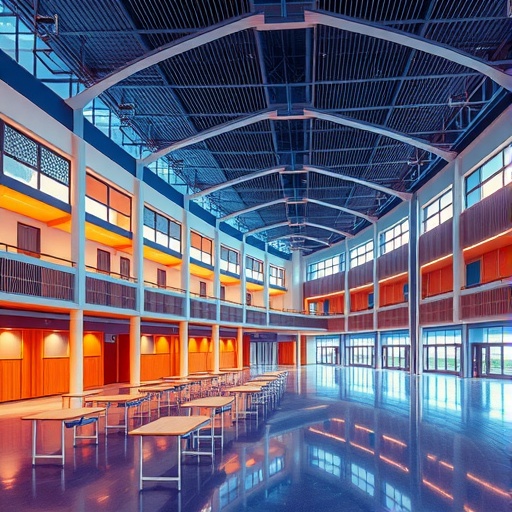
In a groundbreaking study, researchers have found a novel approach to intelligent school design by integrating post-occupancy evaluation with energy performance metrics using cutting-edge conditional generative adversarial networks (cGANs). This innovative methodology promises not just to enhance educational environments but also to ensure sustainability in modern architecture. As schools increasingly seek to become more energy-efficient and user-friendly, this research, to be published in the journal “Discover Sustainability,” presents a compelling case for the adoption of advanced computational techniques in educational facility planning.
The paper, authored by Ilbeigi, Ghomeishi, Asgharzadeh, and colleagues, delves into the challenge of creating learning environments that effectively support student outcomes while maximizing energy efficiency. The integration of post-occupancy evaluation—which assesses building performance after construction and occupation—with energy performance indicators represents a significant advance in how educational facilities are designed and analyzed. This dual-focus approach not only targets the physical aspects of school design but also emphasizes the importance of the user experience within these spaces.
At the heart of this study lies the application of conditional generative adversarial networks, machine learning frameworks that are particularly adept at generating new data samples based on existing datasets. In the context of architectural design, cGANs can be employed to simulate various school layouts and operational scenarios, effectively allowing architects and designers to visualize potential outcomes before any physical construction takes place. This capability emerges as a pivotal tool in responding to the complex, multifaceted requirements of educational infrastructure.
The research highlights a critical gap in traditional school design methodologies, where often, energy performance metrics are assessed independently of how the space is used day-to-day. By merging these two essential elements, the study offers a roadmap for creating schools that are not only sustainable but also conducive to learning. The researchers argue that understanding the actual use of space can dramatically inform design decisions, ensuring that buildings are tailored to meet both energy efficiency goals and the needs of students and teachers alike.
As the climate crisis continues to reshape our built environment, fostering sustainable design in schools becomes more pressing than ever. Educational facilities serve as vital community hubs, and these spaces are often heavily utilized—making them prime candidates for energy performance improvements. By adopting the findings from this research, educational institutions can potentially decrease their carbon footprints while enhancing the quality of education provided to students. The integration of technology and sustainability becomes not merely an aspiration, but a necessary framework for the schools of the future.
Moreover, the incorporation of user feedback into the design process through post-occupancy evaluation adds another layer of refinement. This feedback mechanism allows for a continuous improvement loop, with data collected from real users informing future iterations of design. The potential applications of this methodology extend beyond educational institutions, setting a precedent for other types of public buildings to follow suit. Healthcare facilities, office buildings, and community centers could benefit from similar evaluations designed to align user experience with energy performance.
The use of cGANs allows for a data-driven design approach, where designers can experiment with different configurations and layouts to find the perfect blend of aesthetics and functionality. This technology drastically reduces the time typically required for prototyping and testing in design processes, enabling architects and engineers to produce efficient, practical outcomes far more swiftly than conventional methods. The implications of this technology, when effectively implemented, could lead to a paradigm shift in architectural practices across various sectors.
The researchers conducted a series of simulations drawing from extensive datasets reflective of both existing school designs and user experience metrics. The results not only validated the efficacy of cGANs in this manner but also offered surprising insights into how certain spatial configurations could either enhance or diminish energy performance. The ability to predict these outcomes before ground is broken could transform how educational institutions plan their facilities, transitioning from reactive to proactive design methodologies.
As educational environments evolve, the role of technology in shaping these spaces cannot be overstated. This study positions itself at the intersection of education, architecture, and environmental science, providing a framework that other researchers and practitioners can build upon. The holistic view presented by the authors emphasizes the necessity of multidisciplinary collaboration, advocating for partnerships between educators, architects, engineers, and environmental scientists to create truly intelligent school environments.
Furthermore, this research serves as a clarion call for policymakers to prioritize investment in sustainable educational facilities. Funding models that support innovative designs centered around user experience and energy efficiency can lead to profound long-term benefits, not only for the environment but also for the stakeholders invested in these institutions. Empowering schools with the tools and methodologies outlined in this study could significantly bolster their contributions to wider sustainability goals.
As challenges including climate change and urban development continue to pressure existing educational infrastructures, the insights gleaned from this research offer a pathway forward. The model proposed by Ilbeigi and his colleagues may very well be the key to unlocking a future where schools are not only centers of learning but also exemplary models of sustainable living. This shift towards a more responsive, technologically integrated design philosophy could be what is needed to inspire students about sustainability itself, preparing them to face the challenges of tomorrow.
In conclusion, the integration of post-occupancy evaluation and energy performance metrics using conditional generative adversarial networks signifies a pivotal moment in the evolution of school design. Through this innovative approach, the researchers have laid the groundwork for a future where educational spaces are not just places of instruction but are also architecturally responsible entities that actively contribute to various sustainability objectives. The implications of their work extend beyond the architectural realm, influencing discussions about how we conceive and construct public spaces in a way that embraces both the environment and human experience.
This transformative research underscores the potential for technology to revolutionize the interaction between architecture and functionality, offering new avenues for exploration within the realm of educational buildings. By marrying rigorous data analysis with creative architectural design, future schools can emerge not only as spaces for academic enlightenments but as beacons of sustainability that educate future generations about the importance of conscientious living.
Subject of Research: Intelligent school design through integrating post-occupancy evaluation and energy performance metrics.
Article Title: Integrating post occupancy evaluation and energy performance metrics using conditional generative adversarial networks for intelligent school design.
Article References: Ilbeigi, M., Ghomeishi, M., Asgharzadeh, A. et al. Integrating post occupancy evaluation and energy performance metrics using conditional generative adversarial networks for intelligent school design. Discov Sustain (2025). https://doi.org/10.1007/s43621-025-02523-9
Image Credits: AI Generated
DOI: 10.1007/s43621-025-02523-9
Keywords: School design, conditional generative adversarial networks, post-occupancy evaluation, energy performance metrics, sustainability.


