

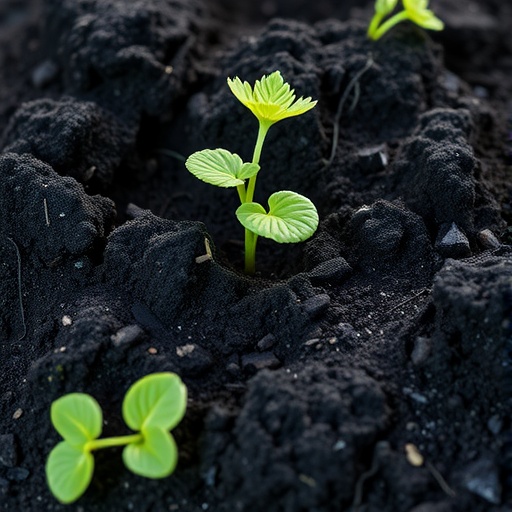
In a groundbreaking advancement poised to transform environmental remediation, scientists have unveiled a pioneering method that activates soil’s intrinsic chemical properties to dismantle stubborn antibiotic pollutants without relying on external chemical additives. This innovative approach centers on an iron-enhanced biochar capable of catalyzing the breakdown of antibiotics like sulfamethoxazole (SMX), a commonly detected contaminant in agricultural soils linked to manure amendments and wastewater reuse. The technology taps into the natural oxidative potential of soil oxygen, offering a sustainable and environmentally benign solution to an escalating global ecological challenge.
The persistent presence of antibiotics such as SMX in soils has alarmed researchers and environmentalists alike due to their role in fostering antimicrobial resistance and threatening ecosystem health. Conventional remediation strategies typically involve the application of aggressive chemical oxidants—substances which often irreversibly compromise soil microbial communities and structure, and whose effectiveness diminishes at trace contaminant levels. This new biochar-centered technique circumvents the need for such chemicals, capitalizing instead on an engineered material that co-opts the soil’s own contained oxygen and mineral machinery to achieve potent pollutant degradation.
Central to this breakthrough is the meticulous engineering of biochar, a carbon-rich product derived from biomass pyrolysis, which has been chemically modified with iron to serve dual catalytic purposes. This iron modification facilitates enhanced iron redox cycling—specifically the cyclical transformation between Fe(II) and Fe(III), a fundamental process that drives the generation of hydroxyl radicals (·OH). These radicals represent some of the most aggressive oxidizing agents encountered in natural systems, possessing the capability to fragment complex organic molecules through pathways including hydroxylation, ring-opening, and bond cleavage reactions.
Experimental studies conducted under both laboratory and field-like soil incubation scenarios demonstrated that the optimized iron-modified biochar amplified hydroxyl radical production by more than fourfold in controlled tests, reaching concentrations up to 881.6 micromolar. Even outside highly controlled environments, under more variable field conditions, the biochar sustained a significant tripling in reactive species generation compared to untreated soils. This impressive radical production translated directly into substantive pollutant degradation, with sulfamethoxazole breakdown exceeding 80% in amended soils, thereby substantially mitigating the compound’s toxicological profile.
What distinguishes this novel biochar system is its synergistic operational mechanism. On the one hand, the material’s surface actively catalyzes oxidative reactions; on the other, it stimulates the soil’s inherent biogeochemical processes by fostering continuous iron redox cycling. This self-perpetuating catalytic loop ensures sustained hydroxyl radical generation over extended periods, a marked advantage over conventional advanced oxidation technologies that typically rely on finite external oxidants with transient lifespans. Thus, this method heralds a new era of “in situ” remediation, minimizing ecological disruption while maximizing contaminant breakdown.
The importance of microbial communities in this remediation dynamic was also elucidated. Soil microorganisms were found to contribute approximately 40% of the hydroxyl radical production, underscoring an intimate interaction between biological activity and chemical electron transfer processes. The biochar amendment not only enhanced microbial diversity but also enriched populations of iron-cycling bacteria, effectively coupling microbial metabolisms and abiotic electron shuttling to sustain contaminant degradation. This tripartite interaction between iron cycling, electron transfer modulation, and microbial ecology embodies a sophisticated, eco-friendly remediation paradigm.
Beyond the efficient degradation of contaminants, the application of the iron-modified biochar offers compelling ancillary benefits for soil health. Toxic intermediates generated during pollutant breakdown were less harmful than the parent compounds, reducing environmental risks. Moreover, plant bioassays demonstrated improved seed germination and increased biomass in soils treated with the biochar compared to contaminated controls, indicating that the remediation process not only detoxifies but also revitalizes the soil environment. Additionally, the system enhanced the formation of stable soil organic matter, signifying potential long-term gains for soil carbon sequestration and fertility.
Distinct from typical advanced oxidation processes that often require chemical inputs like hydrogen peroxide or persulfates, this strategy leverages the ubiquity of molecular oxygen and prevalent soil minerals to drive oxidative transformations. This circumvents the introduction of extraneous chemicals, thereby preserving soil integrity and promoting scalability. Given its reliance on natural soil constituents and conditions, the technology aligns closely with principles of sustainable agriculture and environmental stewardship.
Another noteworthy facet of this innovation is its origin as a “waste-to-remediation” approach. The base biochar is synthesized from agricultural biomass residues, effectively valorizing these wastes into a high-value functional material for environmental cleanup. This not only mitigates the burden of agricultural byproducts but also embodies circular economy ideals by closing loops between waste generation and resource reuse in a manner that addresses pressing pollution challenges.
Methodologically, the research integrates aspects of material science, electrochemistry, soil science, and microbiology to craft a cohesive framework. By bridging the fields of iron redox cycling and electron transfer modulation, the resulting biochar acts as an electron conduit and redox mediator that can be fine-tuned for optimal formation of reactive oxidative species. The implications extend beyond antibiotic degradation, suggesting applicability to a broad spectrum of emerging contaminants threatening soil and water quality worldwide.
This innovative study leads the way for future research and development of biochar-based remediation strategies, illustrating how an interdisciplinary, mechanistic understanding can unlock new potentials for sustainable environmental technologies. As antibiotic resistance continues to undermine global health and ecosystems, such soil-centric, chemical-free solutions offer a promising route to remediation that is both effective and ecologically harmonious.
Subject of Research: Environmental remediation of antibiotic contaminants in agricultural soils using iron-modified biochar.
Article Title: In-situ and long-enduring oxidation of SMX by Fe-modified biochar activated O2 in soil: bridging Fe-redox cycling and electron transfer modulation.
News Publication Date: March 11, 2026.
Web References:
References:
Du, H., Zhang, L., Liu, W. et al. In-situ and long-enduring oxidation of SMX by Fe-modified biochar activated O₂ in soil: bridging Fe-redox cycling and electron transfer modulation. Biochar 8, 76 (2026).
Image Credits: Hongying Du, Lei Zhang, Wenbo Liu, Yuyang Xie, Xueyan Hou, Junkang Guo & Qixing Zhou
Keywords
Applied sciences and engineering, Life sciences, Bioremediation, Environmental remediation, Environmental management, Electrocatalysis, Electrochemical reactions, Iron


