

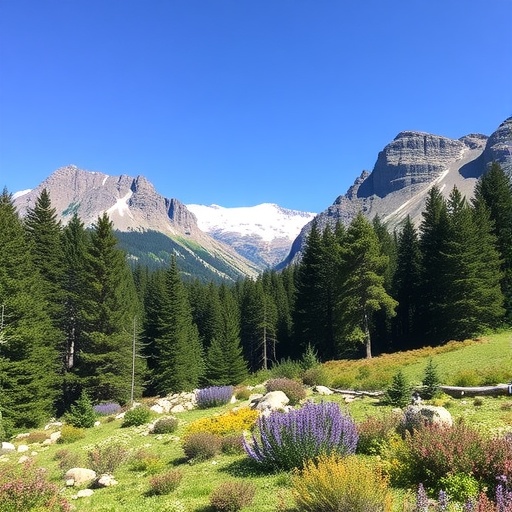
In the sprawling and rugged landscapes of the world’s mountain ranges, the interplay of sunlight, temperature, and moisture carves out distinct micro-environments that have long fascinated ecologists and climatologists alike. These mountain environments are characterized by striking heterogeneity in vegetation growth that can occur over surprisingly short distances, largely due to the topographic modulation of solar radiation and water availability. One of the most pronounced features of this phenomenon is the difference in vegetation density between slopes facing towards the poles and those angling towards the equator—an effect known as aspect asymmetry. Yet, despite decades of study, the long-term impact of climate change on this subtle but crucial landscape feature across vast expanses of mountainous terrain has remained enigmatic.
New research led by Tian and Tian presents fresh and compelling evidence that the aspect asymmetry of mountain vegetation in the Northern Hemisphere has been weakening over the past two decades. Through comprehensive satellite data analyses, spanning from 2003 to 2024, the researchers determine that the relative difference in vegetation density between polar-facing and equatorial-facing slopes is diminishing. This trend reveals a fundamental shift in the control mechanisms governing vegetation growth on mountainous slopes—one that signals altered patterns in water and energy availability under a changing climate.
Topography has long been acknowledged as a potent force in altering the local microclimate within mountainous ecosystems. Slopes oriented towards the equator typically receive more direct solar radiation, higher temperatures, and lower humidity, often resulting in different water stress and thermal conditions compared to slopes facing the opposite direction. This results in denser vegetation on polar-facing slopes in many regions, as cooler and moister conditions often prevail there. However, the new study finds that the strength of this gradient—this aspect asymmetry—is declining over time. This weakening indicates a convergence of hydrothermal conditions across slope aspects, potentially diminishing the refugia that polar-facing slopes have historically provided.
Intriguingly, the decline of aspect asymmetry is not uniform but most pronounced in regions where polar-facing slopes initially exhibited higher vegetation density compared to their equatorial counterparts. Over the 21-year study period, the magnitude of this difference shrank not only in terms of spatial extent but also with respect to its seasonal persistence. The duration during which polar-facing slopes harbored denser vegetation has notably contracted, highlighting a compression in the seasonal window where water availability and radiation conditions differed sufficiently to sustain stronger vegetation growth on these slopes.
The study’s reliance on satellite-derived vegetation indices lends robust spatial and temporal fidelity to these findings, capturing subtle yet consistent shifts across diverse mountainous terrains throughout the Northern Hemisphere. This approach enables the researchers to dissect the intricate responses of mountain ecosystems to climate drivers on scales both broad and local, ensuring that the signals extracted are representative of physical changes at the ecosystem level rather than anomalies confined to isolated sites.
Delving deeper into the mechanistic underpinnings, the findings elucidate that the weakening of aspect asymmetry is intricately linked to shifts in hydrothermal variables, primarily solar radiation and temperature. The altered solar energy receipt across slopes, influenced by atmospheric changes, combined with rising temperatures, appears to homogenize moisture regimes and thermal stress between the slopes. This homogenization results in decreasing disparity in plant growth conditions, thereby eroding the ecological niches uniquely shaped by aspect-driven microclimates.
This transformation in mountain vegetation patterns has substantial implications for biodiversity and ecological stability. Microclimates shaped by aspect have historically fostered diverse assemblages of flora and fauna, offering refuge and maintaining ecological gradients crucial for species adaptation. The attenuation of these microclimatic refuges could reduce habitat heterogeneity, potentially compromising the resilience of mountain ecosystems to ongoing and future climate perturbations.
Moreover, the notable decrease in the spatial area exhibiting distinct aspect asymmetry caught the researchers’ attention, emphasizing that the very fabric of mountain ecosystem variability is transforming. This shrinkage not only signals a biological response but also hints at broader geomorphological and climatological shifts affecting mountain energy and water cycles. The balance between solar radiation influx and vegetation-mediated water retention, central to ecosystem function, is evidently recalibrating under the influence of climate change.
Seasonally, the reduced duration of aspect-driven vegetation differences suggests alterations in phenological patterns and water availability timing. A diminished growing season advantage on polar-facing slopes constrains opportunities for plants that rely on consistent moisture and lower heat stress to thrive, potentially impacting productivity and carbon sequestration dynamics within mountainous biospheres.
This study’s insights underscore the necessity of integrating topographical and microclimatic considerations into climate change impact assessments. Traditionally, climate models and vegetation projections have been challenged by the complex spatial heterogeneity of mountainous terrains, but these findings highlight how fine-scale topographic features directly modulate ecosystem responses in ways that are now quantifiable and temporally trackable.
In addition to elucidating the mechanistic basis of aspect asymmetry weakening, the study broadens the perspective on how climate change manifests differently within complex landscapes compared to flat or uniform ecosystems. The nuanced energy and water redistribution caused by mountain topography can either amplify or buffer climatic impacts for vegetation. Yet, the damping of this modulation mechanism accentuates vulnerability through reduced habitat buffering, a concern warranting further investigation.
Policy and conservation strategies must heed these revelations by considering these microclimatic shifts. Mountainous regions often serve as biodiversity hotspots and freshwater sources; changes to their vegetation structure and greening patterns could cascade through hydrological and ecological networks affecting human and wildlife communities alike. Protecting and monitoring these natural refuges necessitates an improved understanding of how climate-driven energy conditions reshape spatial vegetation dynamics.
Technological advances in remote sensing combined with process-based modeling afford a powerful toolkit for ongoing monitoring. This study’s use of multi-year satellite observations offers a replicable framework for detecting subtle vegetation responses to altered energy regimes, providing a critical benchmark for assessing the efficacy of climate adaptation interventions in mountain landscapes.
Looking ahead, future research will benefit from integrating ground-based measurements with remote observations to refine the causality nexus between local microclimate changes and species-level vegetative response. Additionally, expanding the spatial scope to include southern hemisphere ranges and tropical mountains could test the universality of observed aspect asymmetry trends and enhance global ecosystem projections.
Fundamentally, this research redefines the role of mountain topography under climate change. Rather than a static factor setting the stage for ecological variation, aspect-driven differences are themselves dynamic and responsive to climate-induced changes in energy and water availability. These findings challenge researchers to rethink past assumptions and propel mountain ecosystem science towards a new frontier where micro-scale heterogeneity is actively transforming in concert with global environmental shifts.
Such clarity on the spatiotemporal trends governing mountain vegetation asymmetry provides new avenues to anticipate and mitigate adverse climate impacts on mountain ecosystems. It also underscores the complexity embedded within mountainous landscapes, where subtle shifts in solar radiation and temperature can ripple outward to influence biodiversity, carbon cycling, and ecological resilience within some of Earth’s most striking and sensitive natural environments.
In conclusion, the weakening of mountain vegetation aspect asymmetry documented by Tian and Tian constitutes a profound signal of ongoing ecological transformation driven by altered energy conditions. By illuminating how topographically mediated energy gradients are eroding, their work offers critical insight into the multifaceted ways climate change is reshaping the Earth’s vegetative patterns at local and hemispheric scales. Responding effectively to these changes will require multidisciplinary collaboration, integrating climatology, ecology, and remote sensing to safeguard mountain biodiversity and sustainability in an era of rapid global change.
Subject of Research: The impact of topography-driven solar radiation and temperature changes on vegetation growth asymmetry between polar-facing and equatorial-facing mountain slopes in the Northern Hemisphere under climate change.
Article Title: Weakening mountain vegetation aspect asymmetry due to altered energy conditions
Article References:
Tian, Q., Tian, F. Weakening mountain vegetation aspect asymmetry due to altered energy conditions. Nat. Clim. Chang. (2026). https://doi.org/10.1038/s41558-025-02542-4
Image Credits: AI Generated


