

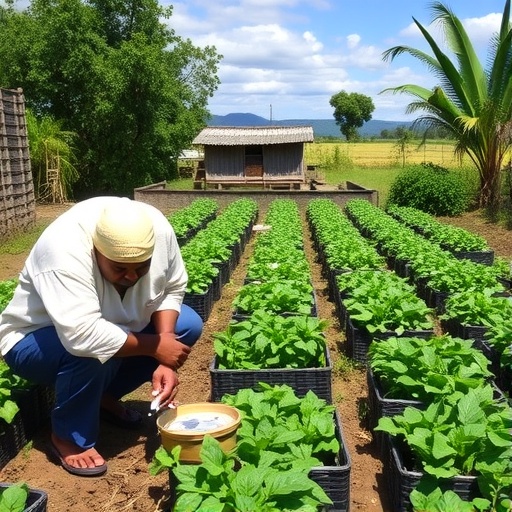
In recent years, the need for sustainable agricultural practices has become more pressing, particularly in developing regions where smallholder farmers struggle to maintain their livelihoods. A significant study conducted by Pawar and Channaveer sheds light on how community education interventions can catalyze the adoption of these crucial practices. Set in Vaijapur Village, Karnataka, India, this research highlights not only the barriers faced by farmers but also the transformative potential of education and community engagement in fostering sustainable agriculture.
The context of the study is essential to understanding the challenges inherent in smallholder farming. Farmers in Vaijapur Village, like many in India, often operate on marginal lands, facing climatic uncertainties and market fluctuations. These conditions can lead to unsustainable farming practices that degrade soil quality and diminish crop yields. The authors argued that without strategic interventions—particularly through education—farmers would continue to face these persistent challenges. The research delves into how well-informed communities could alter their practices for better environmental and financial outcomes.
One key aspect of the study is the role of community education interventions in facilitating knowledge transfer among smallholder farmers. The authors conducted workshops and training sessions that focused on sustainable farming techniques, including crop rotation, organic fertilizer application, and integrated pest management. By empowering farmers with practical knowledge, the interventions aimed to create a cultural shift toward sustainability within the agricultural community. Farmers who attended these sessions reported feeling more confident and capable of implementing new practices.
The methodology employed by the researchers involved both qualitative and quantitative approaches to gather comprehensive data. Surveys were administered to gauge the baseline knowledge and practices of farmers before the interventions. Follow-up assessments revealed staggering improvements in the adoption of sustainable methods. This multidimensional assessment provided a clearer picture of the impact and efficacy of educational initiatives on the ground. The researchers consider this approach critical in demonstrating real-world applicability and fostering trust within the community.
Moreover, the findings suggest that the social dynamics of the community play a pivotal role in shaping attitudes towards sustainable practices. Traditional farming methods, deeply rooted in cultural practices, often resist change. However, through community engagement, these interventions facilitated dialogue among farmers, creating an environment where sharing ideas and experiences became commonplace. As trust and camaraderie grew, so did the willingness to experiment with new methods, underscoring the importance of social learning in agriculture.
The research also underscores the importance of tailored educational content that resonates with the specific needs and contexts of the farmers. As Pawar and Channaveer found, emphasizing local resources and traditional knowledge alongside modern techniques increased farmers’ propensity to adopt new practices. This acknowledgment of indigenous knowledge fosters a sense of ownership over the strategies being implemented and enhances the likelihood of long-term sustainability.
Another significant takeaway from this research is the measurable impact these interventions have on crop productivity and environmental health. Over time, farmers reported increases in yields and soil fertility. By adopting techniques presented during the training, they not only improved their economic standing but also contributed positively to their local ecosystems. This reciprocal relationship highlights the dual benefits of education: financial stability for farmers and ecological balance within the landscape.
However, the authors also caution that while community education is transformative, it is not a panacea. Constant support and follow-up are necessary to ensure ongoing implementation of sustainable practices. The study provides evidence that initial training sessions must be supplemented with continuous learning opportunities, mentoring, and resources to maintain momentum. This ongoing relationship between educators and farmers is fundamental to reinforcing sustainable practices over time.
The implications of this research extend beyond the immediate community. Notably, the findings can be scaling across similar agricultural contexts in India and elsewhere. As nations worldwide face the dual pressures of food security and environmental crises, adopting lessons learned from community education interventions may be a key strategy in promoting sustainability on a broader scale. Policymakers and agricultural extension services are encouraged to consider these findings when designing programs aimed at supporting smallholder farmers.
Pawar and Channaveer advocate for a holistic approach to agricultural education that addresses not just technical knowledge but also socio-economic factors influencing farmer behavior. By aligning educational initiatives with the actual lived experiences of farmers, programs can maximize their effectiveness and foster genuine change. The transformative power of education, as demonstrated in Vaijapur Village, serves as a blueprint for other regions striving for sustainability in agriculture.
As the study highlights, education is crucial for empowering farmers to make informed decisions that benefit both their livelihoods and the environment. The importance of investment in community-based educational programs cannot be overstated. Ensuring farmers have access to the latest research, techniques, and resources is essential for fostering innovation and resilience among smallholder farmers, especially in developing regions.
Ultimately, the research from Pawar and Channaveer presents an optimistic outlook for sustainable agriculture. With the right frameworks in place, smallholder farmers can navigate the complexities of modern farming and adopt practices that are not only economically viable but also ecologically responsible. The study stands as a testament to the power of educating communities as a catalyst for meaningful change, showing that sustainable agricultural practices are within reach through dedicated effort and collaboration.
In conclusion, the impact these educational interventions may have on the future of agriculture cannot be understated. Pawar and Channaveer reinforce that, given the right tools and knowledge, smallholder farmers can become resilient stewards of their environment, contributing to a sustainable future that honors tradition while embracing innovation. Their work encourages a reevaluation of agricultural education and outreach, emphasizing the vital role of local context and community dynamics in fostering sustainable practices.
Subject of Research: Impact of community education interventions on adopting sustainable agriculture practices among smallholder farmers in Vaijapur Village, Karnataka, India.
Article Title: Impact of community education interventions on adopting sustainable agriculture practices among smallholder farmers in Vaijapur Village, Karnataka, India.
Article References:
Pawar, S., Channaveer, R.M. Impact of community education interventions on adopting sustainable agriculture practices among smallholder farmers in Vaijapur Village, Karnataka, India.
Discov glob soc 3, 162 (2025). https://doi.org/10.1007/s44282-025-00287-1
Image Credits: AI Generated
DOI: https://doi.org/10.1007/s44282-025-00287-1
Keywords: community education, sustainable agriculture, smallholder farmers, India, Vaijapur Village, agricultural practices, intervention, knowledge transfer, ecological impact.


