

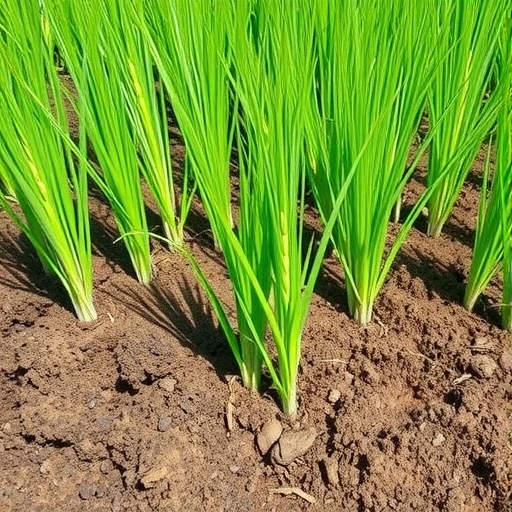
A landmark decade-long study has unveiled a critical challenge looming over global agriculture: the combined impact of rising atmospheric carbon dioxide (CO₂) and warming temperatures is profoundly diminishing phosphorus availability in rice-upland cropping systems. This revelation, emerging from an extensive experimental investigation conducted by leading scientists at the Institute of Soil Science of the Chinese Academy of Sciences, sounds an alarm for the future of food security, particularly in major rice-producing regions that sustain billions worldwide.
Phosphorus is an essential macronutrient for plant growth, intricately involved in energy transfer, signal transduction, and photosynthesis. Unlike nitrogen, which can be fixed from the atmosphere by specialized bacteria, phosphorus is locked within finite and often inaccessible mineral deposits. This dependency makes its availability highly susceptible to soil chemistry and biological activity. The interplay of increased atmospheric CO₂ and climate warming, both cornerstones of ongoing climate change, introduces complex disruptions to phosphorus cycling, especially in environments subjected to artificial irrigation and drainage, such as rice paddies.
The research team deployed Free-Air CO₂ Enrichment (FACE) technologies paired with sophisticated in situ warming apparatuses to simulate future climate scenarios over a continuous ten-year period in a rice-upland crop rotation system. This system cycles rice and wheat fields annually, representing a common agricultural practice in many parts of Asia. Despite the immense technical challenge of maintaining precise warming treatments amid typhoons and monsoons, the experiment meticulously replicated predicted climate conditions, providing unprecedented real-world insights.
Data analysis revealed a synergistic interaction between elevated CO₂ levels and warming that collectively impaired the bioavailability of soil phosphorus. Crucially, warming proved to be the dominant factor influencing this shift. Long-term exposure redirected phosphorus from readily plant-available pools into more stabilized forms bound within organo-mineral complexes and microbial biomass. This transition illustrates a shift towards closed phosphorus cycling, where nutrient recycling within the soil ecosystem limits the external accessibility of phosphorus for crop uptake.
Further scrutiny integrating soil phosphorus fractionation profiles, iron-organic matter associations, microbial functional traits, and detailed crop nutrient uptake metrics allowed the researchers to unravel the complexity of these biogeochemical processes. The findings highlight that increased temperatures exacerbate phosphorus immobilization via enhanced binding to iron oxides and organic compounds. This mechanism effectively reduces the pool of phosphorus accessible to plants, imposing constraints on crop productivity despite elevated CO₂-induced photosynthetic stimulation.
The repercussions of these discoveries are profound for global food systems. Rice paddies are a staple for over half the global population, and the rice-upland cropping rotation is a cornerstone agricultural model, especially in Asia. The study indicates that merely increasing phosphorus fertilizer application may be insufficient to counterbalance the negative climate-induced shifts in phosphorus availability. Particularly in weathered soils, which inherently exhibit strong phosphorus fixation, or in resource-limited regions with restricted fertilizer access, traditional nutrient management approaches may falter or incur environmental risks.
This ten-year investigation builds upon earlier work from the same research group, which documented that elevated CO₂ alone reduces soil phosphorus availability. The current study is pioneering in integrating realistic warming scenarios to probe the compounded effects of climate drivers. The robust experimental framework and the interdisciplinary analytical approach underline the dynamic and interwoven nature of soil chemistry, microbiology, and crop physiology under shifting environmental parameters.
The practical implications demand an urgent reevaluation of phosphorus management strategies within agricultural systems facing climate change. The researchers advocate for climate-resilient approaches combining precision fertilization techniques with soil amendments designed to modulate iron-phosphorus chemistry, thereby enhancing phosphorus bioavailability under future climatic realities. This tailored approach could help sustain crop yields and nutrient use efficiency, mitigating some risks posed by changes in phosphorus cycling dynamics.
A broader takeaway from this study is the recognition of the intricate feedback loops shaping nutrient cycles amid global warming and elevated greenhouse gas scenarios. The findings underscore how anthropogenic influence transcends straightforward carbon and temperature metrics, extending deep into biogeochemical interactions critical for ecosystem productivity and resilience. This amplifies the urgency for integrated climate-agriculture research, focusing not only on carbon but also on essential nutrient flows that underpin food production.
Moreover, the insight into microbial biomass acting as a phosphorus sink highlights the nuanced role of soil biota in mediating nutrient transformations and availability. Understanding these microbial contributions adds a new dimension to managing soil fertility under changing climatic regimes. Future research targeting microbial functional diversity and resilience could unlock novel pathways to enhance phosphorus retention and recycling efficiencies.
Lastly, the study’s integration of field-scale manipulations with detailed chemical and biological analyses sets a benchmark for future climate impact studies. By tackling technical challenges such as maintaining infrared warming equipment during extreme weather events, the researchers have paved the way for more realistic environmental simulations, bridging the gap between controlled laboratory experimentation and unpredictable field conditions.
As the world contends with accelerating climate change, this research illuminates a less visible yet critical vulnerability in agricultural sustainability. Addressing phosphorus bioavailability under warming and elevated CO₂ is paramount for safeguarding staple crop production. This knowledge equips policymakers, agronomists, and farmers with a clearer perspective on adapting nutrient management in an era where every element—from climate to micronutrient cycling—intertwines to shape humanity’s food security.
Subject of Research: Not applicable
Article Title: Reduced phosphorus bioavailability in rice paddies intensified by elevated CO2-driven warming
News Publication Date: 3-Feb-2026
Web References:
DOI: 10.1038/s41561-026-01917-2
Image Credits: ZHU Chunwu’s team
Keywords: Crops, Anthropogenic carbon dioxide, Climate change, Phosphorus, Soil science, Food security


